
On this page
Start here
Quick answer
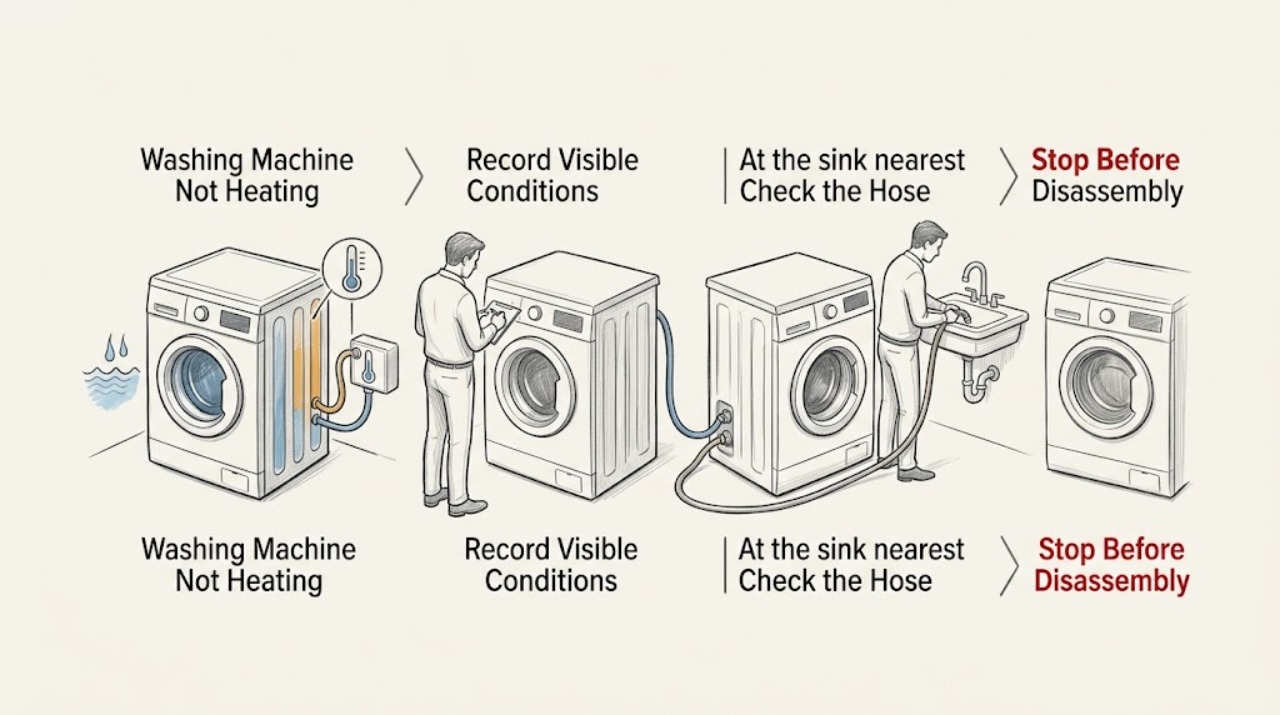
A Maytag washing machine that seems not to heat is often receiving cooler household water than expected, using a cycle whose temperature is intentionally moderated, or filling through reversed, restricted, or incorrectly opened hot and cold supplies. Maytag says the washer may begin a cycle with cold water, senses temperature in the tub, and can use an internal heater only on select heated or Steam cycles. First identify the model and cycle, observe the hot water at the nearest faucet, and check the two inlet hoses and valves without opening the cabinet. If the selected cycle is one that should heat but the water remains cold, an error code appears, or the problem returns after the safe checks, stop testing and arrange qualified service. Stop immediately for a hot-water burn risk, a leak near electrical parts, smoke, a burning odor, arcing, or repeated breaker trips.
Work through in order
Diagnostic checks
Use only checks that match the exact appliance or system and its official guide.
-
Check 1
Read the model number and write down the selected cycle, temperature setting, and whether the washer is top-load or front-load. Check the model's Use and Care Manual to see whether that cycle is described as heated, Steam, or Sanitize.
Expected result: The manual may show that the selected cycle uses incoming water only, or that heating is available only on a particular model and option.
Next step: If the cycle is not a heated cycle, continue with the hot-water supply checks. If it is heated, record the cycle stage and any display code before continuing.
Why this matters
Why: A cycle without a heater can be operating normally even when its water feels less hot than expected; a documented heated cycle creates a meaningful service symptom.
-
Check 2
At the sink nearest the washer, run the hot faucet until the water is hot, then start the washer's safe warm or hot selection only if the fabric label permits it. Do not touch water that could scald you.
Expected result: The faucet water becomes hot before the washer starts, or it remains lukewarm or cold despite the household hot-water system being in normal use.
Next step: If the faucet is not hot, resolve the household water-heating or supply issue first. If it is hot, compare the washer's fill behavior with the selected cycle.
Why this matters
Why: Hot water that arrives late or is depleted by several loads can make the washer seem not to heat; a persistent household supply problem is upstream of the washer.
-
Check 3
With the washer idle and the floor dry, visually trace the hot and cold hoses from the faucets to the rear of the machine. Confirm both supply valves are open, the hoses are not kinked, and hot is connected to hot while cold is connected to cold.
Expected result: A hose is crossed, sharply bent, partly closed at the valve, or damp at a connection; or both connections look correct and dry.
Next step: If a connection must be corrected, close the water valves first, follow the model installation instructions, retain the gaskets, reopen the valves slowly, and check for leaks. If the routing is correct and dry, continue to the inlet screens and error-code check.
Why this matters
Why: Reversed or restricted inlets can produce the wrong wash temperature or a slow fill even when the control setting is correct.
-
Check 4
If the fill is weak or an inlet warning appears, turn off the water supplies, place the hose ends in a container for residual water, and inspect the inlet screens without removing them. Clean only an accessible screen with a soft brush and mild soap and water, following the model instructions.
Expected result: Mineral debris is visible, a hose stream is restricted, or the screens and hoses are clear.
Next step: Restore connections carefully and check for leaks. If a hose remains restricted, replace it only with model-appropriate parts. Persistent low flow or a repeated fill code requires service rather than cabinet disassembly.
Why this matters
Why: A restricted inlet can prevent the expected hot or cold water volume from reaching the washer; clear flow shifts attention back to cycle selection or a component diagnosis.
-
Check 5
Run one controlled observation on the documented heated cycle, if the model has one: note the initial fill, the point where the display pauses or advances, the final water result, and any exact code. Do not open the cabinet or attempt a live electrical test.
Expected result: The cycle pauses while heating and then continues, completes without heat, stops with a code, or never reaches the heating stage.
Next step: Save the exact code and model number. If the washer repeatedly fails to heat on a documented heated cycle, stop further trials and request qualified diagnosis.
Why this matters
Why: Maytag notes that heated and Steam cycles can take longer based on incoming temperature, load size, and load type; failure on an applicable cycle after the supply checks points to a model-specific heater, sensor, control, or related fault.
-
Check 6
If a display code is present, photograph or transcribe it exactly, including spaces and the cycle stage, then compare it with the error-code page and the model manual.
Expected result: The code matches a water-temperature, low-flow, control, or other model-specific entry, or it is not listed for this model.
Next step: Perform at most the model-approved single reset when the instructions call for it. If the code returns, the listed remedy does not apply, or the washer has a safety symptom, leave it out of service and arrange qualified service.
Why this matters
Why: Maytag cautions that the published code list is not complete for every model; a code should not be interpreted by borrowing a meaning from another washer.
Use your observations
Decision map
Find the observation that best matches what you see, then follow the next safe action.
-
PATH 01Next step
What you see
The nearest faucet is not hot when the washer is started.
Do this next
Restore safe household hot water or obtain plumbing assistance, then repeat only the normal washer check.
Why this path and its safety boundary
Why it matters: Treat this as a household hot-water supply issue first; do not diagnose an internal washer heater from this observation.
-
PATH 02Next step
What you see
The faucet is hot but the washer hoses are crossed, kinked, partly closed, or leaking.
Do this next
Correct the connection only with the water supplies closed and the model instructions available; check for leaks before operating.
Why this path and its safety boundary
Why it matters: The inlet path can explain the wrong temperature or restricted fill.
-
PATH 03Next step
What you see
The cycle is not documented as heated or the model intentionally moderates warm and hot water.
Do this next
Choose the warmest setting safe for the fabric and use the model's cycle guide rather than trying to force a higher temperature.
Why this path and its safety boundary
Why it matters: Cooler-than-an-older-washer water may be expected for that cycle.
-
PATH 04Next step
What you see
A documented heated, Steam, or Sanitize cycle still fails after hot supply and inlet checks.
Do this next
Stop repeated test cycles, retain the exact code and model number, and request qualified appliance service.
Why this path and its safety boundary
Why it matters: A model-specific heater, temperature sensor, control, or related fault is possible, but cannot be safely isolated from outside the cabinet.
Helpful context
Understand the symptom
What not heating means on a Maytag washer
Most Maytag washers do not heat every load in the same way. Temperature Control regulates incoming hot and cold water, and the first fill can be cold even when a warmer wash was selected. Some front-load models use a heater for cycles such as Sanitize or Steam, while other models rely mainly on the household hot-water supply. A cool tub at the start of a cycle therefore does not by itself prove that an internal heater has failed.
Work from the symptom
Separate three observations: the faucet never becomes hot, the washer fills with the wrong temperature, or a model-specific heated cycle completes without reaching its expected result. Record the cycle, temperature choice, model number, display message, and when the temperature seems wrong. That record determines whether the next check belongs to the home water supply, the inlet path, or a qualified appliance technician.
Only after diagnosis
Potential parts
- water inlet valve
Consider only if model-specific diagnosis shows an inlet valve is not admitting the required supply after hoses and screens are confirmed clear.
Confirm the complete model number and manufacturer's fit information before ordering. - temperature sensor
Consider only on models that use this sensor and only after a qualified diagnosis links the failed heated-cycle result to temperature sensing.
Sensor design and fit vary by model; do not assume a part crosses between Maytag washer families. - washer heater assembly
Consider only for a model documented to have an internal heater and only after qualified testing identifies the heater circuit as the cause.
Many washers do not heat every cycle; confirm that the exact model uses this assembly.
When checks do not resolve it
Need a professional?
Arrange qualified appliance service when an applicable heated cycle repeatedly fails after the water-supply and inlet checks, when a model-specific code returns, or whenever an electrical, leak, burn, smoke, odor, arcing, or repeated-trip safety symptom appears.
Common questions
FAQ
Why is my Maytag washer cold at the beginning of a hot wash?
Maytag says the washer can begin every cycle with cold water and sense temperature in the tub. A short initial cold fill is not enough to prove a heater failure; check the complete cycle, hose routing, and model-specific temperature behavior.
Do all Maytag washing machines have an internal water heater?
No. Heater behavior is model and cycle dependent. Maytag identifies heated, Sanitize, or Steam options on select models, while other washers primarily regulate incoming hot and cold water. Use the exact model manual before assuming a heater should run.
When should I stop troubleshooting a Maytag washer that is not heating?
Stop when there is a leak near electrical equipment, a burn risk, smoke, burning or melting odor, visible arcing, a hot or discolored plug, repeated breaker trips, or a returning code. A repeated failure on a documented heated cycle also needs qualified service rather than cabinet-level testing.
Read the exact guide
Official sources
- Error Codes in Front Load WashersMaytag Product Help · Maytag front-load washer error-code scope, model-manual caution, reset guidance, and service escalation
- F3E2 - Error CodeMaytag Product Help · Maytag top-load washer F3E2 hose-routing, water-supply, and single power-reset guidance
- Water Not Hot or Not Warm EnoughMaytag Product Help · Maytag top-load washer water temperature, inlet hose routing, hot-water supply, and cycle-temperature behavior
- Getting Cold Water when Warm or Hot was SelectedMaytag Product Help · Maytag washer inlet valves, selected temperature behavior, first-fill behavior, and tub temperature sensing
- Cycles, Options, and Modifiers on a Top Load HE WasherMaytag Product Help · Maytag top-load HE washer temperature controls and the select-model Steam Clean heater option
- Long Cycle Time - WasherMaytag Product Help · Maytag front-load washer heated and Sanitize cycle timing, incoming temperature, load effects, and service routing
- Not Filling or Filling Slowly - Front Load WasherMaytag Product Help · Maytag front-load washer water valves, hose routing, inlet screens, restricted hoses, and safe external fill checks
Community feedback
Share a repair observation
Share a plain-text repair observation. Accepted observations are published automatically; this page may take a moment to update.