
On this page
Start here
Quick answer
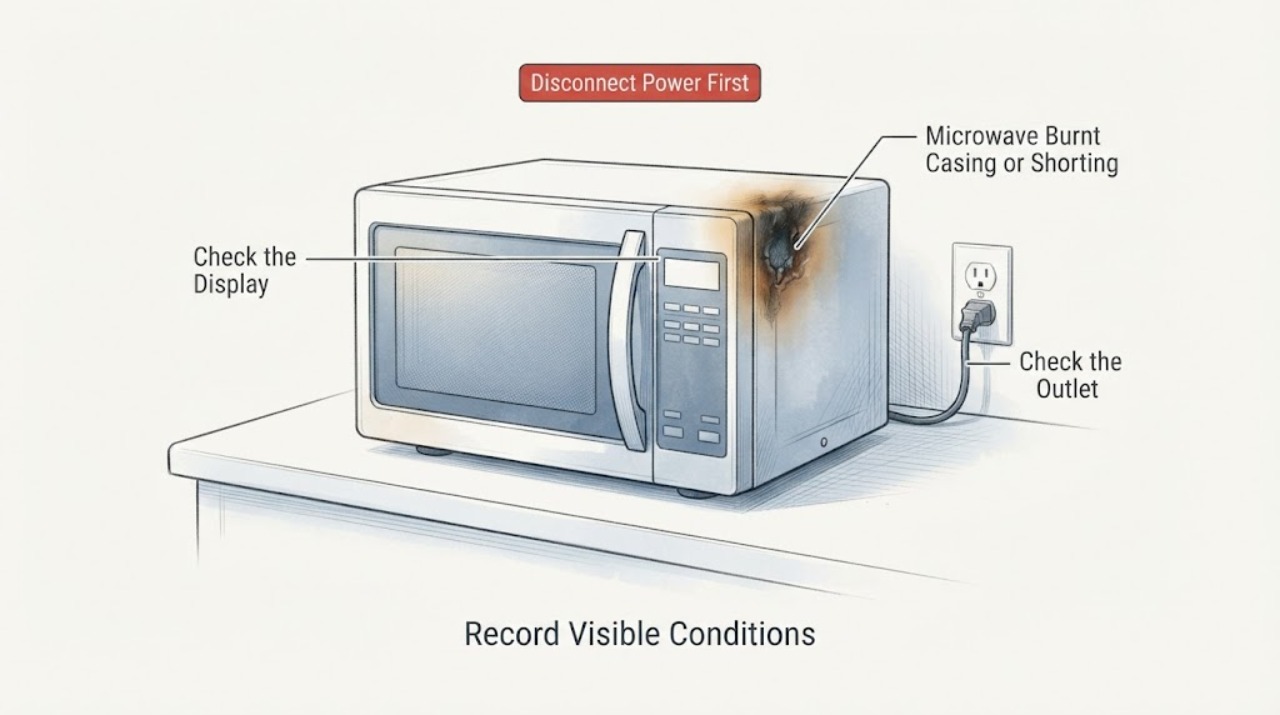
A burnt casing or a report that a microwave shorted out is a stop-use symptom, not proof of a particular failed part. Turn the microwave off; if there is smoke or fire, keep the door closed and disconnect power only if that can be done safely. Once it is cool and disconnected, identify whether the burn is food residue, a cavity coating burn or hole, the door or cover area, the outer cabinet, or the plug and outlet. Manufacturer guidance says to stop using a microwave with arcing, paint burns, peeling coating, a cavity hole, an electrical or chemical odor, abnormal heat, or visible cord or outlet damage. Do not open the metal case, remove a cover, test the unit empty, repaint the cavity, or keep resetting a breaker. Arrange qualified microwave service, and use the owner's manual for the exact model before any cleaning or authorized repair decision.
Work through in order
Diagnostic checks
Use only checks that match the exact appliance or system and its official guide.
-
Check 1
Stop the microwave immediately and write down what preceded the event: food or cookware used, sparks or flash, popping, smoke, odor, breaker behavior, and whether the mark is inside the cavity, on the outer cabinet, at the cord or plug, or on the wall outlet. If there is an active fire, keep the door closed, evacuate if needed, and call emergency services; do not open the door to inspect flames.
Expected result: There was only an overcooked-food smell, or there was smoke, fire, arcing, a breaker trip, an electrical or chemical odor, or visible heat damage outside the cavity.
Next step: Keep the unit out of service. Disconnect power only if the plug or breaker is safely accessible and not hot, sparking, or damaged; otherwise leave it alone and call emergency or qualified electrical/appliance service.
Why this matters
Why: Food residue may be a cleaning issue only when there is no burn damage or electrical symptom. Smoke, fire, arcing, electrical odor, or external heat damage is a stop-use safety event and does not prove which internal component failed.
-
Check 2
With the microwave cool and power disconnected, inspect only visible surfaces: cavity walls and floor, the area under the turntable, door edge and frame, the visible waveguide or splatter cover, and the outer casing. Do not remove the outer cover, inlet or waveguide cover, door, or control panel.
Expected result: The cavity has a hole, active peeling or flaking, a distinct paint burn, melted or warped material, soot, or a damaged door/cover; or the surfaces show only removable food splatter and intact coating.
Next step: For any hole, active peeling, burn mark, melted material, or door/cover damage, do not operate the microwave and arrange qualified service or replacement guidance. Continue only with the residue-cleaning branch if the coating and hardware are intact.
Why this matters
Why: A cavity hole, active peeling, paint burn, melted material, or door/cover damage is not a cosmetic cleanup problem. Removable residue without coating damage is a narrower cleaning branch, but it still does not explain an electrical odor or external burn.
-
Check 3
If the evidence is limited to food splatter or a burned-food odor and there is no cavity, door, cord, plug, outlet, smoke, spark, or electrical damage, clean the interior, turntable, and roller area only as the exact owner's manual permits, using a non-abrasive method. Do not paint, scrape, sand, or cover a burn mark.
Expected result: The odor clears after the appliance is cleaned and left unused to dry, or the odor remains, returns, or was electrical/chemical rather than food-related.
Next step: Keep the unit out of service if the odor persists or returns. Do not run the microwave empty or add a test cycle to reproduce the smell.
Why this matters
Why: Improvement supports food residue as the source; it does not validate a microwave with burn damage. A persistent or non-food odor requires service rather than a stronger cleaner or another heating test.
-
Check 4
Inspect the accessible plug and receptacle without touching a hot, loose, wet, melted, or visibly burned connection. Note heat discoloration, a damaged cord, repeated breaker trips, or an outlet that is warm or smells burned. Do not replace the receptacle, bypass a breaker, use an extension cord, or open the microwave to trace wiring.
Expected result: The plug, cord, or outlet shows charring, melting, looseness, abnormal heat, or an electrical smell; or the external supply shows no visible damage.
Next step: Stop using the circuit and arrange a qualified electrician or appliance technician for visible supply damage, heat, or odor. Give the technician the event timeline and photographs taken only with power off.
Why this matters
Why: External supply damage can be a separate electrical hazard and cannot be cleared by replacing a microwave part. A normal-looking outlet does not rule out an internal fault or a prior arcing event.
-
Check 5
Use the exact model and serial information to obtain the owner's manual or authorized service path. Include whether the unit is countertop, over-the-range, built-in, or a combination wall-oven microwave, the location and size of the burn, the cookware used, smoke or spark behavior, breaker events, and all visible damage. Do not attempt capacitor, magnetron, transformer, interlock, waveguide, or control-board testing.
Expected result: The model documentation gives a user-level cleaning or accessory instruction, or it routes cavity damage, electrical odor, recurring arcing, or smoke to service.
Next step: Follow only the documented user-level instruction and otherwise leave the unit disconnected for qualified service. If the cavity wall is holed or the coating is actively peeling, ask the manufacturer or technician whether the unit must be replaced.
Why this matters
Why: Microwave construction and approved cleaning or replacement decisions vary by model. A generic symptom cannot establish a safe internal repair or a compatible replacement part.
Use your observations
Decision map
Find the observation that best matches what you see, then follow the next safe action.
-
PATH 01Next step
What you see
The only evidence is removable food residue or a burned-food odor, with no smoke, spark, coating burn, peeling, hole, door damage, or electrical symptom.
Do this next
Clean with the exact manual's non-abrasive method, leave the unit unused while it dries, and escalate if the smell remains or returns. Do not test it empty.
Why this path and its safety boundary
Why it matters: Food contamination is plausible, but it is not evidence that the microwave was electrically shorted.
-
PATH 02Next step
What you see
There is a paint burn, active peeling, a hole, melted material, or damage to the cavity, door area, or visible cover.
Do this next
Discontinue use and arrange qualified service or a model-specific replacement decision. Do not scrape, paint, glue, or continue cooking to see whether the mark grows.
Why this path and its safety boundary
Why it matters: The microwave interior or safety boundary may be damaged; this is not a cosmetic repainting job.
-
PATH 03Next step
What you see
Sparks or arcing occurred, especially with metal, foil, a rack, food splatter, or an item touching the cavity, and the microwave now has a burnt mark or odor.
Do this next
Keep the microwave off. Remove only loose cookware after it is safe and cool; do not repeat the cycle. Have persistent arcing, a burn, or any damaged coating assessed by service.
Why this path and its safety boundary
Why it matters: The material or residue may have initiated arcing, but prolonged arcing can damage the cavity and the event does not identify the internal cause.
-
PATH 04Next step
What you see
The plug or outlet is hot, charred, melted, loose, or smells electrical, or smoke/fire came from outside the cavity.
Do this next
Do not touch a damaged connection or reset the breaker repeatedly. If there is fire, keep the door closed and leave/call emergency services; otherwise arrange qualified electrical and appliance service before reuse.
Why this path and its safety boundary
Why it matters: There may be an electrical or fire hazard at the supply or appliance connection; a microwave component swap cannot make the circuit safe.
Helpful context
Understand the symptom
Treat “shorted out” as a report of an event, not a diagnosis
A flash, breaker trip, popping sound, odor, smoke, or visible burn can come from food residue or unsuitable metal use, but a cavity burn, peeling coating, hole, damaged door area, cord, plug, or outlet changes the safety decision. The visible symptom cannot distinguish a magnetron, capacitor, transformer, interlock, waveguide cover, wiring, or supply fault. Record what happened and stop before trying to prove a theory with another cooking cycle.
Inspect only visible, accessible surfaces after power is off
After the unit is cool and disconnected through a normal accessible switch, plug, or breaker, inspect the cavity, turntable area, door edge, visible cover, outer cabinet, cord, plug, and outlet without removing panels. Look for a hole, active peeling, a melted or warped cover, soot, recurring wet or oily residue, discoloration around the plug, or heat damage at the receptacle. Do not assume that a clean cavity proves the internal microwave circuit is safe.
Cleaning can address residue only when the appliance is otherwise undamaged
Manufacturer cleaning guidance can help with ordinary food splatter or a lingering burned-food smell, but it does not repair a burnt cavity coating, hole, door damage, melted cover, or electrical odor. If the visible mark is a true burn, the coating is peeling, or the smell persists after the cavity is clean, leave the microwave out of service and use an authorized technician or replacement decision for the exact model.
When checks do not resolve it
Need a professional?
Leave the microwave out of service and arrange qualified appliance or electrical service for any cavity burn, hole, active peeling, melted cover, damaged door, recurring arcing, electrical or chemical odor, smoke, breaker trip, hot or burned plug/outlet, or unexplained exterior casing damage. In a fire, keep the door closed, leave the area if needed, and call emergency services; do not open the door while flames are present.
Common questions
FAQ
Does a burnt casing mean the microwave shorted out?
No. It describes a visible or reported symptom, not a confirmed failed part. Food residue, metal-related arcing, cavity coating damage, a door or cover problem, and an electrical supply fault lead to different service decisions. Stop use and document where the burn is before anyone diagnoses it.
Can I repaint or touch up a burnt spot inside the microwave?
Do not treat a paint burn, active peeling, or a hole as a cosmetic repair. GE advises discontinuing use for a cavity hole or active peeling and states it has no approved repair method for chips, burns, or scratches to the interior coating.
Should I run the microwave with a cup of water to see if it still works?
Do not use a test cycle to reproduce a burnt-casing or shorting event. Operating empty can damage the cavity, and continued arcing or an electrical odor requires service. Use the exact manual and a qualified technician for the next operating decision.
Read the exact guide
Official sources
- Microwave Arcing or Sparking - Wall OvenWhirlpool · Official Whirlpool wall-oven microwave support used for arcing behavior and immediate stop-use guidance; it is not used to assert a specific model or internal part fault.
- Microwave - Staining or Browning Inside the CavityGE Appliances · Official GE microwave support used to distinguish overcooked-food discoloration from paint burns or arcing.
- Home fire prevention bookletGovernment of Canada · Government home-fire safety guidance used only for active-fire response; it is not appliance repair or model diagnosis.
- Panasonic - Troubleshooting Questions for Safe Usage and Operation of Microwave OvensPanasonic · Official Panasonic microwave safety support used for general stop-use and no-empty-test boundaries; exact model operating manuals remain controlling.
- Microwave - Cavity Repair Needed Due to Arcing, Chipping, Peeling or ScorchingGE Appliances · Official GE microwave support used for visible cavity damage and stop-use boundaries; it does not diagnose an unverified model's internal circuitry.
- Microwave - OdorsGE Appliances · Official GE microwave odor support used for food-versus-electrical odor branching; model-specific manuals remain controlling.
Community feedback
Share a repair observation
Share a plain-text repair observation. Accepted observations are published automatically; this page may take a moment to update.