
On this page
Start here
Quick answer
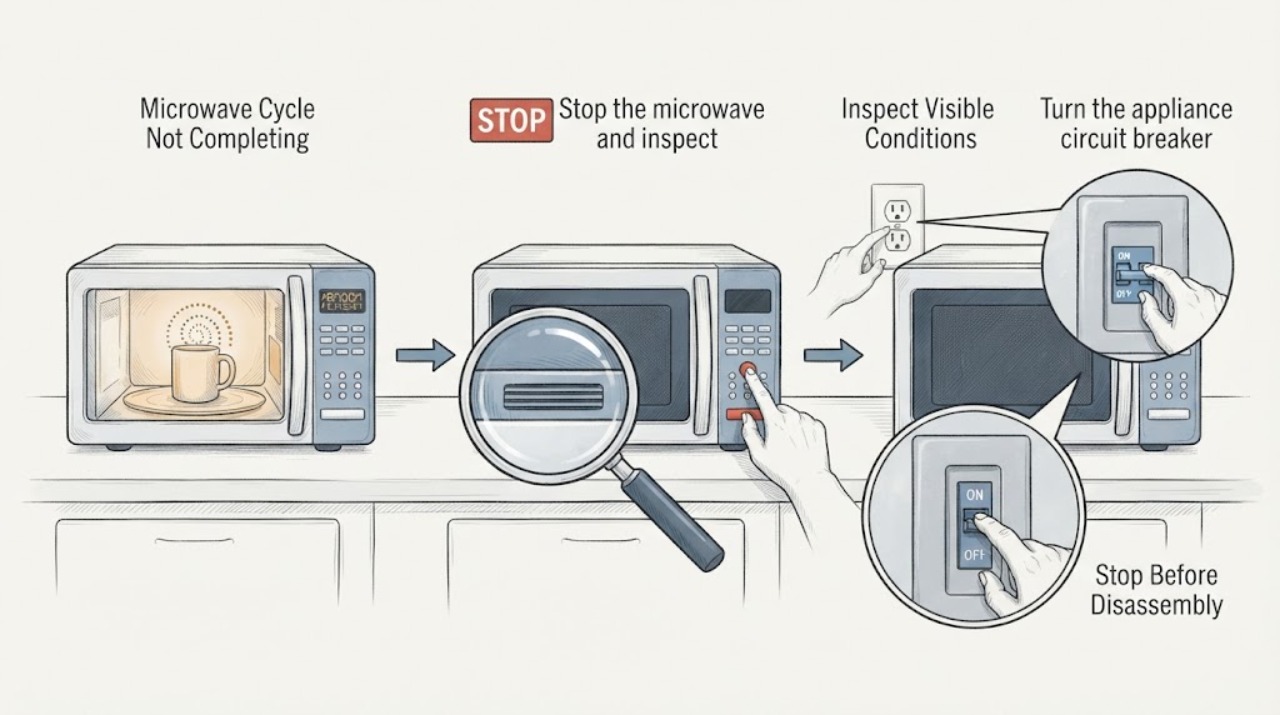
If a microwave starts but stops before the programmed time, first note whether the display also resets, whether the cooling fan is blocked, and whether the stop happens only on long or repeated cycles. Clear only accessible ventilation openings and reset the appliance circuit once for 30 seconds. Stop using it for smoke, burning odor, abnormal heat, sparks, or repeated premature stops; internal switches, thermal cutouts, wiring, and control faults require qualified service.
Work through in order
Diagnostic checks
Use only checks that match the exact appliance or system and its official guide.
-
Check 1
Stop the microwave and inspect the user-accessible ventilation openings and surrounding clearance for cookware, towels, grease buildup, or other blockage.
Expected result: Openings are clear, blocked, or the cabinet is unusually hot and the fan is not audible.
Next step: Clear only external obstructions and allow the unit to cool. Do not remove panels or insert tools into openings.
Why this matters
Why: Blocked ventilation can cause premature shutdown; unusual heat or absent cooling points toward a protection or cooling fault.
-
Check 2
Run one short supervised test and observe whether the display resets, the light/fan remain on, or the cycle stops at a repeatable time.
Expected result: The display loses time/power, the fan stops, or the same stop point recurs with a clear display.
Next step: Do not keep repeating cycles. Record the exact timing and display state for service.
Why this matters
Why: A reset display suggests supply/control interruption; a repeatable stop with power present is more consistent with a protection, switch, or control issue.
-
Check 3
Turn the appliance circuit breaker off for 30 seconds, turn it back on, and retest once only after the microwave has cooled and no safety symptom is present.
Expected result: The cycle completes after the reset, or it stops early again.
Next step: Leave the microwave unused and arrange qualified service if the stop recurs.
Why this matters
Why: A single successful reset can clear a transient power/control state; recurrence means the underlying fault remains.
-
Check 4
Check whether the symptom occurs only with repeated or long cycles, or also during a short test with adequate cooling time.
Expected result: Only long/repeated use triggers it, or even a short cycle ends early.
Next step: Do not bypass a door switch or attempt internal diagnosis. Escalate either recurring pattern.
Why this matters
Why: Heat management may be involved in the first pattern; an early stop on a short cycle raises concern for power, door switches, controls, or thermal protection.
-
Check 5
Inspect the food and cavity only after power is off and the unit is cool; note sparks, smoke, burning odor, arcing, or a hot plug/cabinet.
Expected result: Any abnormal heat, smoke, burning odor, sparks, or damaged cord is present, or the cycle is normal.
Next step: Disconnect power at the plug or breaker if safe and arrange service; do not use it again until cleared.
Why this matters
Why: These are safety stop conditions rather than user-adjustable timing issues.
Use your observations
Decision map
Find the observation that best matches what you see, then follow the next safe action.
-
PATH 01Next step
What you see
The cycle completes after one 30-second breaker reset and no safety symptom returns.
Do this next
Monitor the next use and stop if the early-stop symptom returns.
Why this path and its safety boundary
Why it matters: A transient control or power state may have cleared.
-
PATH 02Next step
What you see
The display resets or loses power when the cycle ends early.
Do this next
Stop use and have the circuit and microwave inspected by a qualified technician.
Why this path and its safety boundary
Why it matters: Power supply, wiring, or control interruption is plausible.
-
PATH 03Next step
What you see
The cabinet is hot or the stop appears after long/repeated cooking while ventilation was obstructed.
Do this next
Allow full cooling, clear external airflow, and seek service if it recurs.
Why this path and its safety boundary
Why it matters: Cooling airflow or thermal protection may be involved.
-
PATH 04Next step
What you see
Smoke, burning odor, sparks, abnormal heat, or repeated early stops occur.
Do this next
Disconnect power if safe and arrange qualified microwave service; do not open the cabinet.
Why this path and its safety boundary
Why it matters: The appliance should be treated as unsafe for continued operation.
Helpful context
Understand the symptom
A cycle that ends early is different from a normal completion or a deliberate STOP/CLEAR press. Record the programmed time, when the stop occurs, what remains on the display, and whether the cavity fan or light continues.
Check airflow and power state before repeating a cycle
Microwave heating creates heat that must be managed by the cooling system. A blocked opening, power interruption, or protective cutoff can end a cycle; repeated testing can worsen a fault.
When checks do not resolve it
Need a professional?
Disconnect power and arrange qualified service for smoke, burning odor, sparks, abnormal heat, a damaged cord, repeated early stops, or a cycle that ends with the display/power resetting. Do not open the microwave or bypass door switches.
Common questions
FAQ
Why does a microwave stop before the timer reaches zero?
Wolf lists cooling/ventilation blockage, power or breaker issues, switches, wiring, controls, and a thermal cutout as possible causes. Clear external airflow and reset the breaker for 30 seconds once; recurring stops need service.
Should I keep restarting a microwave that stops early?
No. One supervised short retest after cooling and one 30-second breaker reset are reasonable; repeated early stops should be isolated and serviced.
What if the microwave is hot or smells burnt?
Stop immediately, disconnect power if safe, and do not continue using or opening it. Arrange qualified service.
Read the exact guide
Official sources
- Microwave Drop-Down Door Oven Begins Cook Cycle but Shuts Down Before End of CycleSub-Zero, Wolf, and Cove · microwave cook cycle stopping before completion
- UCGSub-Zero, Wolf, and Cove · Wolf microwave operating controls and reset context
Community feedback
Share a repair observation
Share a plain-text repair observation. Accepted observations are published automatically; this page may take a moment to update.