
On this page
Start here
Quick answer
A fan that continues after a microwave cycle can be normal cooling, especially on an over-the-range model after microwave use or heat from the cooktop below. KitchenAid says some models automatically run the cooling fan and may leave it on while the microwave cools; GE likewise says its over-the-range models may run a fan after nearby heat and shut it off when cool. Because the task supplies no model, do not copy a fixed run time from another brand. First confirm that only the fan is running: there must be no uncommanded heating, turntable movement or other start-up behavior. Let the microwave and nearby cooktop cool, use only the controls and user-accessible filter/vent checks described in the exact manual, and arrange service if the fan remains on after the appliance is cool and idle, becomes noisy, or the microwave starts or heats by itself.
Work through in order
Diagnostic checks
Use only checks that match the exact appliance or system and its official guide.
-
Check 1
Watch and listen with the microwave stopped. Confirm whether only air is moving, or whether the turntable rotates, the cavity or cooktop light changes, the display shows a running function, or food heats without a new command.
Expected result: Only the fan runs, or the fan is accompanied by heating, turntable movement, lights or other signs of an uncommanded cycle.
Next step: If anything heats or starts by itself, stop using the microwave and use the safe external power cutoff only if it is immediately accessible; otherwise leave it alone and arrange service. If only the fan runs, continue with the heat and cooldown checks.
Stop if: Do not place a hand inside, run a test load, open the cabinet or touch internal parts to determine whether it is heating.
Why this matters
Why: Fan-only operation can be automatic cooling; heating or an uncommanded cooking cycle is not explained by ordinary cooldown and may be a door/control safety fault.
-
Check 2
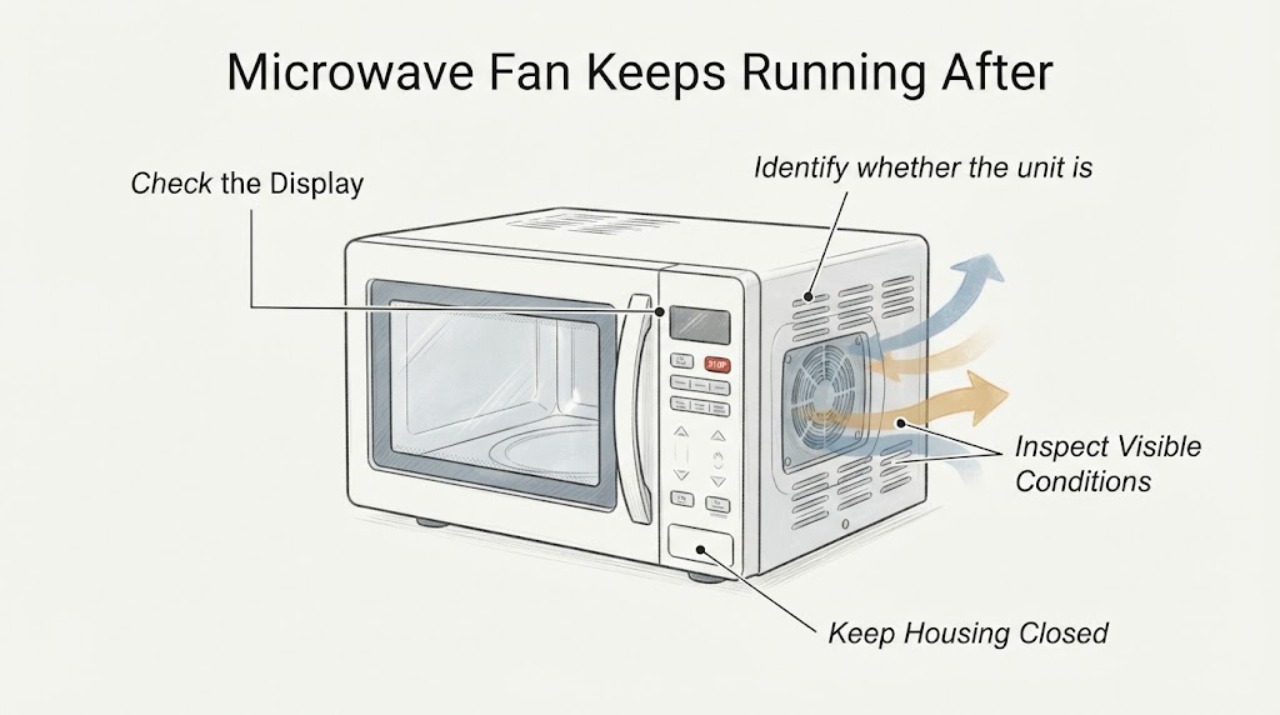
Identify whether the unit is an over-the-range microwave and note whether the cooktop below was recently used, whether the microwave ran for a long period, and whether the fan began during or just after that heat.
Expected result: The fan began after nearby cooktop heat or an extended microwave cycle, or it begins while the appliance and cooktop are cool and idle.
Next step: For a heat-related start, let the area cool and observe whether the fan cycles off. For a cool, idle start, record the behavior and use the exact model manual or service path rather than assuming a thermostat or relay failure.
Why this matters
Why: Heat-triggered automatic ventilation or cooling is more likely in the first pattern. A fan that starts or persists with no recent heat is less consistent with the documented automatic-cooling explanation.
-
Check 3
Allow the microwave and cooktop to cool naturally with the controls off. Observe whether the fan stops or cycles down without repeatedly pressing buttons or switching the appliance on and off.
Expected result: The fan stops after cooling, cycles only while heat remains, or continues indefinitely after the appliance and cooktop are cool.
Next step: If it stops, monitor the pattern and obtain the exact manual for the model's normal behavior. If it does not stop once cool, leave the microwave unused and arrange service; do not borrow another brand's maximum time.
Why this matters
Why: Stopping as the unit cools supports normal automatic cooling for that installation. Continued operation after cooling is not enough by itself to identify a failed part, but it warrants model-specific instructions or service.
-
Check 4
Use only the exact owner's manual to check the Vent Fan or Cancel control and any user-accessible charcoal filter or vent cover. Do not remove the outer cabinet or any cover that exposes wiring or high-voltage parts.
Expected result: The fan was manually selected, a user-accessible filter/cover is visibly mis-seated, or no external control/filter issue is apparent.
Next step: Cancel only the manually selected function using the exact manual. If a filter or cover can be reseated without exposing internal parts, follow the manual once; otherwise stop and request service.
Stop if: Do not remove the microwave cabinet, defeat an interlock, or reach into the vent, control or high-voltage area.
Why this matters
Why: A selected vent function or an installation-specific filter/cover condition can affect fan operation on some models. A normal-looking exterior does not clear the internal control or thermal path.
-
Check 5
Record the microwave type, model number, whether the fan is internal or vents the cooktop, when it starts, how the sound changes as the unit cools, and whether the display, light or turntable behaves abnormally.
Expected result: The fan is quiet and stops after cooling, or it is unusually loud, rubbing, intermittent without heat, or persistent while the unit is cool.
Next step: Keep the record and use the manufacturer's service route if the behavior persists, worsens or cannot be matched to the exact manual.
Stop if: Stop use for burning smell, smoke, sparks, damaged cord, a microwave that starts or heats by itself, or any need to open the case.
Why this matters
Why: A repeatable cool-down pattern supports normal operation for the specific installation. Abnormal noise or a persistent cool-idle fan needs a technician to inspect the fan, thermal control and control circuit without user access to the high-voltage area.
Use your observations
Decision map
Find the observation that best matches what you see, then follow the next safe action.
-
PATH 01Next step
What you see
Only air movement is audible after a cooking cycle or recent cooktop use, and the fan stops as the microwave and surrounding area cool.
Do this next
Continue normal use only within the exact owner's manual and record the model-specific behavior; do not apply another brand's run-time limit.
Why this path and its safety boundary
Why it matters: This pattern is consistent with automatic cooling or heat-triggered venting for the installation.
-
PATH 02Next step
What you see
The fan starts while the cool microwave is idle, remains on after cooling, or cannot be stopped with the exact documented control.
Do this next
Keep the unit unused and arrange manufacturer-qualified service; do not disassemble the cabinet or test internal parts.
Why this path and its safety boundary
Why it matters: The behavior is not explained by the opened generic cooling guidance alone and could involve an installation-specific control or thermal issue.
-
PATH 03Next step
What you see
The turntable moves, the microwave heats, or the unit appears to start without a command instead of running only a fan.
Do this next
Stop using it, isolate power only through a safe accessible external disconnect if possible, and request service. Do not run a cup-of-water test or open the microwave.
Why this path and its safety boundary
Why it matters: This is an uncommanded-operation or heating safety concern, not ordinary cooling.
-
PATH 04Next step
What you see
The fan becomes loud, rubs, smells burnt, produces smoke or sparks, or the cord/plug is damaged.
Do this next
Stop use and arrange qualified appliance service; do not continue cycling the fan or reach through the vent to inspect it.
Why this path and its safety boundary
Why it matters: These observations exceed normal cooling behavior and create an electrical or fire risk.
Helpful context
Understand the symptom
A fan-only cooldown is different from the microwave running
The assigned topic has no brand or model, so the article cannot supply a universal fan run time. Official guidance separates the internal electronics fan from an over-the-range vent fan and says either can continue briefly or cycle after heat. The first useful observation is whether the sound is only air movement, or whether the turntable, lights or microwave heating also operate without a command.
Heat from the cooktop can start an automatic vent or cooling fan
KitchenAid says some over-the-range models automatically run a cooling fan during microwave operation or while the cooktop below is being used, and that the fan can stay on while the microwave cools. GE describes the same type of heat-triggered behavior for its over-the-range models. This makes the nearby cooktop, recent long cooking and the microwave's installation type important observations, but it does not establish how long another model should run.
Do not open the case to investigate a fan
Microwave ovens contain high-voltage parts even after a cooking cycle ends. Use the exact owner's manual for buttons, a removable filter or an external vent cover. Do not remove the cabinet, reach toward the capacitor or magnetron area, defeat door interlocks, or perform live electrical tests. A persistent fan with abnormal noise or an uncommanded heating event needs service diagnosis.
When checks do not resolve it
Need a professional?
Arrange qualified microwave service when the fan remains on after the appliance and cooktop are cool, starts with no heat source, becomes unusually loud or rubs, or when the exact model manual does not explain the behavior. Stop immediately for uncommanded heating, turntable movement, smoke, sparks, burning smell or a damaged cord. Microwave cabinet and high-voltage diagnosis are not user-level checks.
Common questions
FAQ
How long should a microwave fan run after cooking?
There is no universal time for an unidentified model. KitchenAid and GE describe automatic cooling that stops when the microwave or nearby cooktop cools, while their model-specific examples differ. Use the exact owner's manual and judge the result by cooling behavior, not another brand's timer.
Is the fan normal if the microwave is no longer heating?
Often, yes, if only the fan runs after recent microwave or cooktop heat and it stops as the appliance cools. If the turntable or heating also starts without a command, stop using the microwave and request service.
Can I unplug the microwave to stop the fan?
Use only an immediately accessible external plug or disconnect when it can be done without moving the appliance or touching wiring. For a hardwired or built-in unit, do not open panels or reach behind it; leave it off and arrange service.
Can I remove the microwave cover to inspect the fan?
No. The fan is near internal electrical and high-voltage components. Limit checks to the controls, model manual and any explicitly user-accessible filter or vent cover; cabinet removal and internal diagnosis belong to qualified service.
Read the exact guide
Official sources
- Microwave - Normal Operational CharacteristicsGE Appliances · Opened GE guidance. It supports symptom-level distinctions between internal and vent fans and heat-triggered operation, but its model-specific behavior is not transferred as a universal rule.
- Microwave Use and CareWhirlpool · Opened Whirlpool's official manual and used it only for general safety boundaries and the clearly labeled problem-solver statement that a post-cycle cooling fan can be normal. It does not establish a procedure or duration for an unidentified microwave.
- Vent Randomly Turns On - Over-the-Range MicrowaveKitchenAid Product Help · Opened KitchenAid guidance. It supports the distinction between automatic cooling and manually controlled venting on some over-the-range models; it does not establish a universal duration for an unidentified microwave.
- Microwave - Starting On Its OwnGE Appliances · Opened GE guidance. It supports treating fan-only heat response as potentially normal and uncommanded heating as a service condition; documented two-hour behavior is GE-specific and is not generalized.
Community feedback
Share a repair observation
Share a plain-text repair observation. Accepted observations are published automatically; this page may take a moment to update.