
On this page
Start here
Quick answer
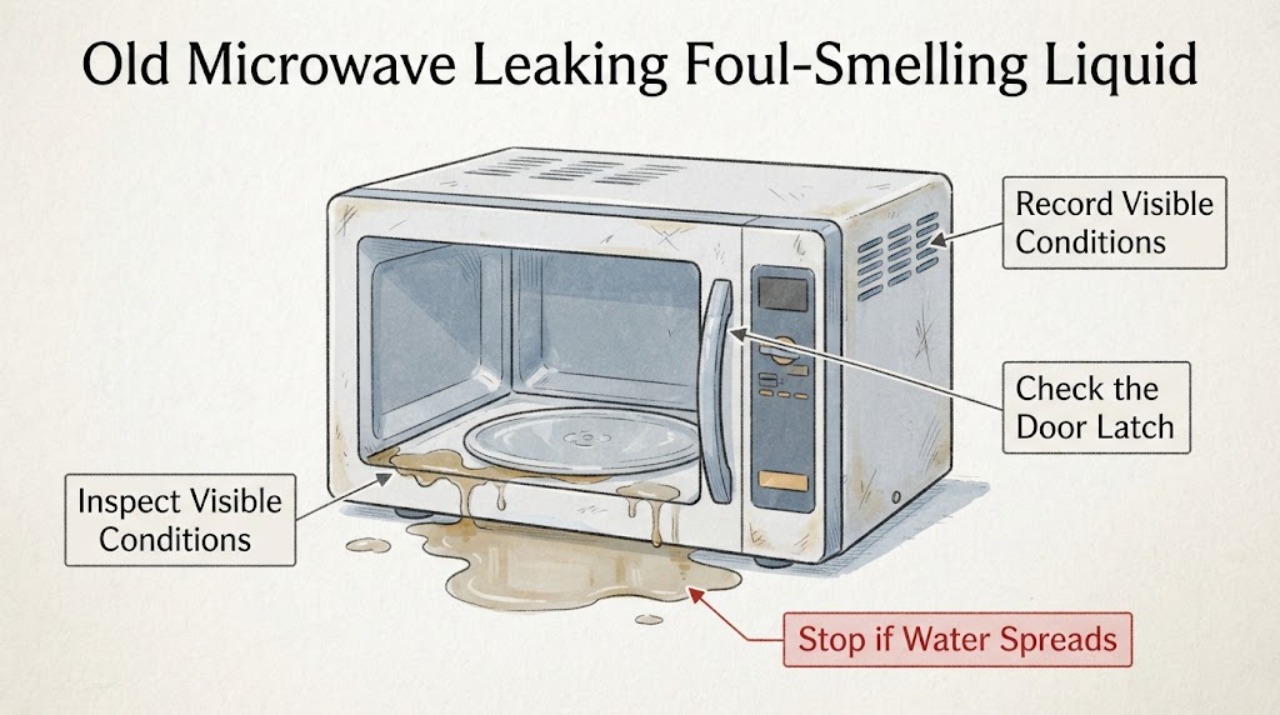
A foul-smelling liquid from an old microwave is not identifiable safely by smell or colour. In the opened Reddit report, the renter described a strong bug-spray-like odour and liquid around the microwave, then unplugged and removed it; a comment mentioned possible condensation or an internal capacitor only as an unverified guess. Keep the microwave unplugged and out of service, document where the liquid appeared, and tell the landlord or property manager. FDA guidance says to stop using a microwave with a damaged door, hinge, latch, or seal, and its cleaning guidance is limited to a cool cavity, water or mild detergent, and a soft cloth. Do not open the cabinet, probe the liquid, run a heated cleaning test, or reuse the microwave just because the smell temporarily fades.
Work through in order
Diagnostic checks
Use only checks that match the exact appliance or system and its official guide.
-
Check 1
Leave the microwave unplugged or switched off at its accessible supply, keep people and pets away from the liquid, and do not turn it on to see whether the smell returns.
Expected result: The appliance remains isolated, and the liquid or odour is confined to a photographed area or continues to appear while the appliance is off.
Next step: Use gloves and absorbent material only to protect the surrounding counter if needed, without touching internal parts; photograph the area and notify the landlord or property manager.
Why this matters
Why: Isolation prevents a suspected electrical or heating fault from being re-energized, but the liquid location alone does not identify its chemistry or source.
-
Check 2
From the outside only, record where the liquid is coming from: the cooking cavity or door edge, a vent or side seam, the underside/base, or the counter below; also note smoke, sparking, heat damage, a fishy/chemical smell, or a damaged cord.
Expected result: The liquid is only an accessible food residue inside the cavity, or it appears from a vent, seam, underside, door area, or damaged electrical surface.
Next step: For any exterior/vent/underside source, do not remove covers or continue use; keep it isolated and route the appliance to the landlord and qualified service or replacement.
Why this matters
Why: An interior food residue can be cleaned only under the limited cavity-cleaning guidance. Liquid or odour from a vent, seam, underside, cord, or damaged door leaves an internal or safety issue unresolved.
-
Check 3
Inspect the door, hinges, latch, sealing surfaces, and cavity opening without forcing or dismantling them; do not test the microwave with the door partly open or with a damaged seal.
Expected result: The door closes firmly with intact visible seals, or it is bent, warped, loose, damaged, or does not latch normally.
Next step: If any door or seal problem is present, stop use and tell the landlord immediately. Do not adjust the latch, bypass an interlock, or attempt a leakage test with household items.
Why this matters
Why: FDA identifies damaged hinges, latches, or seals and a door that does not close firmly as reasons to contact the manufacturer and avoid use; a damaged door also prevents a safe radiation-safety assumption.
-
Check 4
If and only if the liquid is visibly a food spill inside a cool, intact cavity, wipe the cavity, door edge, and accessible exterior with water or mild detergent and a soft cloth or paper towel; do not use abrasives, steel wool, oven cleaner, or sharp tools.
Expected result: The residue is removed and no odour returns while the unit remains unplugged, or the odour/liquid persists, spreads, or smells electrical or chemical.
Next step: If the smell or liquid persists, leave the microwave out of service and have the landlord arrange qualified evaluation or replacement. Do not run a water, lemon, vinegar, or deodorizing cycle to test it.
Why this matters
Why: Cleaning can address accessible food residue, but it cannot diagnose liquid behind a panel, a damaged cavity, or a recurring electrical/chemical smell.
-
Check 5
Give the landlord or property manager the microwave location, appliance label or model if visible, photographs of the liquid path, when the smell began, whether it appeared during or after heating, and whether the door, cord, outlet, or breaker showed damage.
Expected result: The landlord can identify the appliance and arrange service/replacement, or the source remains unclear and the unit is old or heavily used.
Next step: Keep the unit disconnected until the owner or qualified technician clears it. If there was smoke, fire, sparking, shock, or injury, leave the area and use emergency or building procedures before handling cleanup.
Why this matters
Why: A rental owner controls the appliance and can obtain the correct manufacturer documentation; an unclear source on an old appliance is not a safe basis for a tenant repair.
Use your observations
Decision map
Find the observation that best matches what you see, then follow the next safe action.
-
PATH 01Next step
What you see
The liquid is a visible food spill only inside a cool, intact cooking cavity, with no smoke, sparking, door damage, or exterior seepage.
Do this next
Clean only the accessible cavity with mild detergent and a soft cloth, keep the unit unplugged, and have the landlord confirm whether it should be returned to service.
Why this path and its safety boundary
Why it matters: An accessible cooking residue is plausible, but the reported strong odour still does not prove that the microwave is safe to run.
-
PATH 02Next step
What you see
Liquid or strong odour comes from a vent, side seam, underside, cord area, or any place outside the cooking cavity.
Do this next
Do not operate or open the microwave. Notify the landlord and arrange qualified service or replacement.
Why this path and its safety boundary
Why it matters: The source may be behind the enclosure or in an external installation area and cannot be identified by a tenant-level wipe-down.
-
PATH 03Next step
What you see
The door is bent, does not close firmly, the latch or seal is damaged, or the microwave ever operates with the door open.
Do this next
Immediately discontinue use and contact the manufacturer through the owner or landlord; do not test, bypass, or adjust the interlock.
Why this path and its safety boundary
Why it matters: FDA treats these as microwave safety concerns rather than ordinary odour or cleaning issues.
-
PATH 04Next step
What you see
The smell returns after cleaning, the liquid is unexplained, or there is smoke, arcing, heat damage, electrical smell, a damaged cord, shock, or a tripped breaker.
Do this next
Keep it isolated, leave the area if there is smoke or fire risk, and use the landlord’s qualified service or emergency process.
Why this path and its safety boundary
Why it matters: The appliance remains an unresolved safety or internal-fault question, and repeated operation could worsen the hazard.
Helpful context
Understand the symptom
Treat the liquid as unidentified until the appliance is isolated
A microwave does not provide a user-safe way to identify an unknown liquid from its smell. It may be residue or condensation from cooking, but liquid emerging from a vent, underside, side panel, or damaged cavity also leaves the source unresolved. Because this is a rental, keep the appliance disconnected and let the landlord or property manager decide whether it is removed, replaced, or sent to qualified service. Do not open the cabinet to inspect an electrical part; the Reddit replies themselves offered only unverified possibilities.
Clean only the accessible cooking cavity
If the liquid is clearly a food spill inside the cool cooking cavity and there is no electrical smell, smoke, arcing, door damage, or liquid from the cabinet, FDA guidance supports wiping the cavity, door and outer edge with water and a mild detergent using a soft cloth or paper towel. That does not authorize cleaning behind vents, under panels, or inside the electrical enclosure, and it does not make a recurring chemical odour safe to test by running the oven.
Common questions
FAQ
Could this just be condensation or old food?
It could be accessible food residue or moisture, but the strong odour and apparent leakage do not identify the source. Clean only a clearly visible residue in a cool, intact cavity; keep the microwave out of service until the landlord or qualified service provider clears an unexplained liquid or recurring smell.
Can I remove the outer cover to see where the liquid came from?
No. Do not open the cabinet, probe the liquid, or work on internal parts. The exact source cannot be safely inferred from the Reddit guesses, and an unplugged microwave can still require qualified internal service.
When is wiping the microwave enough?
Only when the material is visibly a food spill inside a cool, intact cavity and there are no signs of smoke, sparking, electrical or chemical smell, door damage, or exterior seepage. FDA recommends water or mild detergent and a soft cloth or paper towel, without abrasive cleaners or steel wool.
What should a tenant do with the appliance?
Leave it unplugged, photograph the liquid and model label if safely visible, and notify the landlord or property manager. The owner should arrange the manufacturer’s qualified service or replacement decision for an old rental microwave.
Read the exact guide
Official sources
- Microwave OvensU.S. Food and Drug Administration · Government consumer-safety guidance used for the model-agnostic stop-use and cleaning boundaries. It does not identify the unknown liquid or diagnose any internal component.
- Foul smelling liquid leaking from old microwave?Reddit r/Appliances · Exact Reddit post opened and used only for the reported context and uncertainty. It does not verify a component diagnosis or repair outcome.
Community feedback
Share a repair observation
Share a plain-text repair observation. Accepted observations are published automatically; this page may take a moment to update.