
On this page
Start here
Quick answer
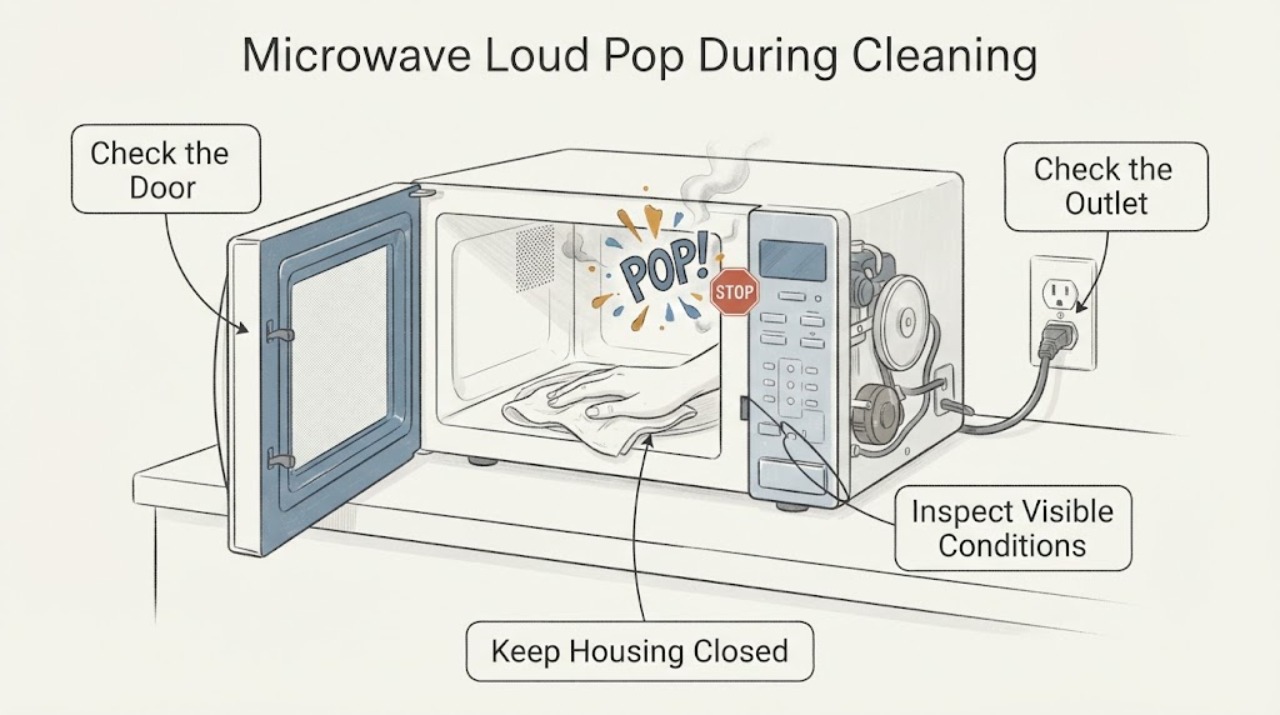
Stop the microwave and do not run another cleaning cycle or power test to reproduce the loud pop. If there was flame, smoke, an electrical smell, visible arcing or a damaged cavity, keep the door closed while a fire is active, leave the area if needed, and use emergency fire guidance; do not open the cabinet or attempt a repair. Once the unit is cool and safe to approach, unplug it before cleaning or inspection and look only through the door for scorch marks, peeling or a damaged inlet cover, door frame or rack support. Manufacturer guidance says food soil, metal, an empty cavity and buildup around the cavity or inlet cover can cause popping or arcing, but a loud electrical or mechanical pop needs service. With no brand or model supplied, do not assume the cause or replace a waveguide cover, magnetron or fuse.
Work through in order
Diagnostic checks
Use only checks that match the exact appliance or system and its official guide.
-
Check 1
If the pop is happening now, stop the microwave. If there is flame or an active microwave fire, turn it off and keep the door closed; do not open the door to look inside. Move away and call emergency services if the fire does not go out or smoke makes the area unsafe.
Expected result: There is current flame, smoke, an alarm, or a strong burning/electrical odor, or the sound has stopped with no active fire.
Next step: Follow fire-service instructions and do not re-enter or open the door until the fire is out and the area is safe. If there was no active fire, leave the microwave off and continue with the unpowered checks below.
Why this matters
Why: An active fire or electrical burning sign is an immediate fire/electrical hazard, not a cleaning troubleshooting branch. A stopped sound without visible damage still does not prove that the microwave is safe to energize.
-
Check 2
Once there is no active fire and the appliance is cool, unplug it if the plug and outlet are safe to reach. Do not pull a built-in or over-the-range unit from its mounting and do not remove the outer cabinet, door, inlet cover or control panel.
Expected result: The cord, plug and outlet are intact and dry, or there is scorching, melting, looseness, moisture or other visible electrical damage.
Next step: If any electrical damage or moisture is present, keep the circuit off if safely possible and arrange qualified appliance/electrical service. Do not restore power to see whether the pop returns.
Why this matters
Why: A safe plug area allows the unit to remain isolated for visual inspection. Damage at the cord, plug or outlet can add an electrical-fire risk and is not an internal cleaning repair.
-
Check 3
Without powering the microwave, inspect through the door and with the door open only after the unit is isolated and cool. Look for a burned or peeled cavity coating, a hole, soot, a damaged microwave inlet cover, damaged rack support, food carbonization or damage where the door meets the frame.
Expected result: There is visible arcing damage, a burned hole, peeling coating, a damaged cover/support, or only removable food soil with no damage visible.
Next step: Keep the microwave out of service and contact qualified service for any burn, hole, peeling or damaged component. If only removable soil is present, clean it only with the exact model's mild, non-abrasive method and do not run a test cycle after the unexplained pop.
Why this matters
Why: GE says arcing or burns in the cavity require stopping use, and Whirlpool identifies soil buildup at the cavity, inlet cover, rack supports and door contact area as an arcing source. A clean-looking cavity does not rule out an electrical or mechanical fault after a loud pop.
-
Check 4
Reconstruct what was inside and what cleaning method was being used: an empty cavity, metal or metallic trim, a rack, a cleaning container, a cloth or chemical product, wet soil, or loose food residue. Do not put the same setup back in and do not run the microwave empty to compare sounds.
Expected result: The pop coincided with an empty cavity, metal/rack, food or soil, or it sounded electrical/mechanical without a clear contents-related trigger.
Next step: Record the exact model, cleaning function, contents and visible result for service. Do not select a replacement component from the suspected cause or use a different load as a home test.
Why this matters
Why: GE links popping/arcing to food, spills, an empty cavity and metal or rack conditions; a clear contents-related event may identify a use trigger but does not clear a microwave that arced or popped loudly. An electrical or mechanical sound is a service signal.
-
Check 5
If the cavity and power cord look undamaged, compare the event only with the exact model's owner manual or official support page; do not use another brand's cleaning cycle or sound description as a model-specific clearance. Keep the unit unplugged until the unexplained loud pop has been assessed.
Expected result: The exact model instructions explain a normal cleaning sound, or the manual does not cover the event or describes electrical/mechanical noise as abnormal.
Next step: If the manual does not clearly explain the event, schedule qualified microwave service. Do not open the high-voltage compartment, bypass the door interlock or make energized measurements.
Why this matters
Why: A model-specific instruction may explain a designed cleaning cycle, but no model was supplied here. Generic manufacturer guidance does not prove that this particular appliance is safe after a loud unexplained pop.
Use your observations
Decision map
Find the observation that best matches what you see, then follow the next safe action.
-
PATH 01Next step
What you see
There was flame, smoke, an active electrical smell or visible fire when the loud pop occurred.
Do this next
Keep the door closed while a microwave fire is active, turn the unit off if it is safe, leave if needed and contact emergency/fire services. Do not reopen, unplug through smoke or re-energize it for a test.
Why this path and its safety boundary
Why it matters: This is a fire or electrical safety event; the absence of a flame now does not establish that the microwave is safe.
-
PATH 02Next step
What you see
A burn, hole, peeling coating, damaged inlet cover, damaged rack support or door-area damage is visible after the appliance is isolated and cool.
Do this next
Leave the microwave unplugged and arrange qualified appliance service or replacement assessment. Do not repaint, tape, remove the cover or continue cleaning as a repair.
Why this path and its safety boundary
Why it matters: The cavity or microwave energy path may be damaged. GE says to stop using a microwave with arcing or burns, and Whirlpool identifies the inlet-cover and cavity areas as arcing-sensitive locations.
-
PATH 03Next step
What you see
There is no visible damage, but the pop sounded electrical or mechanical rather than like food or a spill.
Do this next
Keep the unit off and unplugged, record the exact model and event details, and have qualified service evaluate it. Do not repeat the cleaning cycle or run the microwave with a different load.
Why this path and its safety boundary
Why it matters: GE treats an electrical or mechanical popping sound as a reason to contact service; a clean cavity does not rule out an internal fault.
-
PATH 04Next step
What you see
The event clearly followed food soil, metal/metallic trim, an empty cavity or a rack condition, and no arcing, smoke or damage is visible.
Do this next
Remove the trigger only while the unit is unplugged and cool, clean with the exact model's mild method, and seek service if any popping, arcing, burning odor or abnormal sound returns; do not use an empty-cavity test.
Why this path and its safety boundary
Why it matters: The contents or soil may have caused the pop, but the event is not a license to test the same setup or assume the microwave is undamaged.
Helpful context
Understand the symptom
A loud pop during cleaning is a stop signal, not a reason to repeat the cycle
The topic gives no model and does not say whether the sound was a single food-related snap, an electrical crack, a visible flash or a mechanical bang. GE distinguishes ordinary food or spill popping from an electrical or mechanical sound that needs service. Whirlpool also warns that soil around the cavity, inlet cover, rack supports or door frame can produce arcing. These sources support a safe stop-and-inspect decision, not a definitive diagnosis of a magnetron, capacitor, fuse or cover.
Cleaning instructions are model-dependent
After the appliance is isolated and cool, clean only with the exact model instructions. GE recommends unplugging before maintenance or cleaning, using a mild damp cloth, avoiding commercial oven cleaners, abrasives, ammonia and bleach, and not spraying the controls directly. Whirlpool likewise calls for a cool oven, mild soap and water, a soft cloth and thorough drying. Those cleaning methods do not authorize opening the microwave cabinet or powering a unit that has arced or made a loud electrical/mechanical pop.
Common questions
FAQ
Can I run the microwave again to see if the loud pop happens again?
No. Do not run it empty or repeat the cleaning cycle to reproduce an unexplained loud pop. Keep it isolated and use the exact model's manual or qualified service, especially if there was arcing, smoke, odor or visible damage.
What if the microwave only popped while it was being cleaned?
Cleaning-related soil, an empty cavity, metal or a rack can cause popping or arcing, but the sound alone does not prove which condition occurred. Leave the unit off, let it cool, inspect for damage without opening the cabinet, and follow the exact model's cleaning instructions only after the safety issue is resolved.
Should I open the door if there was a microwave fire?
No. The U.S. Fire Administration says to turn the microwave off immediately and never open the door until the fire is out. If the situation is unsafe or the fire persists, leave and call emergency services.
Read the exact guide
Official sources
- Appliance and Electrical Fire SafetyU.S. Fire Administration, FEMA · Opened official USFA appliance-safety page used only for visible cord/plug/outlet damage escalation, not for microwave fault diagnosis.
- Cleaning the Interior or Cavity - Countertop MicrowaveWhirlpool Product Help · Opened official Whirlpool cleaning guidance for model-family-safe cleaning principles; exact model instructions remain controlling because the task has no model.
- Pictograph: Microwave Oven SafetyU.S. Fire Administration, FEMA · Opened official U.S. Fire Administration fire-safety guidance used for the active-fire branch only.
- Microwave Arcing or Sparking - Wall OvenWhirlpool Product Help · Opened official Whirlpool support guidance for microwave arcing causes and the stop-use boundary; the article does not claim the assigned unit is Whirlpool or a wall oven.
- Microwave - Cleaning RecommendationsGE Appliances · Opened official GE Appliances cleaning guidance; used only for unplug-before-maintenance, mild damp-cloth and no-abrasive/bleach/ammonia boundaries, not for the unidentified unit's model-specific cycle.
- Panasonic - Troubleshooting - Microwave power, fan or motor problemsPanasonic North America · Opened official Panasonic support guidance used only as a cross-brand safety corroboration for abnormal sound/arcing; no Panasonic identity is assigned to the topic.
- Microwave - Staining or Browning Inside the CavityGE Appliances · Opened official GE Appliances support guidance used only for the visible-burn/arcing safety boundary, not for model-specific repair.
- Microwave - Arcing or Making SoundsGE Appliances · Opened official GE Appliances support guidance for generic microwave sound/arcing symptoms; no GE brand or model is asserted for the assigned topic.
Community feedback
Share a repair observation
Share a plain-text repair observation. Accepted observations are published automatically; this page may take a moment to update.