
On this page
Start here
Quick answer
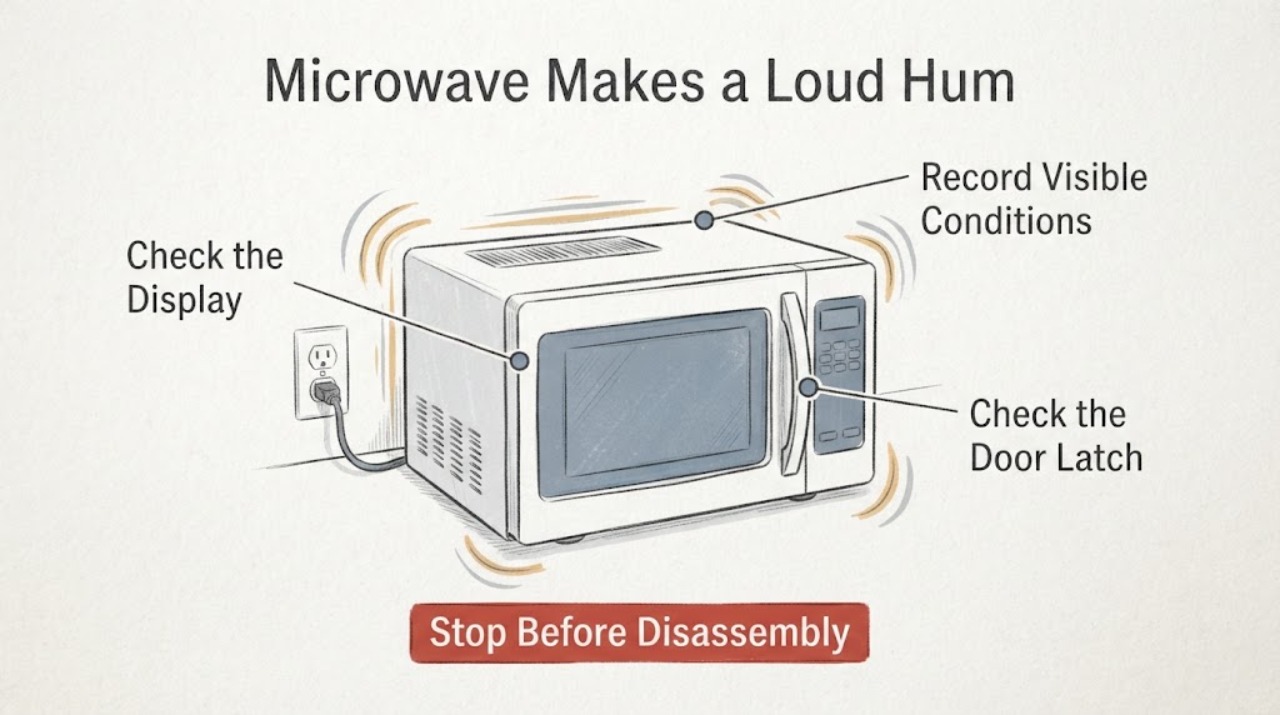
A slight standby hum can be normal on some microwave models, but a loud or new hum while the controls are off is not enough to diagnose a transformer, fan, magnetron, or another internal part. Unplug the microwave if the sound is accompanied by heat, burning odor, sparks, smoke, a display or interior light turning on, a turntable moving, or any apparent heating. With power isolated, record the model and whether the sound changes with the door, cooktop heat, or vent controls; use the exact manual or qualified service for the model. Never open the cabinet or test high-voltage parts.
Work through in order
Diagnostic checks
Use only checks that match the exact appliance or system and its official guide.
-
Check 1
From outside the microwave, note whether the sound is a steady hum or a pulsing/rattling sound and whether the display, interior light, turntable, fan, or apparent heating is active while no cycle is selected.
Expected result: Only a faint steady hum is present, or another function appears to be operating without a selected cycle.
Next step: If any function appears to operate without a command, unplug the microwave if safe and do not use it; arrange manufacturer or qualified service. If it is only a low steady hum, continue with model identification rather than assuming a universal fault.
Why this matters
Why: A slight standby transformer hum is documented for some GE models, but apparent operation while off is outside what can be called normal from this unbranded symptom.
-
Check 2
Record the full model and serial information, whether the unit is countertop, over-the-range, or built-in, and whether the sound changes when the cooktop or vent area is warm.
Expected result: The hum occurs only after cooktop use or with a vent-fan condition, or it continues when the appliance is cool and idle.
Next step: Use the exact model manual to identify normal fan or standby behavior. If the sound remains loud while cool and idle, stop troubleshooting by sound and request service.
Why this matters
Why: GE notes that over-the-range vent fans can run automatically when heat rises from the cooktop and that installation changes the sounds a microwave makes. This is a model and installation clue, not proof of an internal component failure.
-
Check 3
With the microwave unplugged or its circuit safely isolated, inspect only the exterior, power cord, plug, outlet area, cabinet, door, hinges, latch, and visible seals for damage, scorching, moisture, or looseness.
Expected result: The door is bent or does not close firmly, a hinge/latch/seal is damaged, or the cord/plug/cabinet shows heat or electrical damage.
Next step: Leave the microwave disconnected and contact the manufacturer or qualified service. Do not operate it to see whether the hum changes and do not remove the cabinet.
Why this matters
Why: FDA identifies damaged door components and an improperly closing door as radiation-safety concerns; visible electrical or heat damage also makes continued testing unsafe.
-
Check 4
After documenting the symptom, check the exact manual for the model's standby, clock-transformer, internal-fan, and vent-fan descriptions; do not use another brand's internal-noise explanation as a repair diagnosis.
Expected result: The exact manual describes the sound as normal in that standby or fan condition, or it does not describe the sound and the hum is new or loud.
Next step: If the manual does not clearly cover the sound, provide the recording, model, installation type, and visible observations to qualified service. Do not guess a replacement transformer, fan, magnetron, relay, or capacitor.
Why this matters
Why: Official guidance is model-specific: GE lists a slight standby transformer hum for its own microwaves, while also saying noise varies by model and installation. An undocumented loud hum remains unresolved.
-
Check 5
Do not run an empty-cavity experiment or open the microwave to locate the hum; if a service provider requests a test, follow only the exact model instructions and keep the door and safety interlocks intact.
Expected result: The sound can be recorded without operating the oven, or a proposed test would require energizing an unexplained noisy unit or removing a cover.
Next step: Keep the unit disconnected when the cause is unexplained and arrange qualified service. If the door ever permits apparent operation while open, discontinue use immediately.
Why this matters
Why: A cabinet exposes hazardous electrical and microwave-safety systems, and the assigned symptom does not justify a high-voltage diagnosis by a consumer.
Use your observations
Decision map
Find the observation that best matches what you see, then follow the next safe action.
-
PATH 01Next step
What you see
The hum is faint, steady, and the microwave remains cool and otherwise inactive while plugged in.
Do this next
Check the exact manual and compare the sound with a recording. Treat a new, loud, or worsening hum as a service issue rather than assuming it is normal.
Why this path and its safety boundary
Why it matters: Some models can make a slight standby transformer hum; GE documents this for its own microwave line, but the assigned microwave has no identified brand or model.
-
PATH 02Next step
What you see
The sound occurs with a hot cooktop or appears to be a vent fan on an over-the-range unit, then stops as the area cools.
Do this next
Use the exact model manual to confirm the fan behavior. If the noise persists when cool, is unusually loud, or is accompanied by heat or odor, disconnect and request service.
Why this path and its safety boundary
Why it matters: GE documents automatic vent-fan operation on some over-the-range microwaves when cooktop heat rises; installation and model controls matter.
-
PATH 03Next step
What you see
The hum is accompanied by a light, turntable, fan, display activity, apparent heating, or operation without a selected cycle.
Do this next
Unplug or isolate power if safe, do not use the microwave, and arrange manufacturer or qualified service. Do not test it with food or an empty cavity.
Why this path and its safety boundary
Why it matters: The appliance is not merely demonstrating an unexplained standby sound; continued operation needs professional assessment.
-
PATH 04Next step
What you see
The door, hinges, latch, or seal is damaged or the door does not close firmly.
Do this next
Keep the unit disconnected and request service. Do not adjust the latch, defeat an interlock, or open the cabinet.
Why this path and its safety boundary
Why it matters: FDA identifies these conditions as reasons for manufacturer assistance and says a damaged or improperly closing microwave should not be operated.
Helpful context
Understand the symptom
Separate a standby hum from apparent operation
Microwave sounds vary with the model and how it is installed. GE's official guidance gives one manufacturer-specific example: a slight hum from the clock transformer may be heard while a GE microwave is not in use. That is not a universal diagnosis for an unidentified microwave, and the word loud matters. First determine whether the sound is only a steady vibration or whether a fan, light, turntable, display, or heating function is also active.
Use the door and safety condition as a stop boundary
The FDA says to contact the manufacturer for damaged door hinges, latches, or seals and not to operate an oven whose door is bent, warped, damaged, or unable to close firmly. It also says to discontinue use if a microwave appears to continue operating with the door open. A loud hum is not a reason to open the cabinet or inspect high-voltage parts.
Do not identify a component by sound alone
A hum can be transmitted through the cabinet, countertop, wall, or over-the-range installation, and the available official guidance does not map this symptom to one internal part across brands. Record the model, installation type, when the sound starts, and what visibly operates. Give those observations to the manufacturer or qualified microwave service provider rather than trying a cabinet repair.
When checks do not resolve it
Need a professional?
Disconnect power if safe and stop using the microwave for apparent operation while off, smoke, sparks, burning odor, abnormal heat, a damaged cord or cabinet, or a door that is bent or will not close firmly., Request manufacturer or qualified microwave service for a new, loud, persistent, or worsening hum that the exact manual does not identify as normal., Do not open the cabinet, defeat a door interlock, probe high-voltage parts, run an empty-cavity test, or select a transformer, fan, magnetron, relay, or capacitor from the sound alone.
Common questions
FAQ
Can a microwave hum while it is off?
Some models can make a slight standby hum; GE documents a faint clock-transformer hum for its own microwaves. That does not make a loud hum on an unidentified microwave automatically normal. Check the exact manual and arrange service if the sound is new or unusually loud.
What if the light, fan, turntable, or heating starts without pressing Start?
Disconnect power if safe and do not use the microwave. The symptom is outside a simple standby-noise check and needs manufacturer or qualified service; never test it with the door open or by running it empty.
Can I remove the cover to find the source of the hum?
No. The assigned symptom does not justify consumer access to the cabinet or high-voltage parts. Record the sound and model information and arrange qualified microwave service.
Does a damaged door matter if the microwave still heats?
Yes. FDA guidance says not to operate a microwave if the door is bent, warped, damaged, or does not close firmly, and to contact the manufacturer for damaged hinges, latches, or seals.
Read the exact guide
Official sources
- Microwave OvensU.S. Food and Drug Administration · FDA consumer guidance supports not operating a microwave with a damaged or improperly closing door and immediately discontinuing use if it appears to operate with the door open. It does not diagnose the cause of a hum or authorize consumer cabinet/high-voltage service.
- Microwave - Normal Operational CharacteristicsGE Appliances · GE-specific official guidance used only as a bounded comparison: it says sounds vary by model and installation, describes a slight clock-transformer hum while not in use, and describes some over-the-range fan behavior. It does not establish that an unidentified or non-GE microwave's loud hum is normal.
Community feedback
Share a repair observation
Share a plain-text repair observation. Accepted observations are published automatically; this page may take a moment to update.