
On this page
Start here
Quick answer
Treat a large amount of smoke as a safety event, not as a reason to try the microwave again. Stop the cycle; if there is an active fire, keep the door closed and turn the oven off, unplugging it only if that can be done safely. Once the oven is completely cool and there is no fire, remove the dish and inspect the cookware and visible cavity for melting, charring, arcing marks, or damage. A non-microwave-safe dish can melt or reflect microwave energy, but smoke alone does not prove that the oven is undamaged. Do not use it again if the door, latch, seal, cavity, cord, or plug is damaged, if it operates with the door open, or if smoke or a burning odor returns; arrange qualified service.
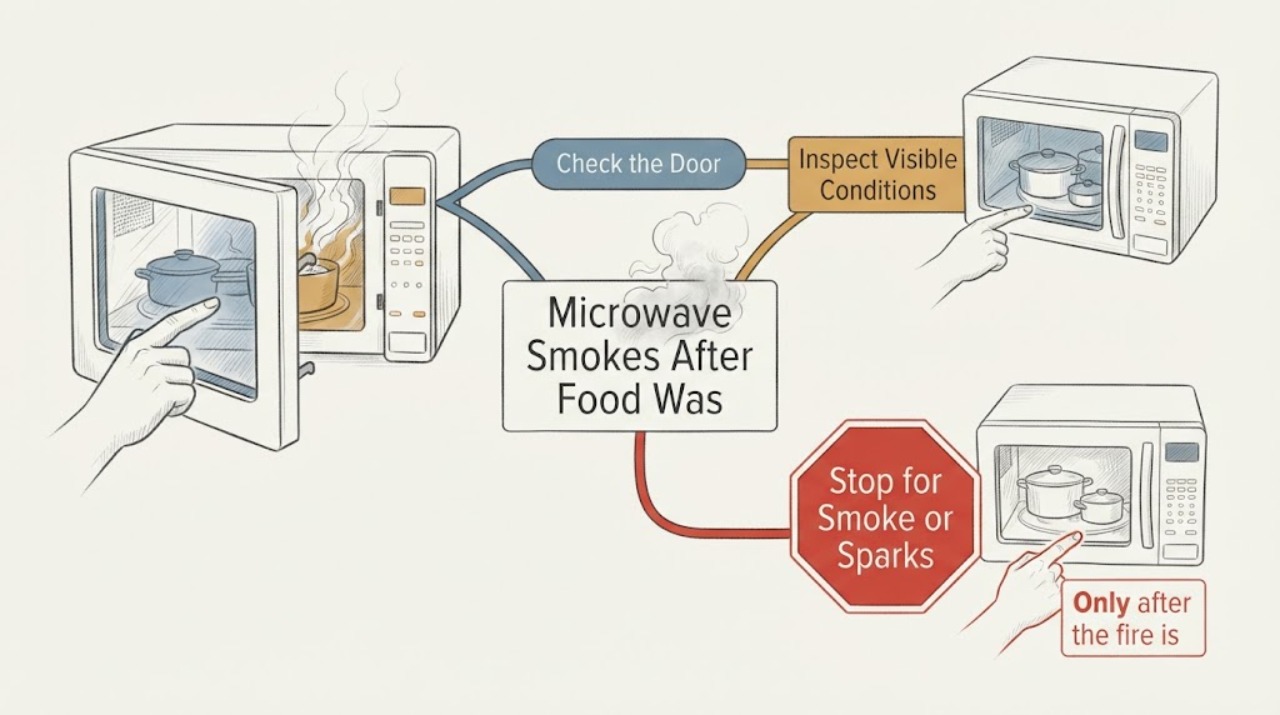
Work through in order
Diagnostic checks
Use only checks that match the exact appliance or system and its official guide.
-
Check 1
Stop the microwave immediately. If flames or an active fire are present, leave the door closed and turn the oven off; unplug it from the wall only if you can reach the plug without passing through smoke or flame. Leave the area and call the fire department if the fire does not go out or is spreading.
Expected result: The smoke or flame stops with the door closed and the oven off, or fire/smoke continues, escapes the cavity, or triggers a smoke alarm.
Next step: For any continuing or spreading fire, evacuate and call emergency services. After a contained event, keep the microwave disconnected and let it cool completely; do not open the door to inspect an active fire.
Stop if: Do not throw water into a microwave fire, reach into a smoking cavity, or restart the oven to see whether it still works.
Why this matters
Why: The first pattern is consistent with the fire-control guidance but does not prove that the microwave is undamaged. Continuing or spreading fire is an emergency rather than a troubleshooting condition.
-
Check 2
Only after the fire is out, the smoke has cleared, and the oven is completely cool, remove the plate and food with care. Inspect the plate, any lid, the food residue, the turntable, and the visible cavity without removing the outer cover.
Expected result: The dish or lid is melted, warped, cracked, charred, or has metal decoration; food or grease is burned; or the cavity, turntable, or interior coating has scorch, arc, blister, or other visible damage.
Next step: Discard a melted, charred, cracked, or questionable dish and remove only loose residue using the exact manual's cleaning method. Stop and arrange qualified service if the cavity, turntable, door area, or interior coating is damaged or the source remains uncertain.
Stop if: Do not scrape damaged coating, remove panels, or touch an unknown residue while the oven is warm or connected to power.
Why this matters
Why: A damaged dish or burned food can explain the smoke source, while arc marks, coating damage, or damage inside the cavity keep an oven fault in scope. Smoke by itself cannot distinguish these causes.
-
Check 3
Identify the cookware before any future use: look for a microwave-safe marking and check for metal trim, foil, metallic paint, a metal handle, or a material that can melt. Keep the smoke-affected dish out of service; follow the microwave's own manual for permitted containers.
Expected result: The dish is marked microwave-safe and has no metal decoration, or its marking is absent/unclear, it has metal decoration, or it warped or melted during the incident.
Next step: Use only a confirmed microwave-safe container after the appliance has been cleared for use by the manufacturer's guidance or a qualified technician. Do not perform a deliberate repeat run with the affected dish.
Stop if: Do not rely on a dish test or a brief empty run to clear a microwave that has produced heavy smoke.
Why this matters
Why: A clear microwave-safe marking and no metal trim remove one cookware uncertainty, but they do not clear an oven that smoked. An unclear, metallic, melted, or warped dish should not be used in a microwave.
-
Check 4
From the outside, check whether the door closes firmly and whether the hinges, latch, seal, power cord, and plug show bending, looseness, melting, scorching, or other damage. Do not test operation with the door open.
Expected result: The door does not close firmly, the door or seal is bent or damaged, the microwave appeared to run while open, or the cord or plug is scorched, loose, or melted.
Next step: Keep the microwave disconnected and contact the manufacturer or qualified appliance service for any listed condition. If none is visible but the smoke was substantial or the odor returns, still arrange model-specific evaluation before reuse.
Stop if: Do not adjust a door interlock, bypass a latch, open the outer cabinet, or perform a high-voltage test.
Why this matters
Why: FDA treats damaged door hardware or a microwave that continues operating with the door open as a radiation-safety concern. Cord, plug, or repeat smoke damage adds an electrical and fire concern; a clean exterior does not prove internal safety.
Use your observations
Decision map
Find the observation that best matches what you see, then follow the next safe action.
-
PATH 01Next step
What you see
Flames or dense smoke continue after the microwave is turned off, escape the cavity, or spread into the room.
Do this next
Leave the area, close doors behind you if possible, and call the fire department from outside; do not reopen the microwave.
Why this path and its safety boundary
Why it matters: This is an active fire and cannot be diagnosed as a plate problem at home.
-
PATH 02Next step
What you see
The fire is out and the cooled inspection finds a melted or charred dish/food residue but no visible cavity, door, cord, or plug damage.
Do this next
Discard the affected dish, clean only as the exact manual permits, and ask the manufacturer or qualified service whether the oven should be cleared before reuse; do not deliberately repeat the event.
Why this path and its safety boundary
Why it matters: The cookware or food is a plausible smoke source, but the event still does not prove that the microwave's internal parts are sound.
-
PATH 03Next step
What you see
The cavity, turntable, door, seal, cord, or plug is damaged, the oven ran with its door open, or smoke or burning odor returns.
Do this next
Keep the microwave disconnected and arrange qualified manufacturer or appliance service. Do not use, bypass, open, or electrically test it.
Why this path and its safety boundary
Why it matters: The symptom exceeds a cookware-only explanation and includes a radiation, electrical, or fire-safety concern.
-
PATH 04Next step
What you see
No damage is visible, but the smoke source cannot be identified or the user is unsure whether the plate was microwave-safe.
Do this next
Keep the appliance out of service until the exact manual or a qualified technician provides a model-specific reuse decision; retain the model and incident details for service.
Why this path and its safety boundary
Why it matters: An absence of visible damage is not an operational safety clearance after heavy smoke.
Helpful context
Understand the symptom
Why the dish matters
FDA guidance says microwave energy passes through some glass, paper, plastic, and similar materials, but some plastics can melt from the heat of the food; metal or aluminum foil can reflect energy, cook unevenly, and possibly damage the oven. GE also warns that metal decoration can arc and that some foam containers can melt. These facts explain why the plate and its decoration must be identified, but they do not establish that the microwave itself is safe after a smoke event.
Do not test a smoke-damaged oven by running it again
A cavity that looks clean can still have an unverified electrical or internal fault. The published safety guidance supports stopping use for door damage or unsafe operation and leaving repair or modification to qualified personnel; it does not support opening the outer cover or testing high-voltage parts at home.
When checks do not resolve it
Need a professional?
Provide the microwave brand and full model, the dish and food used, approximate heating time, whether there was flame or only smoke, where residue or damage was seen, and whether the door, plug, or cord was affected. Do not open the outer cabinet or attempt high-voltage repair.
Common questions
FAQ
Can I run the microwave once with a microwave-safe cup of water to see if it still works?
Not after heavy smoke unless the manufacturer or a qualified technician has cleared the appliance. A smoke event may leave damage that is not visible, and a test run could recreate arcing or fire.
Does a non-microwave-safe plate always mean the microwave is ruined?
No. A plate or food residue may be the smoke source, but you must still inspect the cooled visible cavity and door area and follow the model-specific service boundary. Do not assume the oven is safe solely because it powers on.
Is a plate with metal trim safe in a microwave?
Do not use it unless the exact manufacturer manual explicitly permits it for that mode. GE warns that metal decoration can reflect energy and arc, and FDA generally advises against metal pans or aluminum foil.
Read the exact guide
Official sources
- What are the required safety standards for Microwave Ovens?Samsung India · Opened Samsung support article; it says only qualified staff should modify or repair a microwave oven and gives general grounding and power-cord precautions.
- How do you use the microwave?Whirlpool · Opened Whirlpool's official microwave-use page; it directs users to the owner's manual, a microwave-safe dish, loose lids for steam release, and cleaning to prevent burnt smell.
- Which cookware is safe for a Samsung microwave?Samsung Gulf · Opened Samsung support article; it discusses microwave-safe labels, metal dishes and trim, melting/warping, and the need to use model-specific guidance.
- Microwave Oven SafetyNational Fire Protection Association · Opened NFPA microwave safety tip sheet; it addresses microwave-safe containers and the response to a microwave fire.
- Microwave OvensU.S. Food and Drug Administration · Opened FDA consumer and safety page for microwave ovens; it covers cookware materials, metal/foil risks, door damage, operation with the door open, and safe cleaning/use boundaries.
- Microwave - Dish and Utensil GuidelinesGE Appliances · Opened GE Appliances support article; it covers metal decoration, foam, microwave-safe materials, clearance, and the manufacturer's water-cup dish test.
- Pictograph: Microwave Oven SafetyU.S. Fire Administration · Opened USFA microwave safety pictograph; it states to turn off a microwave fire immediately and not open the door until the fire is out.
Community feedback
Share a repair observation
Share a plain-text repair observation. Accepted observations are published automatically; this page may take a moment to update.