
On this page
Start here
Quick answer
If a microwave sparks, stop the cycle and inspect the food and cookware only after the oven is off. A one-time spark from unsuitable metal, dirty cavity, or food with intact skin differs from repeated arcing, scorch marks, smoke, or damage. Whirlpool gives food/cookware prevention guidance; GE directs internal microwave faults to service.
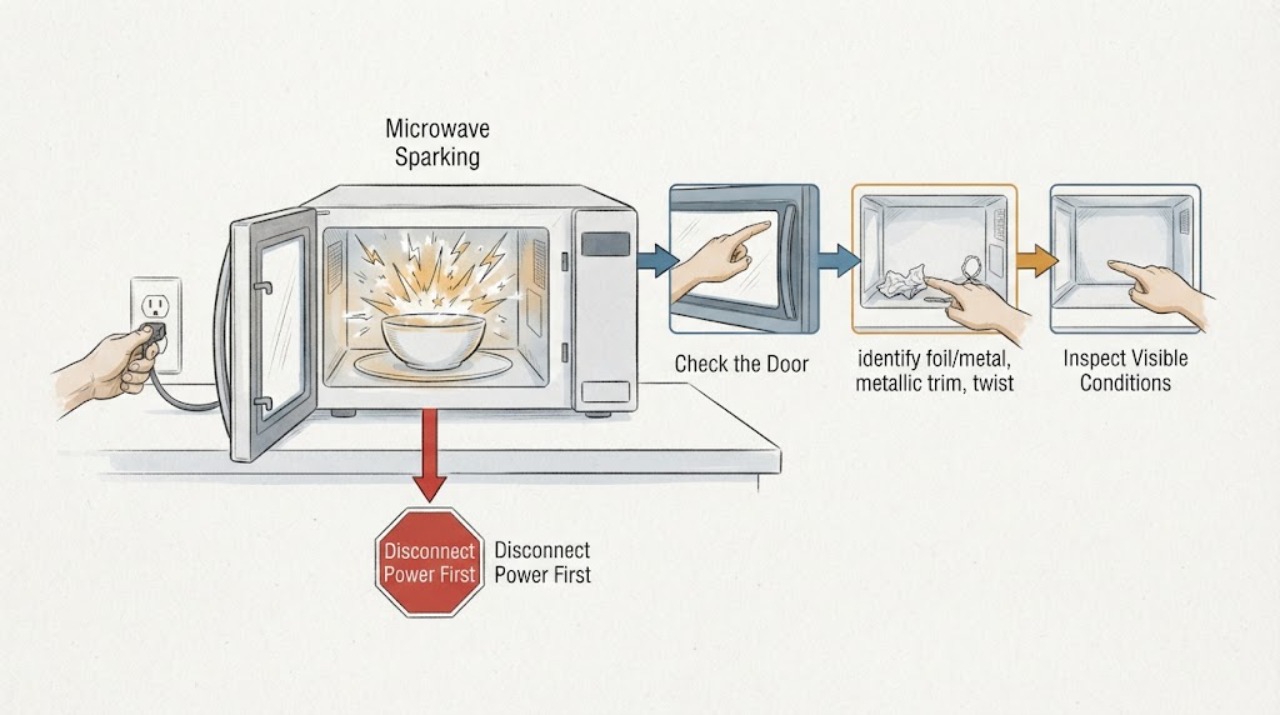
Work through in order
Diagnostic checks
Use only checks that match the exact appliance or system and its official guide.
-
Check 1
Stop the cycle and look for smoke, flame, scorch, cavity damage, or arcing that continues.
Expected result: Any is present.
Next step: Disconnect power only if safe, keep unused, and arrange qualified service/emergency help.
Stop if: Stop if there is a safety hazard or internal access would be required.
Why this matters
Why: This is a fire or safety boundary.
-
Check 2
After cooling, identify foil/metal, metallic trim, twist tie, or dense food with intact skin.
Expected result: Unsuitable metal/food is present or no clear cause exists.
Next step: Use microwave-safe cookware and food preparation; do not repeat if cavity is damaged.
Stop if: Stop if there is a safety hazard or internal access would be required.
Why this matters
Why: Whirlpool identifies food and cookware contributors; no cause leaves an oven fault more likely.
-
Check 3
With power off, wipe visible residue from cavity and door edge; do not remove covers or waveguide parts.
Expected result: Residue clears with no damage, or burned/peeling damage remains.
Next step: Leave unused if damaged and arrange service.
Stop if: Stop if there is a safety hazard or internal access would be required.
Why this matters
Why: Residue can cause a one-time event; cavity damage needs service.
-
Check 4
Do not conduct repeated empty tests; record model and spark location for service.
Expected result: Sparking recurs with safe cookware or oven operates abnormally.
Next step: Keep disconnected and obtain qualified microwave service.
Stop if: Stop if there is a safety hazard or internal access would be required.
Why this matters
Why: Recurrence points to an internal fault.
Use your observations
Decision map
Find the observation that best matches what you see, then follow the next safe action.
-
PATH 01Next step
What you see
Spark follows foil, metal trim, or unsuitable cookware
Do this next
Remove it and use microwave-safe cookware; stop if cavity marked.
Why this path and its safety boundary
Why it matters: The load may be the immediate cause.
-
PATH 02Next step
What you see
Spark repeats with safe cookware or appears inside cavity
Do this next
Stop use and arrange service.
Why this path and its safety boundary
Why it matters: Internal fault is possible.
-
PATH 03Next step
What you see
Smoke, flame, or door/cavity damage appears
Do this next
Disconnect if safe and seek professional help.
Why this path and its safety boundary
Why it matters: Continued operation is unsafe.
Helpful context
Understand the symptom
How to read the result
If a microwave sparks, stop the cycle and inspect the food and cookware only after the oven is off. A one-time spark from unsuitable metal, dirty cavity, or food with intact skin differs from repeated arcing, scorch marks, smoke, or damage. Whirlpool gives food/cookware prevention guidance; GE directs internal microwave faults to service.
When checks do not resolve it
Need a professional?
Arrange qualified microwave service for recurring sparks, cavity/door damage, smoke, or internal diagnosis.
Common questions
FAQ
Should I run it empty to test?
No. Do not perform repeated confirmation runs; service it if sparking recurs.
Can I repair the high-voltage section after unplugging?
No. GE warns the capacitor can retain high voltage after unplugging.
Read the exact guide
Official sources
- Foods that May Spark - Microwave - Product HelpWhirlpool · microwave food/cookware sparking
- Microwave - Runs But Does Not HeatGE Appliances · microwave internal repair boundary
Community feedback
Share a repair observation
Share a plain-text repair observation. Accepted observations are published automatically; this page may take a moment to update.