
On this page
Start here
Quick answer
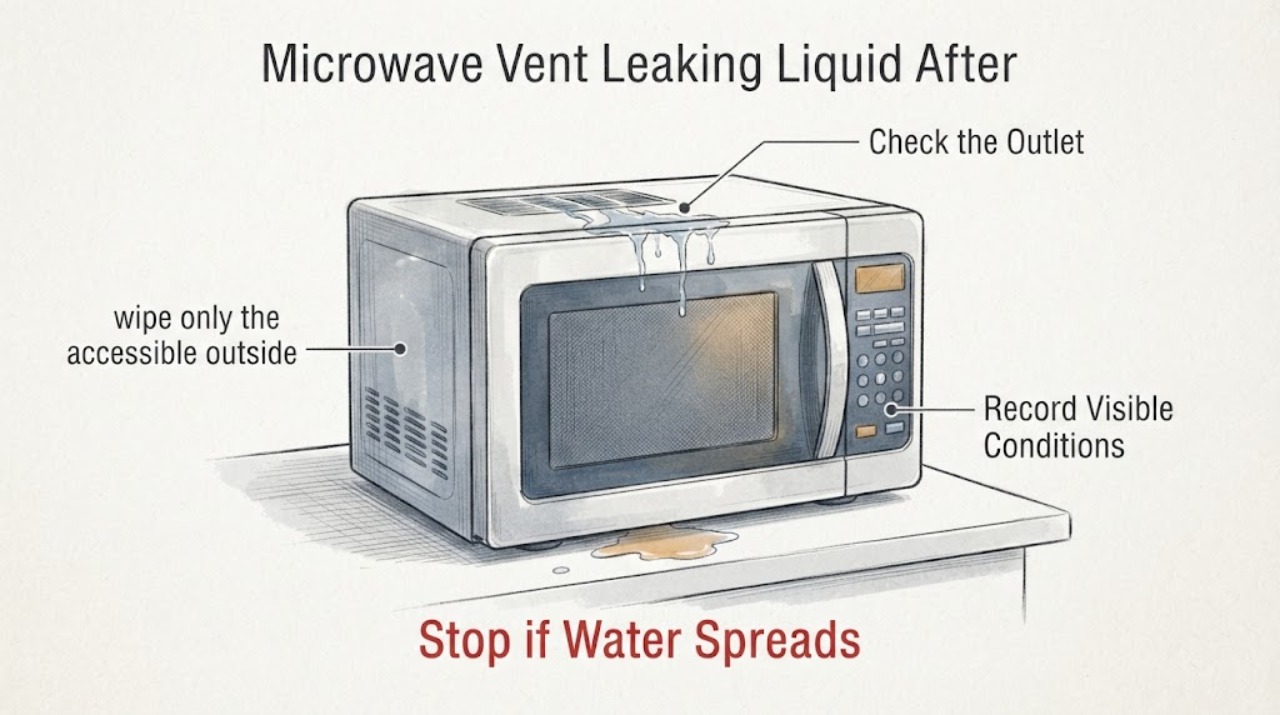
If liquid is coming from a microwave vent after the appliance has been unused, stop using it and disconnect power from a dry, safe location before trying to identify the source. Normal microwave condensation is associated with cooking steam, while liquid appearing after a week unused can also come from moisture entering an over-the-range duct or from a spill or leak above the appliance; the source cannot be identified through the vent. Wipe only accessible exterior surfaces, check whether the liquid returns after rain or cooktop use without running the microwave, and have an appliance technician inspect the microwave if liquid may have entered it. If the vent is ducted outdoors, a qualified building, HVAC or roofing professional may also need to inspect the visible duct route or exterior cap. Do not open the microwave cabinet, run a test cycle, pour water into the vents or use the appliance while it is wet.
Work through in order
Diagnostic checks
Use only checks that match the exact appliance or system and its official guide.
-
Check 1
Stop cooking and vent-fan use. From a dry, safe position, disconnect the microwave's power if the plug and outlet are dry and accessible; otherwise leave the area and have a qualified person isolate it. Keep hands, towels and cleaners out of the vent openings.
Expected result: The plug/outlet is dry and accessible, the outlet or cord is wet, or liquid is still entering the appliance.
Next step: Keep the microwave out of service. If the outlet, cord or wall area is wet, do not touch it; arrange safe electrical/appliance help. Do not restore power just to see whether the leak repeats.
Stop if: Stop immediately for smoke, burning odor, arcing, a hot/discolored cord, or liquid at the outlet or controls.
Why this matters
Why: A dry exterior does not show that the inside is dry. Water or other liquid at an electrical appliance changes this from a cleaning question to a safety and service question.
-
Check 2
After power is isolated and surfaces are safe to touch, wipe only the accessible outside of the microwave and the underside/visible cabinet area with a dry cloth. Note whether the liquid is oily, clear, dirty, or has food/chemical odor, and whether it is emerging from a grille, the cabinet above, the wall or the cooktop area. Do not remove panels or push a cloth into the vent.
Expected result: The moisture is only on an exterior surface, appears to come from above or the cabinet, or reappears at the grille/opening.
Next step: Photograph the location and keep the microwave off. Have an appliance technician assess possible internal contamination; if the visible route is an outdoor duct, also arrange qualified HVAC/building or roofing inspection without dismantling the microwave.
Why this matters
Why: An external spill or building/duct moisture path is different from liquid that has entered the microwave enclosure. Appearance alone cannot prove the source, but location and recurrence pattern help select the right professional.
-
Check 3
Without operating the microwave, record whether new moisture appears after rain, snow, a temperature change, or use of the cooktop below. If the unit is ducted outdoors, inspect only the accessible cabinet/hood area for a visibly open, damaged or dripping transition; do not climb, remove the microwave or probe the duct.
Expected result: Moisture correlates with precipitation or cold/warm air, with cooktop steam, or with neither; the visible duct/cabinet is dry or visibly wet.
Next step: Give the timing, weather and cooktop history to the appliance and building professional. Keep the appliance disconnected; do not run the fan or microwave to reproduce the event.
Why this matters
Why: Cooktop steam can condense around an over-the-range microwave, while weather-linked moisture raises a building/duct source that the microwave itself cannot diagnose. No visible moisture does not clear concealed ductwork or the microwave interior.
-
Check 4
Compare the observation with the official normal-moisture boundary: ordinary condensation occurs around cooking, especially with high-moisture foods, and should dissipate after the cooking event. Do not use this comparison to clear liquid that appears while unused or liquid that remains after drying.
Expected result: Moisture appears only after cooking and clears, or liquid appears while unused, persists, smells unusual or returns from a vent.
Next step: For persistent, idle-time or vent-origin liquid, keep the microwave off and arrange service. If it was a small exterior condensation film after cooking, wipe and dry accessible surfaces and improve cooktop ventilation without spraying into vents.
Why this matters
Why: The first pattern can be ordinary cooking condensation; the second exceeds the cited normal pattern and may involve an external source or liquid inside the appliance.
-
Check 5
Arrange a qualified microwave/appliance inspection before any further use if liquid may have entered a vent, grille, control area or internal cabinet. Provide photos, the appliance model label, liquid timing, weather/cooktop history and whether the unit was powered when the liquid appeared.
Expected result: A technician confirms the liquid was external and the appliance remained dry, or liquid entered the appliance or its source cannot be established.
Next step: Follow the technician's written safety disposition. Keep the microwave unplugged until the appliance professional clears it; repair the external water path before reconnecting a replacement or repaired unit.
Why this matters
Why: Only a qualified inspection can establish whether moisture reached electrical or high-voltage areas. A suspected roof/duct path may require a separate building/HVAC/roofing assessment; neither result justifies user cabinet disassembly.
Use your observations
Decision map
Find the observation that best matches what you see, then follow the next safe action.
-
PATH 01Next step
What you see
A small amount of moisture appears only after cooking or boiling on the cooktop and clears after the appliance dries.
Do this next
Wipe accessible surfaces, use cookware covers and the hood vent as appropriate, and do not spray liquid into vents. Arrange service if moisture persists or changes to liquid entering a grille.
Why this path and its safety boundary
Why it matters: This matches the general condensation behavior described by GE and Samsung more closely than an idle-time leak.
-
PATH 02Next step
What you see
Liquid appears while the microwave has been unused, after rain/temperature changes, or from an outdoor vent route.
Do this next
Keep the microwave unplugged and arrange qualified appliance plus building/HVAC/roofing inspection as the visible route requires. Do not run the microwave or vent fan to test it.
Why this path and its safety boundary
Why it matters: This is outside the cited normal cooking-condensation pattern and may involve moisture entering from above or through ductwork; the microwave cannot identify the building source.
-
PATH 03Next step
What you see
Liquid emerges from a grille, control area or internal seam, has an unusual odor, remains after drying, or the source cannot be located from outside.
Do this next
Do not reconnect or test it. Have a qualified microwave technician determine whether it can be safely repaired, and provide the exact model and photos.
Why this path and its safety boundary
Why it matters: The appliance may have internal contamination or an unresolved external path; the user cannot safely clear the high-voltage enclosure or verify insulation from the vent.
-
PATH 04Next step
What you see
There is smoke, burning odor, arcing, a wet/damaged cord or outlet, or liquid is still entering an energized appliance.
Do this next
Stay clear of the wet electrical area, seek emergency or qualified electrical help from a safe location and do not restore power or open the microwave.
Why this path and its safety boundary
Why it matters: This is an urgent electrical/fire stop rather than a condensation or vent-maintenance question.
Helpful context
Understand the symptom
Treat liquid from a vent as an external-source question first
A microwave can collect steam from cooking, but the opened GE guidance describes normal moisture in relation to cooking and says moisture should dissipate. Liquid that appears while the appliance has been idle should not be explained away as microwave condensation. The safe first decision is whether the liquid is on an accessible exterior surface, entering from above or a vent route, or likely inside the electrical enclosure; only the first category can be wiped by the user.
Do not turn the microwave on to locate the leak
Starting the microwave can spread liquid or energize a wet appliance. Samsung's cleaning guidance warns against getting liquid into vents and says to dry surfaces thoroughly. The microwave cabinet, high-voltage parts and duct transition are not user diagnostic areas; persistent liquid needs qualified appliance and, when applicable, building-vent inspection.
When checks do not resolve it
Need a professional?
Keep the microwave out of service and arrange qualified inspection when liquid appears while unused, comes from a vent or grille, persists after drying, has an unusual odor, or may have reached electrical components. Add building/HVAC/roofing inspection when the visible duct route or weather exposure is implicated.
Common questions
FAQ
Can a microwave leak liquid after sitting unused?
Liquid appearing while unused should not be assumed to be ordinary cooking condensation. The source could be an external spill, moisture entering a duct or liquid inside the appliance, and the microwave should remain off until the source and electrical safety are assessed.
Is moisture from an over-the-range microwave always a microwave failure?
No. GE and Samsung describe cooking steam and condensation as normal in some circumstances. That explanation applies to moisture associated with cooking that dissipates; it does not clear liquid that appears during idle time, enters a vent or persists.
Can I run the microwave briefly to find the leak?
No. Running it can spread liquid or energize a wet appliance. Disconnect power safely and document the location and timing from outside; have a qualified technician inspect any suspected internal entry.
Who should inspect an outside-vented microwave leak?
An appliance technician should assess the microwave itself. If the timing or visible route points to the duct, damper or exterior weather path, a qualified building, HVAC or roofing professional may also be needed. Do not dismantle or climb to the vent yourself.
Read the exact guide
Official sources
- Microwave - Normal Operational CharacteristicsGE Appliances · Used only to distinguish normal operating steam/fan context from an unexplained liquid event; it does not authorize operation of a wet microwave or internal repair.
- Microwave - Moisture or CondensationGE Appliances · Used for normal cooking-condensation comparison and the instruction to seek service when moisture does not dissipate; it does not identify an unknown liquid source for an unidentified model.
- How to clean your Samsung MicrowaveSamsung Electronics Philippines · Used for the external-cleaning boundary: do not get liquid into vents, apply cleaner to a cloth rather than spraying the surface, and dry surfaces thoroughly. It does not diagnose internal liquid entry.
- Condensation forms on Samsung microwave doorSamsung Electronics America · Used for general condensation boundaries only; it does not diagnose liquid entering a vent while a microwave is unused.
Community feedback
Share a repair observation
Share a plain-text repair observation. Accepted observations are published automatically; this page may take a moment to update.