
On this page
Start here
Quick answer
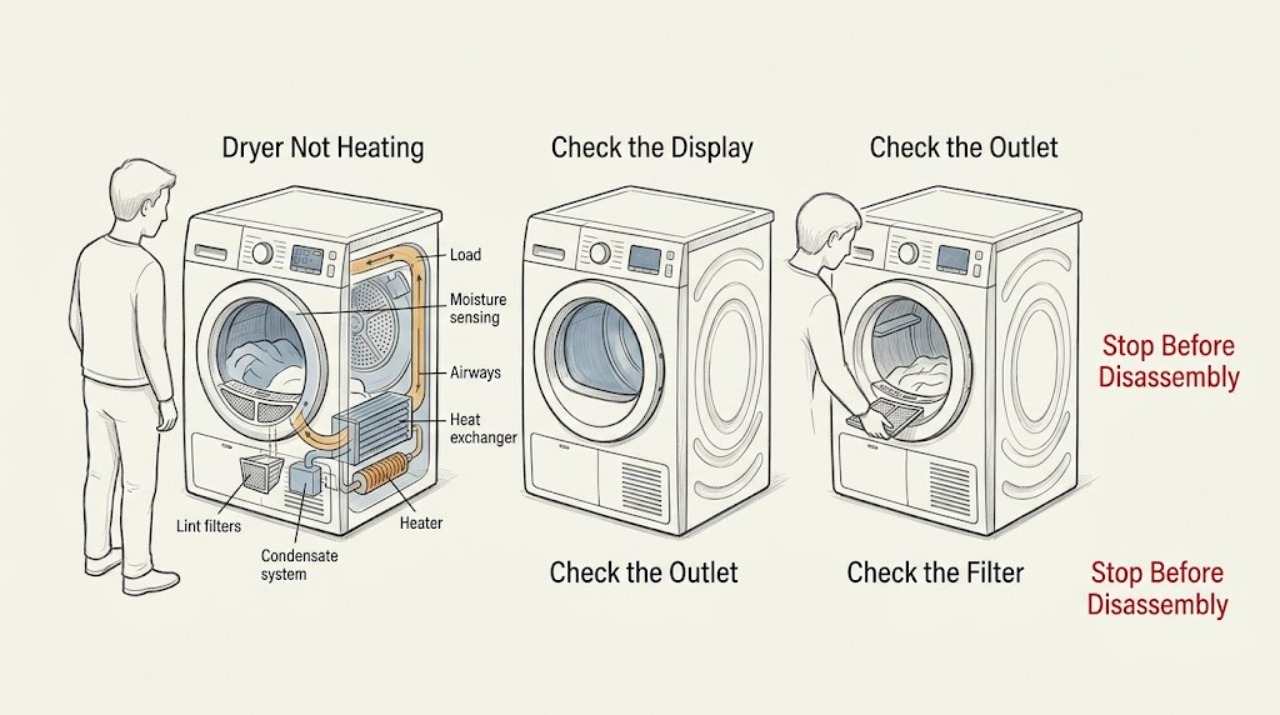
First separate a true no-heat symptom from a cycle or sensing result: record the selected program, load, whether the drum and airflow run, and whether the display shows Clean out airways, Empty out container, Cold air, Finish, or a fault. Stop using the dryer for smoke, a burning or electrical smell, sparks, unusual heat, a damaged cord, a breaker that trips again, or any unsafe condition. If it is cool, dry, and safe, try the exact Miele program for the fabric and load; mixed fabrics, a nearly empty drum, an already-dry load, or wet laundry entering the cycle can change or end the result without proving a failed heater. Clean and dry the door and plinth filters as the model guide specifies, keep the air intake clear, and inspect only accessible heat-exchanger surfaces without touching sharp fins. Empty a full condensate container and straighten a kinked drain hose. If cold air or a fault returns, the dryer still produces no heat after these checks, or an overheat condition is shown, stop and book Miele service rather than opening the cabinet or testing the heater live.
Work through in order
Diagnostic checks
Use only checks that match the exact appliance or system and its official guide.
-
Check 1
Before touching the dryer, look and listen from a safe position. Check for smoke, a burning or electrical smell, sparks, a hot or damaged cord or receptacle, unusual cabinet heat, a breaker that trips again, water near electrical parts, or a displayed overheat fault. If any is present, stop the dryer and do not restart it.
Expected result: There is an immediate fire, electrical, heat, or water warning; or the dryer is cool, dry, intact, and only the heating result is poor.
Next step: For smoke or fire, leave the area and use emergency help. For an electrical or water hazard, keep the dryer off and arrange qualified electrical or appliance service. Otherwise record the model, selected program, cycle behavior, and display message before continuing.
Why this matters
Why: Smoke, sparks, burning odor, abnormal heat, water near electrics, and repeat breaker trips are safety faults, not routine filter symptoms. A hazard-free dryer can proceed to limited program and external airflow checks.
-
Check 2
Run the symptom through the exact Miele program instructions without changing parts: note whether the drum turns, whether the cycle ends early, whether the air feels warm at the intended outlet or drum opening, and whether the load is mixed fabrics, nearly empty, already dry, or very wet from an insufficient wash spin. Do not keep repeating a cycle if the dryer becomes hot or shows a fault.
Expected result: The drum runs but the selected program ends early, a small or nearly empty load cancels, mixed fabrics remain damp, the load was very wet, or the dryer produces no warmth on a suitable program.
Next step: Use a program suited to the fabric and load; for an individual item, use the model's Time Dry option when the manual supports it. If the dryer remains cold with a valid load and program, continue with filter, intake, heat-exchanger, and condensate checks.
Why this matters
Why: Miele says different fabrics can produce an unsatisfactory result, and its load-sensing guidance says an empty, nearly empty, or already-dry drum can cancel some programs. These observations can mimic no heat. Persistent cold air on a suitable program points toward airflow, condensate, sensing, or heating diagnosis.
-
Check 3
Switch the dryer off and follow the exact model instructions to clean the accessible door lint filters and, where fitted, the plinth or toe-kick filter. Rinse only as directed, squeeze out water, and reinstall filters completely dry and in the correct orientation. Do not operate the dryer with a missing filter or open access panel.
Expected result: The filters are coated with lint, detergent residue, hair, or moisture; a filter is damaged or does not seat; or the filters are clean, dry, intact, and correctly installed.
Next step: If a filter is damaged, deformed, or will not seal, leave the dryer off and arrange the model-correct replacement or service; do not invent a substitute. If filters are clean and dry, continue to the airways and heat-exchanger inspection.
Why this matters
Why: Miele identifies soiled or wet filters as causes of operational and drying problems. A worn or damaged plinth filter can allow lint into the heat exchanger, while a dripping-wet filter can itself cause a fault. Clean filters do not rule out a heater or sensor fault.
-
Check 4
With the dryer off and cool, check the visible cool-air intake, under-door grille, and any model-approved air openings for a basket, lint, or other obstruction. If the model has a heat-exchanger access panel, inspect for visible lint without touching the cooling fins; use only the light vacuum-brush method described by Miele and do not bend or press the fins.
Expected result: An intake is blocked, lint is visible around the filter or heat exchanger, the cooling fins are bent or damaged, or the airflow path is clear.
Next step: Remove only loose external obstructions and clean accessible lint exactly as the manual permits. Do not touch fins, dismantle the heat exchanger, or probe a heater. If fins are damaged, the path is inaccessible, or no-heat persists after the safe cleaning, book Miele service.
Why this matters
Why: Miele lists a blocked cool-air intake, clogged filters, and heat-exchanger lint as causes of long or interrupted drying. It warns that damaged or bent fins prevent drying and that the fins can cut skin. A clear path with continuing no heat needs professional diagnosis.
-
Check 5
Check the moisture-removal path without opening the cabinet. If an Empty out container message or indicator is present, switch the dryer off normally, empty and reseat the condensate container, and inspect the visible drain hose for a kink. If water appeared after heat-exchanger cleaning, confirm only that the model's heat-exchanger and condenser-system lid are securely seated.
Expected result: The condensate container is full, the drain hose is kinked, the condenser lid is not seated, water leaks, or the container and visible drain path are normal.
Next step: Correct only the accessible container, hose, or lid condition according to the exact model instructions. If the message, leak, or poor drying persists, stop and arrange service; do not run the dryer with water near electrical parts or with an open access panel.
Why this matters
Why: A full container, kinked hose, or improperly closed condenser system can interrupt drying or cause water to escape. These conditions do not prove that the heater itself has failed, but unresolved drainage can leave the dryer unable to complete its moisture-removal process.
-
Check 6
Record every exact display message or light state, including Cold air, Finish, Clean out airways, a fault code, or a repeated cycle cancellation. After the dryer is cool, dry, and free of hazards, use only the single off/on restart or model-specific reset Miele documents; then try one suitable program. Do not repeatedly reset a fault or continue operation after an overheat indication.
Expected result: The message clears and one normal cycle heats and runs stably; the same Cold air or fault message returns; or an overheat message, smoke, burning odor, sparks, or breaker trip appears.
Next step: If the message or no-heat symptom returns, leave the dryer off and book Miele Service with the model, serial number, exact message, program, load, filter and condensate observations. For smoke, sparks, burning odor, abnormal heat, or a repeat breaker trip, stop immediately and use qualified emergency, electrical, or appliance help as appropriate.
Why this matters
Why: Miele treats a recurring Cold air or Finish cancellation as a fault requiring service, and identifies an overheat fault as technical rather than user-remediable. A single stable cycle after a documented transient message is different from a recurring no-heat condition.
Use your observations
Decision map
Find the observation that best matches what you see, then follow the next safe action.
-
PATH 01Next step
What you see
The dryer is cool, the drum runs, and the selected program ends early with a nearly empty, already-dry, mixed, or unusually wet load.
Do this next
Use the exact Miele program for the fabric and load; use a supported Time Dry option for individual items when appropriate. If a suitable load still receives no warmth, continue to airflow and heating service checks.
-
PATH 02Next step
What you see
Clean out airways appears, lint is visible, a filter is wet, or the cool-air intake is blocked.
Do this next
Switch off, clean and dry the model-approved filters, clear only visible intake obstructions, and inspect the heat exchanger with the manual's light vacuum-brush method. Do not touch fins or run without filters; arrange service if the message or no-heat condition remains.
-
PATH 03Next step
What you see
Empty out container appears, the condensate container is full, the visible drain hose is kinked, or water leaks after heat-exchanger cleaning.
Do this next
Switch off normally, empty and reseat the container, remove a visible hose kink, or reseat the model-approved condenser-system lid. If the message or leak persists, keep the dryer off and arrange service.
-
PATH 04Next step
What you see
Cold air or Finish flashes and the program cancels again after one documented off/on restart.
Do this next
Treat the recurrence as a fault and contact Miele Service. Do not keep restarting the dryer or open its cabinet to test the heater.
-
PATH 05Next step
What you see
An overheat message appears, the cabinet or laundry becomes unusually hot, or the dryer produces smoke, burning odor, sparks, or a repeat breaker trip.
Do this next
Stop immediately and leave the dryer off. Use emergency help for fire or smoke, and arrange qualified appliance or electrical service; do not bypass thermal protection or reset the breaker repeatedly.
-
PATH 06Next step
What you see
The program, dry filters, clear visible intake, and condensate path are all correct, but the dryer remains cold or a particular fault returns.
Do this next
Book Miele Service for diagnosis of the heater, heat-pump or refrigeration system, moisture sensor, control, fan, wiring, or other internal component. Do not perform live electrical tests or install an unverified part.
Helpful context
Understand the symptom
Confirm that the dryer is actually failing to heat
A Miele dryer can leave clothes damp because the selected program is unsuitable, the load is mixed or too small, moisture sensing ends the cycle, airflow is restricted, condensate cannot drain, or a heating or refrigeration component has failed. The useful first observation is whether the drum runs and whether the cycle produces any warmth, not just whether the laundry is still damp.
Miele models differ: some use a heat-pump or condenser arrangement with a plinth filter and heat exchanger, while other models and generations have different filter and vent layouts. Use the exact operating instructions for the model. Do not bypass thermal protection, open panels, touch cooling fins, or keep running a dryer that smells hot, smokes, sparks, or trips its breaker.
When checks do not resolve it
Need a professional?
Stop immediately for smoke, burning or electrical odor, sparks, unusual heat, a damaged cord, a repeat breaker trip, or water near electrical parts; use emergency, electrical, or appliance help as applicable., Book Miele Service when Cold air or a fault returns, an overheat fault appears, the dryer remains cold after the safe external checks, or a moisture-sensing fault persists., Arrange service for a damaged or deformed plinth filter, bent heat-exchanger fins, persistent condensate leaks, an inaccessible blocked airway, or any condition requiring cabinet or live electrical access., Do not operate the dryer without its filters or with an open heat-exchanger panel, and do not bypass a thermal, door, moisture, or control safety.
Common questions
FAQ
Why is my Miele dryer running but not heating?
First check that the program and load are appropriate, then clean and dry the model-approved lint and plinth filters, clear the visible air intake, and check the condensate path. If the drum runs but the dryer stays cold on a suitable cycle, or a fault returns, leave it off and arrange Miele Service rather than opening the cabinet.
Can a Miele dryer leave clothes damp without a failed heater?
Yes. Miele identifies mixed fabrics, a nearly empty or already-dry load, incorrect program selection, insufficient washing-machine spin, restricted airflow, and moisture-sensing behavior as possible reasons for a poor result or early ending. A suitable load and program that remain completely cold needs further diagnosis.
How do lint filters affect Miele dryer heat?
Soiled filters and lint around the heat exchanger can restrict airflow and extend or interrupt drying. Clean filters as the exact model guide directs, reinstall them completely dry and correctly seated, and do not run the dryer with a missing filter or open access panel.
What does Clean out airways mean on a Miele dryer?
It indicates a lint or residue buildup in the airflow path. Switch off, clean the accessible filters and visible lint, and check the model-approved intake and heat-exchanger area. Miele warns not to touch sharp cooling fins and not to damage or bend them; recurring messages need service.
Can a full condensate container make a Miele dryer stop drying?
A full container or kinked drain hose can interrupt moisture removal. Switch off normally, empty and reseat the container, and correct only a visible hose kink according to the model instructions. If the indicator or leak persists, stop and arrange service.
When should I stop testing a Miele dryer with no heat?
Stop immediately for smoke, burning or electrical odor, sparks, unusual heat, a damaged cord, water near electrical parts, an overheat fault, or a breaker that trips again. Also stop when Cold air or another fault returns after one documented restart, or when safe external checks do not restore heat.
Read the exact guide
Official sources
- Tumble dryer does not startMiele USA · Miele tumble dryers; exact electrical and door details vary by model
- Drying process goes on too long or switches offMiele USA · Miele tumble dryers; air-intake and filter layouts vary by model
- Empty out container indicator light lights upMiele USA · Miele condenser and heat-pump tumble dryers with a condensate container or connected drain hose
- Information Clean out airways/end of the programMiele USA · Miele tumble dryers with the described filter and heat-exchanger arrangement; exact model instructions apply
- Adjust the load and appear on the tumble dryer display. The program has been interrupted. The buzzer sounds.Miele USA · Miele tumble-dryer models that display the described load-adjustment message
- Dryer not drying correctlyMiele USA · Miele tumble dryers; exact program and residual-moisture options vary by model
- Water leaks after cleaning heat exchangerMiele USA · Miele tumble dryers with the described heat-exchanger and condenser system
- Fault F158Miele USA · Miele tumble-dryer models that display Fault F158; other overheat messages require their own model guidance
- Cold air or Finish flashesMiele USA · Miele tumble dryers displaying the described Cold air or Finish state
Community feedback
Share a repair observation
Share a plain-text repair observation. Accepted observations are published automatically; this page may take a moment to update.