
On this page
Start here
Quick answer
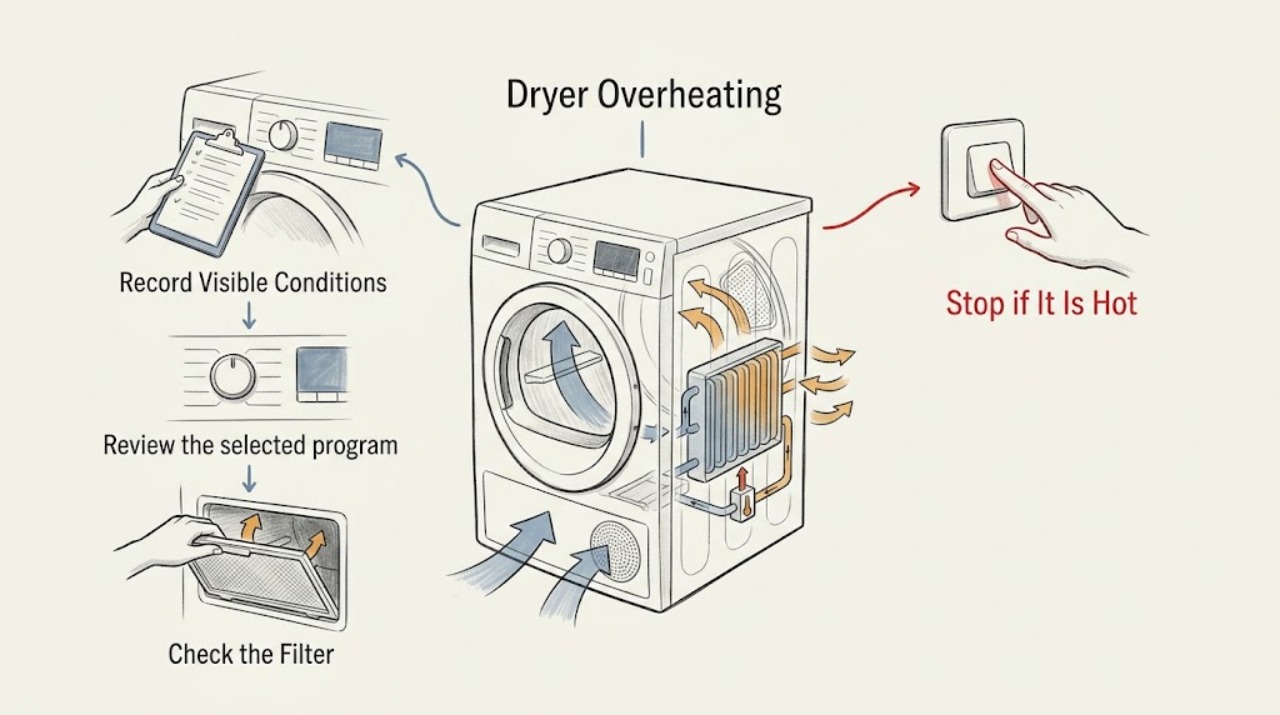
Stop the Miele dryer immediately if you smell burning, see smoke or sparks, find scorched fabric, feel abnormal heat at the outer cabinet, or a breaker trips. A rolling-bar display at the end of a cycle can simply be the normal cooling phase, but an appliance-overheated fault such as F158 is a technical fault that requires Miele service. Once the dryer is cool and isolated from power, record the model, program, load, display message and symptoms. Then make only the low-risk checks supported by the model instructions: reduce or redistribute the load, use a higher washer spin for very wet laundry, clean the lint filters and plinth filter, clean the heat exchanger without touching its sharp fins, keep all filters fully dry, and check the condensate container or accessible drain hose. If overheating returns after those checks, stop using the appliance and arrange professional repair.
Before you begin
Safety first
- Do not open the cabinet, probe live circuits, dismantle the heater or fan, bridge a thermal protector, defeat a door or safety interlock, or continue operating the dryer after a hazardous symptom.
Work through in order
Diagnostic checks
Use only checks that match the exact appliance or system and its official guide.
-
Check 1
Switch the dryer off, disconnect it using the normal isolation method once it is safe to do so, and let it cool. Record the exact model, program, load, display message, odor, smoke, fabric condition and whether the breaker tripped.
Expected result: Rolling bars at the end of a cycle may be a cooling indication. F158, smoke, sparks, a burning odor, scorched fabric, an abnormally hot outer cabinet or a tripped breaker is an abnormal result.
Next step: If any abnormal result is present, keep the appliance isolated and arrange service. If the only indication is rolling bars and the load is simply hot, continue with the external checks only after cooling.
Why this matters
Why: A normal cooling indication can be monitored without treating it as an overheat fault; any abnormal result means the dryer must remain out of service until the hazard is assessed.
-
Check 2
Review the selected program and load against the exact model instructions. Remove excess items, untangle a tightly rolled load, and compare sensor drying with a timed program. If the laundry entered unusually wet, use a higher spin setting on the washer for a later load when suitable.
Expected result: A load that is too full, very damp, or poorly distributed takes longer to dry; Miele associates these conditions and dirty filters with F55 or poor drying behavior.
Next step: Use the model's stated load limits and fabric/program guidance. Escalate if the dryer overheats with a small suitable load or if the fault returns.
Why this matters
Why: If a smaller, evenly distributed load dries normally, the first issue was load moisture or program selection rather than proof of a failed heater. If heat remains excessive with a normal load, continue to the airflow checks and do not keep running test cycles.
-
Check 3
With the dryer cool and isolated, remove and clean the lint filters and the plinth filter as directed for the model. Inspect the filter surfaces for damage, reinstall them only when completely dry, and clean the heat exchanger lightly if the model instructions permit it. Do not touch the cooling fins or use force or a pressure stream.
Expected result: Visible lint, a blocked filter, a damaged or worn plinth filter, or a dirty heat exchanger can restrict airflow. A filter that is still wet after cleaning is not ready to reinstall.
Next step: Replace a damaged filter with a model-confirmed part and arrange service if the filters and heat exchanger are clear but the dryer still overheats. Never remove the outer panels for this check.
Why this matters
Why: Clearing the documented air path can reduce drying time and heat load. Damage, persistent blockage, sharp-fin contact risk or a clean air path with continued overheating points beyond routine maintenance.
-
Check 4
Check the external installation conditions: keep the air intake and under-door grille unobstructed, allow the room to ventilate as the model instructions require, and look only at the accessible condensate container or drain hose. Empty and reseat a full container; correct an obvious accessible hose kink without opening the machine.
Expected result: Miele links dashes and longer drying behavior with insufficient ventilation or an obstructed air path. A full condensate container or kinked drain hose can trigger its indicator and interrupt operation.
Next step: Run no further cycle if the dryer overheats again. Leave internal ducting, fans, sensors, heaters and wiring to a qualified technician.
Why this matters
Why: Restored external airflow or condensate drainage may remove a contributing condition. A clear installation with abnormal cabinet heat, repeated faults or no improvement needs service rather than more testing.
-
Check 5
After the dryer is cool, the safe external checks are complete, and there was no immediate hazard, perform at most the single model-specific reset allowed by the instructions. Observe whether the same fault or heat symptom returns; do not repeatedly restart the machine.
Expected result: F158 means the appliance overheated and Miele states that this technical fault cannot be remedied by the user. A recurring overheat symptom, even without a code, is not a successful reset.
Next step: Stop using the dryer and provide the technician with the model, exact code, program, load, cleaning performed and the time the heat or odor appeared. Do not dismantle or defeat safety components.
Why this matters
Why: A persistent or repeated fault can involve a thermal safety device, temperature or moisture sensing, fan, heater control or another internal condition that needs diagnosis.
Use your observations
Decision map
Find the observation that best matches what you see, then follow the next safe action.
-
PATH 01Next step
What you see
The display shows rolling bars only at the end of a cycle, with no smoke, burning odor, scorching, abnormal cabinet heat or electrical trip.
Do this next
Allow the load to cool and spread it out. Check airflow and installation only if drying is also taking too long.
Why this path and its safety boundary
Why it matters: This can be the normal cooling phase, which may be prolonged by installation or room conditions.
-
PATH 02Next step
What you see
The dryer is repeatedly overloaded, the load is extremely wet, or the result changes when the load is reduced and the washer spin is higher.
Do this next
Follow the exact model load and program guidance. If a suitable smaller load still overheats, stop and arrange service.
Why this path and its safety boundary
Why it matters: Load size and retained moisture can prolong the cycle and increase heat demand.
-
PATH 03Next step
What you see
Lint filters, the plinth filter, heat exchanger or an external grille are dirty or obstructed.
Do this next
Clean only the accessible parts as the model instructions describe, dry filters fully, and escalate if the path is clear but overheating continues.
Why this path and its safety boundary
Why it matters: Restricted airflow is a supported explanation for clean-airways prompts, dashes and poor drying.
-
PATH 04Next step
What you see
The condensate indicator is lit or the container is full, or an accessible drain hose is kinked.
Do this next
Switch off, empty and reseat the container or correct the accessible kink. Persistent indication or any overheating requires service.
Why this path and its safety boundary
Why it matters: Condensate collection or drainage may be interrupting the cycle and should be corrected externally.
-
PATH 05Next step
What you see
F158 appears, or the dryer overheats again after the external airflow, load and condensate checks.
Do this next
Keep the dryer isolated and book qualified Miele service. Supply the exact model and fault details.
Why this path and its safety boundary
Why it matters: This is beyond routine user maintenance; F158 is identified by Miele as a technical fault after appliance overheating.
-
PATH 06Next step
What you see
There is smoke, a burning or electrical odor, visible arcing, scorched fabric, an unusually hot outer cabinet, water near electrical parts or a breaker trip.
Do this next
Stop the cycle, isolate power only if it can be done without approaching danger, leave the area if needed, and obtain emergency or qualified professional help. Do not restart the dryer.
Why this path and its safety boundary
Why it matters: Treat this as an immediate fire, electrical or appliance-safety hazard rather than a cleaning problem.
Helpful context
Understand the symptom
First distinguish cooling from overheating
Miele dryers can show rolling bars while the load is being cooled after a program. That indication may last longer in unfavorable installation or room-temperature conditions, and laundry can still be hot enough to spread out for cooling. It does not explain smoke, a burning odor, scorched textiles, an unusually hot outer cabinet, or a recurring fault. Isolate the dryer and let it cool before inspecting it.
Why airflow and moisture matter
Lint on the lint filters, a blocked plinth filter or heat exchanger, an obstructed air path, an overfull or very wet load, and poor room ventilation can make drying take longer and can raise internal heat. Condensate handling also matters: a full container or kinked accessible drain hose can interrupt operation. Cleaning and reset steps remain model-dependent, so use the instructions for the exact Miele model and do not open the cabinet.
A safe service boundary
F158 is not a user-remedied fault in Miele's support guidance. Repeated overheating after the external checks can indicate a fan, sensor, thermal limiter or control problem. Do not bridge a thermal device, defeat an interlock, probe live wiring, dismantle the heater or keep testing an appliance that has produced smoke, sparks or a burning smell.
Safety boundary
Stop conditions
- Burning, electrical or gas-like odor; smoke; visible sparks or arcing
- Scorched fabric, melting, or an outer cabinet that is abnormally hot
- Water approaching electrical parts or a repeated breaker trip
- F158 or recurrent overheating after external checks
- Any need to open the cabinet or work on live, heated or safety-critical components
Only after diagnosis
Potential parts
- plinth filter
Consider this only when the existing plinth filter is damaged or worn and the exact model instructions identify replacement as appropriate.
Confirm the full Miele model and fit information before ordering any part. - temperature or moisture sensor
Consider this only after airflow, load, condensate and installation checks are clear and a qualified diagnosis identifies a sensing fault.
Do not infer compatibility from appearance; have a qualified technician confirm the model-specific part. - fan or thermal safety component
Consider this only when a technician finds an internal airflow or thermal protection fault after external maintenance is complete.
Internal safety components require model-specific diagnosis and qualified installation.
When checks do not resolve it
Need a professional?
Call for qualified Miele appliance service for F158, recurring overheating, smoke, burning or electrical odor, sparks, scorched textiles, abnormal cabinet heat, a repeated breaker trip, or no improvement after the safe external checks.
Safety scope: Do not open the cabinet, probe live circuits, dismantle the heater or fan, bridge a thermal protector, defeat a door or safety interlock, or continue operating the dryer after a hazardous symptom.
Common questions
FAQ
Are rolling bars on a Miele dryer proof that it is overheating?
Not by themselves. Miele describes rolling bars at the end of a program as the cooling phase. Treat smoke, burning odor, scorching, abnormal outer-cabinet heat, sparks, a breaker trip or F158 as abnormal and stop using the dryer.
Can dirty filters make a Miele dryer run hot?
Restricted airflow from lint filters, the plinth filter, the heat exchanger or an obstructed grille can contribute to poor drying and interrupted programs. Clean only the accessible parts described for the exact model, reinstall filters fully dry, and do not touch sharp heat-exchanger fins.
What does F158 mean on a Miele dryer?
Miele identifies F158 as an appliance-overheated technical fault that cannot be remedied by the user. Keep the dryer isolated and arrange qualified Miele service rather than repeatedly resetting it.
What should I do if the dryer overheats again after cleaning?
Stop using it and give the service technician the model, display code, program, load, cleaning checks and exact symptoms. Do not open the cabinet or work on the heater, fan, sensors, wiring or thermal safety components yourself.
Read the exact guide
Official sources
- Rolling bars in displayMiele USA · Miele tumble dryer cooling-phase display
- Information: Clean out airways/end of the programMiele USA · Miele tumble dryer airflow and filter maintenance
- Dashes in the displayMiele USA · Miele tumble dryer display and ventilation support
- Empty out container indicator light lights upMiele USA · Miele tumble dryer condensate container and drain support
- Tumble dryer supportMiele USA · Miele tumble dryer support index and model-specific troubleshooting
- Fault F55Miele USA · Miele tumble dryer load, moisture and filter fault support
- Fault F158Miele USA · Miele tumble dryer fault support
Community feedback
Share a repair observation
Share a plain-text repair observation. Accepted observations are published automatically; this page may take a moment to update.