
On this page
Start here
Quick answer
A thick layer of frost or ice in a Miele freezer most often means that warm, moist air is entering or that the freezer is not completing its intended defrosting and cooling cycle. Start by checking that drawers and food are not preventing the door from closing, then inspect the door seal from the outside for a gap, damage, or a section out of its groove. Miele advises defrosting and cleaning a freezer with a thick ice layer, but the exact model manual controls the method. Do not chip ice, use a hair dryer or other heater, open sealed refrigeration components, or keep using the appliance if there is a burning smell, arcing, a hot plug, repeated breaker activity, a refrigerant-like hiss or odor, or food has become unsafe. If frost returns quickly after a correct defrost and a sound door seal, arrange Miele or qualified refrigeration service.
Before you begin
Safety first
- This article supports exterior inspection, safe loading checks, documentation, and only the model-approved defrost and cleaning procedure. Do not use heat or sharp tools, open sealed refrigeration or electrical parts, handle refrigerant, or continue operating with safety warning signs.
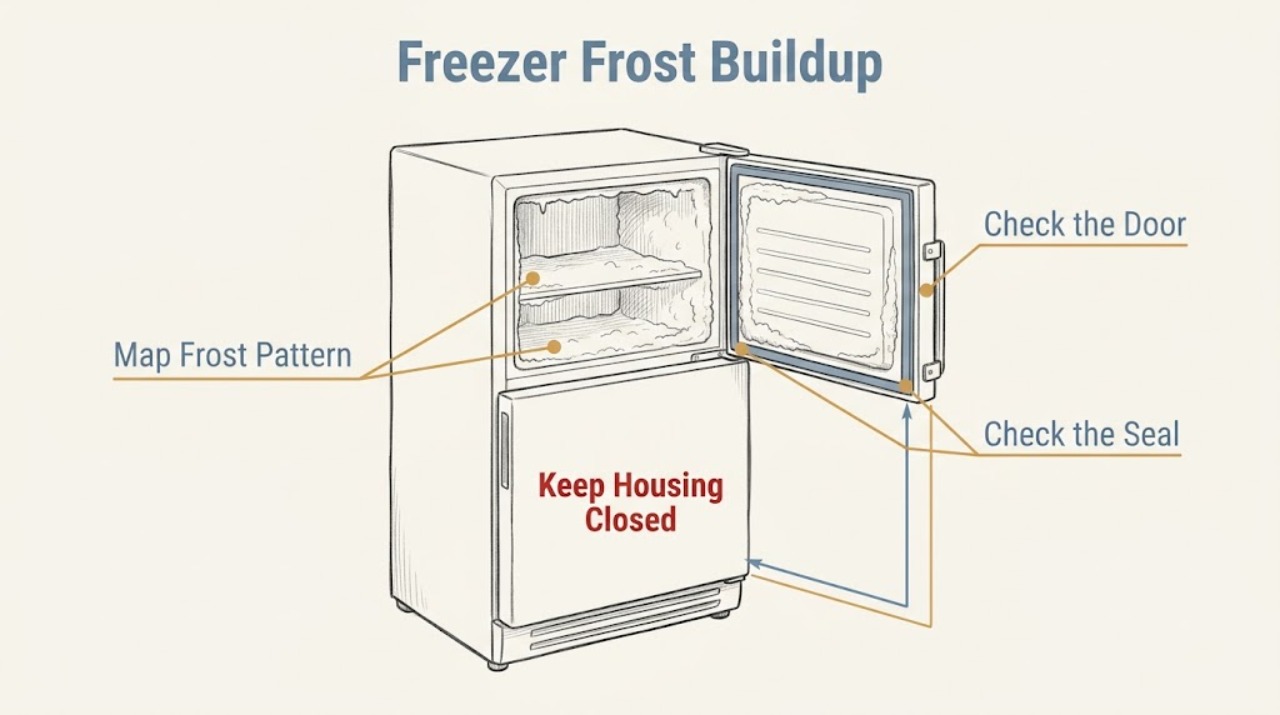
Work through in order
Diagnostic checks
Use only checks that match the exact appliance or system and its official guide.
-
Check 1
Without scraping the ice or removing interior panels, photograph and describe where the frost is building: around the door opening, on one wall, over the rear panel, around a drawer, or throughout the compartment.
Expected result: Record whether the layer is thin or thick, whether it blocks a drawer or vent, whether frost is concentrated near the door edge, and whether it returns after a recent defrost.
Next step: Keep the freezer door closed while gathering the next observations and locate the exact Miele model manual before defrosting or removing any part.
Stop if: Stop if the interior liner is cracked, a tube or coil is exposed, frost must be chipped to access food, or an unusual hiss, odor, smoke, heat, or electrical symptom is present.
Why this matters
Why: Frost at the opening or near a drawer supports a door-sealing or warm-air entry check. Frost that covers an interior panel, returns quickly, or is paired with poor cooling needs model-specific defrost or refrigeration diagnosis rather than more scraping.
-
Check 2
With the door open only as long as needed, check that drawers are fully seated, packages do not project into the gasket path, shelves are not displaced, and the door can close without force; do not force a door against a thick ice layer.
Expected result: Classify the door as closing flat and fully, touching an item or drawer, held open by ice, or unable to close because the hinge or cabinet alignment is abnormal.
Next step: Remove only the accessible obstruction, close the door, and monitor whether the frost stops increasing; use the exact model instructions for safe defrosting if ice itself prevents closure.
Stop if: Do not force the door, pry ice from the frame, bend hinges, or continue operating with a door that cannot seal.
Why this matters
Why: An obstruction or ice preventing closure can let warm air in and sustain frost. A door that cannot close with the compartment clear points to a seal, hinge, installation, or alignment issue rather than a food-loading adjustment.
-
Check 3
After the frost is safely cleared only as the Miele manual permits, inspect the entire visible door seal and its groove with the door open; clean and dry it only by the approved care method, without pulling the magnetic strip.
Expected result: Look for a seal out of its groove, a split or flattened section, a bulge, dirt on the mating surfaces, or a section that does not lie flat against the housing when the door closes.
Next step: If the seal is merely out of its groove and the manual permits repositioning, restore it gently without stretching; arrange Miele service for a damaged seal, hinge, or door that remains misaligned.
Stop if: Do not pull the magnetic strip, use grease or oil, glue the seal, stretch it into place, or keep using the freezer if the door still has a visible gap.
Why this matters
Why: Miele identifies a seal out of its groove or a damaged seal as a cause of ice or condensation and says the seal should lie flat when the door is closed. A seal that is damaged or will not seat evenly can keep admitting moist air.
-
Check 4
Check from outside that the appliance's required ventilation openings are not blocked and that food is arranged so the door closes and the model's airflow paths are not packed solid; use the installation and operating instructions for built-in clearance requirements.
Expected result: Record blocked vents, a very warm installation location, direct heat nearby, overpacked drawers, or a cabinet front or door arrangement that prevents a tight closure.
Next step: Restore only the clearances and loading arrangement specified by the manual; if the cabinet, hinge, or installation prevents sealing, stop and arrange qualified service or an installer assessment.
Stop if: Do not move a built-in appliance, alter cabinet panels, block or remove ventilation parts, or work near the power cord while the appliance is energized.
Why this matters
Why: Blocked ventilation, heat, overloading, or an installation gap can increase cooling demand or prevent the door from sealing. Miele notes that an incorrect built-in position or cabinet front can prevent tight closure and increase condensation.
-
Check 5
If the door is clear and the manual identifies the freezer as requiring manual defrosting, transfer or protect food, isolate power as directed by the manual, and let the ice melt using only the approved method; collect water without allowing it near electrical parts.
Expected result: Record whether the ice melts normally, whether the liner or drain area is damaged, whether water reaches an unexpected place, and whether the freezer can be cleaned and reassembled without tools or force.
Next step: Clean and restart only according to the Miele manual, then monitor temperature and frost recurrence; provide the model and before/after photos to Miele service if the frost returns.
Stop if: Never use a hair dryer, heat gun, heater, knife, screwdriver, or boiling water; stop for a damaged liner, exposed coil, refrigerant-like hiss or odor, electrical contact with water, smoke, or heat.
Why this matters
Why: A safe, complete defrost followed by a properly sealed door supports an air-entry explanation. Ice that will not release safely, returns quickly, or accompanies a damaged liner or abnormal water path needs service; it does not justify heat or sharp tools.
-
Check 6
Keep the freezer door closed while it is warming or being serviced, and after a permitted restart use the appliance's temperature display or a suitable appliance thermometer to record whether it returns to the model's specified frozen-food temperature.
Expected result: Record whether food still has ice crystals, whether the temperature is at or below the model's specified setting, whether an alarm appears, and whether the frost or temperature problem returns after the door-seal correction.
Next step: Apply FoodSafety.gov's item-by-item guidance for thawed food and arrange Miele or qualified refrigeration service for an appliance that cannot maintain temperature or quickly frosts again.
Stop if: Do not taste questionable food, repeatedly cycle power, or continue operation when the plug or cabinet is hot, there is a burning smell, arcing, a breaker trip, or a refrigerant-related concern.
Why this matters
Why: A stable cold temperature with no recurring frost supports a resolved air-leak or defrost-maintenance issue. Food that has thawed, a temperature that does not recover, repeated alarms, or rapidly returning frost indicates a continuing cooling, defrost, seal, or control fault.
Use your observations
Decision map
Find the observation that best matches what you see, then follow the next safe action.
-
PATH 01Safety boundary
What you see
A drawer, package, shelf, or ice layer prevents the freezer door from closing fully.
Do this next
Remove only the accessible obstruction and follow the exact Miele manual for safe defrosting if ice prevents closure, then monitor recurrence.
Why this path and its safety boundary
Why it matters: Warm moist air can enter through the open gap and build frost; the freezer is not yet shown to have an internal cooling fault.
Safety stop: Do not force the door or chip ice from the frame; arrange service if the door still cannot close flat.
-
PATH 02Safety boundary
What you see
The visible seal is out of its groove but is intact and the door can be restored without pulling or stretching it.
Do this next
Reposition it only as the model manual allows, ensure it lies flat, close the door, and monitor the frost and temperature.
Why this path and its safety boundary
Why it matters: Miele identifies a seal out of its groove as a cause of ice or condensation because the door may not seal correctly.
Safety stop: Stop if the seal tears, bulges, remains loose, or the door has a gap; do not glue, oil, or stretch it.
-
PATH 03Safety boundary
What you see
The seal is split, flattened, damaged, or still leaves a gap, or a hinge, cabinet front, or installation prevents tight closure.
Do this next
Keep the door closed and arrange Miele or qualified appliance service; provide photos and the exact model rather than ordering an unverified seal.
Why this path and its safety boundary
Why it matters: The freezer can continue admitting warm air, so repeated defrosting will not correct the underlying sealing or installation problem.
Safety stop: Do not use oil or adhesive, bend the hinge, move a built-in unit, or operate with a door that cannot seal.
-
PATH 04Safety boundary
What you see
The freezer is defrosted by the model-approved method, the door seals flat, the temperature recovers, and frost does not quickly return.
Do this next
Keep the door closed as much as practical, do not block the model's vents, and monitor the temperature and frost pattern during normal use.
Why this path and its safety boundary
Why it matters: The evidence supports an air-entry, loading, or maintenance cause rather than an established sealed-system failure.
Safety stop: Arrange service if frost returns quickly, cooling is weak, alarms recur, or any electrical or sealed-system warning appears.
-
PATH 05Safety boundary
What you see
Frost returns soon after a correct defrost and a sound, fully closed door, or the freezer cannot maintain its specified temperature.
Do this next
Stop repeated defrost experiments and arrange Miele or qualified refrigeration service with the model, temperature history, frost photos, and door-seal findings.
Why this path and its safety boundary
Why it matters: A continuing defrost, airflow, sensor, fan, control, or sealed refrigeration issue remains possible and cannot be identified safely from frost alone.
Safety stop: Do not open refrigeration panels, handle refrigerant or sealed tubing, bypass a defrost control, or keep operating if food safety or electrical symptoms are present.
-
PATH 06Safety boundary
What you see
Food has thawed, the freezer has been without power, or there is a hot plug, burn mark, arcing sound, smoke, odor, repeated breaker trip, or water near electrical parts.
Do this next
Keep the door closed, use FoodSafety.gov's item-by-item frozen-food guidance, and disconnect or leave the appliance de-energized as safe while arranging qualified service for electrical symptoms.
Why this path and its safety boundary
Why it matters: Food-safety and electrical risks take priority over frost diagnosis.
Safety stop: Never taste questionable food, repeatedly reset a breaker, use a heater to defrost, or operate an appliance that is hot, arcing, smoking, or has damaged wiring.
Helpful context
Understand the symptom
Frost is usually an air-sealing or defrost clue
A small amount of frost may be different from a thick layer that blocks a drawer, covers an interior panel, or returns soon after defrosting. Warm humid air can enter when the freezer door is held open, obstructed by a drawer or package, or not pulled closed by a flat seal. Miele's support guidance specifically connects ice deposits with a seal out of its groove or a damaged seal, and connects a thicker freezer ice layer with a door that was not closed properly.
Defrost only by the model-approved method
Before any cleaning or manual defrost, follow the Miele operating instructions for the exact model and protect the frozen food. Do not use a knife, screwdriver, boiling water, hair dryer, heat gun, or other heating appliance to accelerate melting. A punctured evaporator or damaged liner can turn a frost complaint into a sealed-system repair, and water must not reach energized components. If the frost cannot be removed safely under the manual's procedure, stop and request service.
Food and electrical symptoms change the decision
Keep the freezer closed as much as possible while deciding what to do with food. FoodSafety.gov says a full freezer can hold a safe temperature for about 48 hours, or about 24 hours when half full, if the door remains closed; food that still has ice crystals or is at or below 40°F (4°C) may be refrozen, but food safety should be judged item by item and never by tasting. Separately, a hot plug, burn mark, arcing sound, or repeated breaker trip is an electrical stop, not a frost-cleaning task.
Safety boundary
Stop conditions
- Do not chip, stab, scrape, or pry frost or ice with a knife, screwdriver, or other tool; do not puncture the liner, evaporator, or tubing.
- Do not use a hair dryer, heat gun, heater, boiling water, or another heating appliance to accelerate defrosting; use only the exact Miele manual's method.
- Do not open sealed refrigeration parts, handle refrigerant, bypass a defrost control, or improvise a fan, sensor, compressor, or wiring repair.
- Stop for a damaged liner, exposed coil, refrigerant-like hiss or odor, water near electrical parts, smoke, burning smell, hot plug, burn mark, arcing, or a repeated breaker trip.
- Do not keep operating with a door that cannot seal, and do not taste thawed or questionable food to decide whether it is safe.
Only after diagnosis
Potential parts
- Miele freezer door seal
Consider this category only when inspection confirms that the exact model's seal is damaged and Miele service or the model instructions support replacement.
Confirm the exact Miele model and seal design before ordering; do not use adhesive, oil, or a generic seal to compensate for a fit problem. - Miele freezer drawer or door hardware
Consider this category only when a qualified diagnosis finds damaged hardware that prevents the door or drawer from closing and causing warm-air entry.
Confirm the exact model, installation type, and manufacturer procedure; built-in alignment and hinge work may require qualified service. - Miele defrost or temperature-control component
Consider this category only after a sound door seal, correct defrost, and loading checks fail and a qualified technician identifies a defrost, sensor, fan, or control fault.
Do not select or install a control or sealed-system part by symptom alone; verify the exact model and technician diagnosis.
When checks do not resolve it
Need a professional?
Arrange Miele or qualified refrigeration service when the door or seal remains misaligned or damaged, frost returns quickly after a correct defrost, the freezer cannot recover or maintain its specified temperature, an alarm repeats, the interior liner or tubing is damaged, or the cause may involve a fan, sensor, defrost circuit, compressor, or sealed refrigeration system. Use a qualified electrical technician for a hot plug, burn mark, arcing, smoke, damaged cord, or repeated breaker activity.
Safety scope: This article supports exterior inspection, safe loading checks, documentation, and only the model-approved defrost and cleaning procedure. Do not use heat or sharp tools, open sealed refrigeration or electrical parts, handle refrigerant, or continue operating with safety warning signs.
Common questions
FAQ
Why is my Miele freezer building up frost?
Start with warm-air entry: a drawer or package may prevent closure, the seal may be out of its groove or damaged, or a built-in door alignment may leave a gap. A thick layer that returns quickly after a correct defrost can indicate a continuing defrost, airflow, control, or refrigeration issue.
Can I chip the ice out of a Miele freezer?
No. Do not use a knife, screwdriver, or other sharp tool, and do not puncture the liner or tubing. Use only the exact Miele manual's defrost method; do not use a hair dryer, heater, heat gun, or boiling water.
How do I check the Miele freezer door seal?
Check the visible seal for a section out of its groove, damage, bulging, or a gap when the door closes. Miele says not to pull the magnetic strip and says the seal should lie flat against the housing. Arrange service for a damaged seal or a door that will not close flat.
Is some frost in a freezer normal?
The answer depends on the exact Miele model and whether it is designed to be frost free. A thick layer that blocks drawers, prevents closure, reduces cooling, or returns quickly is not a reason to keep scraping; follow the model manual and arrange service when it recurs.
What should I do with food if the freezer warmed while I defrosted it?
Keep the door closed as much as possible and assess each food item using FoodSafety.gov guidance. Food that still has ice crystals or is at or below 40°F (4°C) may be refrozen, depending on the item; never taste questionable food to decide whether it is safe.
When does freezer frost require a technician?
Call Miele or a qualified refrigeration technician when the seal or door is damaged, frost returns quickly after a correct defrost, the freezer cannot maintain temperature, an alarm repeats, or the issue may involve a fan, defrost system, sensor, compressor, or sealed refrigeration circuit. Use qualified electrical service for heat, burn marks, arcing, smoke, or breaker trips.
Read the exact guide
Official sources
- Electrical Safety Advice for Fridges and Freezers/ Fridge and Freezer SafetyElectrical Safety First · Consumer safety guidance for fridges and freezers; model-specific manufacturer instructions control appliance operation and defrosting.
- Condensation forming on freezer compartmentMiele USA · Miele refrigeration support guidance for excessive freezer-compartment condensation; built-in installation changes should follow the model installation instructions.
- Ice deposits in refrigeration applianceMiele USA · Miele refrigeration support guidance for ice or condensation deposits; replacement and care must follow the exact model instructions.
- Thicker ice layer in freezer sectionMiele USA · Miele refrigeration support guidance for a thicker ice layer in the freezer section; the exact model manual controls the defrost procedure.
- Food Safety During Power OutageFoodSafety.gov · U.S. government food-safety chart for frozen food during a power outage; it is a food-disposition guide, not a freezer repair procedure.
Community feedback
Share a repair observation
Share a plain-text repair observation. Accepted observations are published automatically; this page may take a moment to update.