
On this page
Start here
Quick answer
When a Miele freezer is not cooling, first confirm that the freezer zone is switched on and the appliance is receiving power, then check the displayed temperature, door closure, loading, ventilation, and frost pattern. Miele lists a switched-off zone, a disconnected plug, a tripped breaker, demo mode, an incorrect temperature setting, low ambient temperature, frequent door opening, a large fresh-food load, and an improperly closed door among possible explanations depending on model. Keep the door closed while checking food safety, and follow the exact model manual for any defrost procedure. Do not remove interior panels, puncture tubing, handle refrigerant, repeatedly reset a breaker, or use the freezer if there is a hot plug, burn mark, arcing, smoke, or a damaged cord. If power and door checks do not restore cooling, or frost returns after an approved defrost, arrange Miele or qualified refrigeration service.
Before you begin
Safety first
- This article supports normal-control checks, exterior observation, safe loading, documentation, and only the model-approved defrost procedure. Do not open electrical or refrigeration enclosures, handle refrigerant, puncture tubing, use heat or sharp tools, or continue operation with safety warning signs.
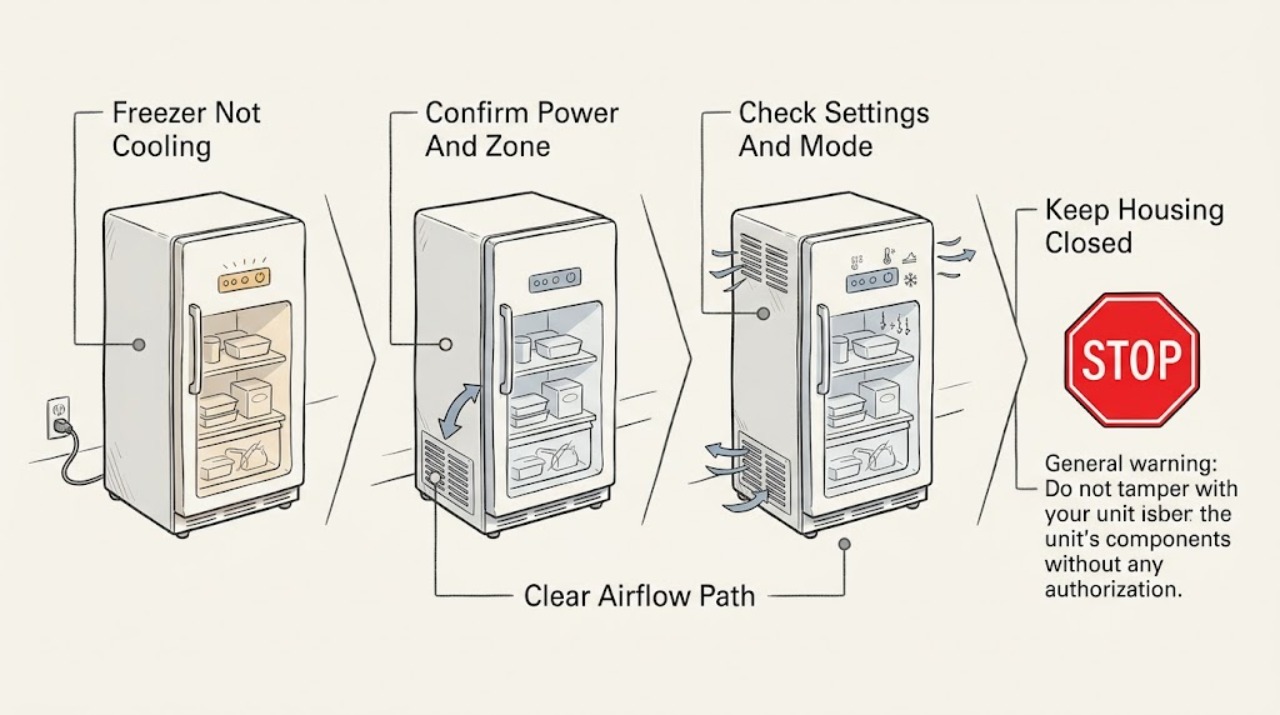
Work through in order
Diagnostic checks
Use only checks that match the exact appliance or system and its official guide.
-
Check 1
From a safe position, check that the Miele appliance and the freezer zone are switched on, the display or interior light responds as expected, and the plug is fully seated without moving the appliance or using an extension lead.
Expected result: Record whether the freezer display is lit, the freezer zone is enabled, the plug or socket is loose or damaged, and whether the circuit breaker has tripped.
Next step: If the zone is off, restore it only through the normal control described in the manual; if power is absent, a breaker has tripped, or the plug or socket is damaged, stop and arrange qualified electrical or Miele service.
Stop if: Do not repeatedly reset a breaker, use a damaged cord or hot socket, move a built-in appliance, or touch exposed wiring.
Why this matters
Why: A disabled zone or missing power can explain no cooling without proving an internal refrigeration fault. A breaker trip may involve the appliance, household wiring, or another load and needs professional attention if it recurs.
-
Check 2
Read the freezer temperature display and any warning or demo-mode indicator, then compare the setting with the exact Miele operating instructions; do not change settings repeatedly while the appliance is unstable.
Expected result: Record whether the temperature setting is warmer than intended, a temperature alarm is active, demo mode is indicated, the freezer zone is disabled, or the display is blank or unresponsive.
Next step: Correct only an obvious setting or mode using the model manual, then allow the model's stated recovery period while keeping the door closed; arrange service if demo mode cannot be cleared or the display remains abnormal.
Stop if: Do not enter undocumented service menus, bypass an alarm or control, or repeatedly disconnect and reconnect the appliance.
Why this matters
Why: An incorrect setting, demo mode, or a recent power interruption can make the freezer appear not to cool. A blank or unresponsive display with confirmed power points toward a control or appliance fault.
-
Check 3
Check the freezer's room and exterior from a safe position: note nearby heat, direct sunlight, blocked ventilation openings, excessive dust, an overpacked compartment, or an installation gap described in the manual.
Expected result: Record whether the room is unusually cold or hot for the model, the exterior ventilation path is blocked, food blocks interior airflow, or a built-in cabinet or front prevents the door from closing tightly.
Next step: Restore only the clearances, loading, and room conditions permitted by the manual; if cabinet alignment, ventilation, or the installation cannot be corrected without moving the unit, arrange qualified service.
Stop if: Do not dismantle the cabinet, remove ventilation panels, place the unit near an unsafe heat source, or move a built-in freezer while connected to power.
Why this matters
Why: Miele says ambient temperature can affect compressor operation and that incorrect cabinet positioning or a cabinet front can prevent tight closure. Blocked ventilation or overloading can also reduce heat removal and airflow.
-
Check 4
With the door open only briefly, ensure drawers and packages are fully seated and inspect the visible gasket for a gap, dirt, damage, a bulge, or a section out of its groove; close the door gently without forcing it against ice.
Expected result: Classify the door as closing flat and fully, obstructed by food or ice, held open by a drawer or hinge, or unable to seal because the gasket or alignment is abnormal.
Next step: Remove an accessible food obstruction and monitor recovery; reposition an intact seal only as the model instructions allow, but arrange Miele service for a damaged seal, hinge, door, or cabinet alignment.
Stop if: Do not pull the magnetic strip, use oil or adhesive, bend the hinge, pry ice from the gasket, or continue operation with a visible door gap.
Why this matters
Why: An obstruction or damaged seal admits warm humid air, which can raise temperature and create frost. Miele says a seal out of its groove or damaged can cause ice or condensation and should lie flat against the housing when closed.
-
Check 5
Photograph the frost pattern without scraping it, and if the exact Miele manual calls for manual defrosting, protect the food and follow only that approved procedure with power isolated as directed.
Expected result: Record whether frost is thin or thick, concentrated near the door or rear panel, blocking a vent or drawer, absent but paired with poor cooling, or returning quickly after an approved defrost.
Next step: Complete only the manual-approved defrost and cleaning, then monitor temperature and recurrence; arrange Miele or qualified refrigeration service when the layer cannot be removed safely or returns.
Stop if: Do not use a knife, screwdriver, hair dryer, heat gun, heater, boiling water, or other heating appliance; do not open panels or puncture an evaporator or tubing.
Why this matters
Why: Door-edge frost supports an air-sealing problem; a thick layer that blocks airflow can reduce cooling. Frost that returns quickly, or poor cooling without a door explanation, keeps a defrost, sensor, fan, control, or sealed-system fault in scope.
-
Check 6
Keep the door closed during recovery and use the model's display or a suitable appliance thermometer to record the freezer temperature after the manual's recovery period; assess food separately if it has warmed.
Expected result: Record whether the freezer reaches its specified target, an alarm clears, food retains ice crystals, temperature remains high, or frost and poor cooling return after a correct seal and defrost check.
Next step: Use FoodSafety.gov's item-by-item frozen-food guidance and arrange Miele or qualified refrigeration service for persistent high temperature, recurring alarms, or recurrence after defrost.
Stop if: Do not taste questionable food, repeatedly power-cycle the freezer, or continue operation with smoke, burning smell, hot plug, arcing, breaker trips, or a refrigerant-related concern.
Why this matters
Why: Stable target temperature after a door or setting correction supports a reversible cause. A temperature that remains high, repeated alarms, thawed food, or rapid frost recurrence indicates a continuing appliance fault or a food-safety decision.
Use your observations
Decision map
Find the observation that best matches what you see, then follow the next safe action.
-
PATH 01Safety boundary
What you see
The freezer zone is off, the display is dark, the plug or socket is not supplying power, or the breaker has tripped.
Do this next
Use the normal model control to enable the zone or confirm the plug connection if safe; arrange qualified electrical or Miele service for a tripped or recurring breaker, damaged cord, or absent power.
Why this path and its safety boundary
Why it matters: The immediate issue is control or power availability, not yet a proven compressor or refrigeration failure.
Safety stop: Do not repeatedly reset the breaker, use an extension lead, move the appliance while connected, or touch damaged electrical parts.
-
PATH 02Safety boundary
What you see
The freezer setting is warmer than intended, demo mode is shown, or the zone was disabled through the controls.
Do this next
Correct the setting or exit demo mode only with the exact Miele manual, then keep the door closed for the specified recovery period.
Why this path and its safety boundary
Why it matters: A control state can stop or reduce cooling without proving a mechanical fault.
Safety stop: Arrange service if demo mode cannot be cleared or the display is unresponsive; do not use undocumented menus or bypass controls.
-
PATH 03Safety boundary
What you see
A package, drawer, hinge, cabinet front, or gasket prevents a flat, complete door closure, or frost is concentrated at the opening.
Do this next
Clear the accessible obstruction and correct an intact seal only as the model manual permits; arrange service for a damaged gasket, hinge, door, or installation alignment.
Why this path and its safety boundary
Why it matters: Warm humid air is likely entering and can raise the temperature and build ice.
Safety stop: Do not force the door, pull the magnetic strip, use oil or adhesive, or keep operating with a visible gap.
-
PATH 04Safety boundary
What you see
A thick layer of ice blocks a drawer or airflow path, especially after the door was left open or not fully closed.
Do this next
Follow the exact Miele manual's defrost and cleaning procedure with food protected; monitor the temperature after restart.
Why this path and its safety boundary
Why it matters: The ice can reduce usable airflow and cooling, but it must be removed without damaging the liner or refrigeration circuit.
Safety stop: Do not chip, stab, pry, or heat the ice, and stop for a damaged liner, exposed tubing, or water near electrical parts.
-
PATH 05Safety boundary
What you see
Power and controls are normal, the door seals flat, approved defrost or loading correction is complete, and temperature returns to the model's target.
Do this next
Keep vents clear, minimize door-open time, maintain the model's loading and temperature guidance, and watch for recurring frost or alarms.
Why this path and its safety boundary
Why it matters: The evidence supports a reversible setting, loading, door, or maintenance cause.
Safety stop: Arrange service if the freezer stops cooling again, frost returns quickly, or electrical symptoms appear.
-
PATH 06Safety boundary
What you see
The freezer remains warm after power, setting, loading, door-seal, and manual-approved defrost checks, or frost returns quickly.
Do this next
Arrange Miele or qualified refrigeration service with the model, temperature history, frost photos, alarm history, and door-seal findings.
Why this path and its safety boundary
Why it matters: A defrost, airflow, fan, sensor, control, compressor, or sealed refrigeration fault remains possible and cannot be identified safely from the outside.
Safety stop: Do not open interior panels, handle refrigerant, bypass controls, or continue running the freezer if it is electrically or mechanically unsafe.
-
PATH 07Safety boundary
What you see
Food has thawed, the freezer has lost power, or there is a hot plug, burn mark, arcing, smoke, burning odor, damaged cord, or repeated breaker activity.
Do this next
Keep the door closed, apply FoodSafety.gov's item-by-item food guidance, and disconnect or leave the appliance de-energized as safe while arranging qualified service.
Why this path and its safety boundary
Why it matters: Food safety and electrical safety take priority over continuing cooling diagnosis.
Safety stop: Never taste questionable food, repeatedly reset a breaker, operate a smoking or hot appliance, or use a heater to defrost.
Helpful context
Understand the symptom
Start with the freezer's state, power, and temperature
A dark display or a freezer zone that is not enabled can look like a cooling failure. Miele's support instructions say to confirm that the required zone is switched on and that the plug is connected, then to check whether the circuit breaker has tripped. On some models, demo mode can leave the cooling system off. Once the controls are active, record the actual temperature or alarm message rather than relying on how cold one package feels.
Door closure and frost can block recovery
Warm air enters when a drawer, package, hinge, cabinet front, or damaged gasket keeps the freezer door from sealing. Miele links excessive condensation and thick ice to door-closure and seal problems, and recommends correcting the cause and defrosting the freezer when a thick ice layer forms. Inspect only the accessible seal and loading path; do not chip ice or remove interior panels to reach a fan or evaporator.
Protect food and stop at electrical or sealed-system symptoms
Keep the door closed as much as possible while diagnosing a warm freezer. FoodSafety.gov says continuously frozen food is intended to be held at 0°F (-18°C) or below, and its power-outage guidance says food with ice crystals or at or below 40°F (4°C) may be refrozen depending on the item; never taste questionable food to judge safety. A hot plug, burn mark, arcing sound, repeated breaker trip, smoke, or refrigerant-like hiss is a service boundary, not a reason to keep cycling the appliance.
Safety boundary
Stop conditions
- Do not repeatedly reset a tripped breaker, use a damaged cord or hot socket, or continue operating when there is smoke, burning odor, arcing, a burn mark, or excessive heat.
- Do not use a knife, screwdriver, hair dryer, heat gun, heater, boiling water, or another heating appliance to remove frost.
- Do not remove interior panels, puncture the liner or tubing, open sealed refrigeration components, handle refrigerant, or bypass a fan, sensor, defrost, or temperature control.
- Stop for a refrigerant-like hiss or odor, a damaged liner or exposed tubing, water near electrical parts, repeated alarms with poor cooling, or a temperature that remains unsafe.
- Do not taste thawed or questionable food; keep the freezer door closed while arranging food-safety and repair decisions.
Only after diagnosis
Potential parts
- Miele freezer door seal
Consider this category only when inspection confirms a damaged seal that prevents a flat closure and Miele service or the exact model instructions support replacement.
Confirm the exact Miele model and seal design before ordering; do not use adhesive, oil, or a generic seal to compensate for poor fit. - Miele freezer drawer or hinge hardware
Consider this category only when a qualified diagnosis finds hardware or drawer alignment that prevents the door from closing and admits warm air.
Confirm the exact model and built-in installation requirements; alignment or hinge work may require qualified service. - Miele defrost, fan, or temperature-control component
Consider this category only after power, settings, door sealing, loading, and approved defrost checks fail and a qualified technician identifies the failed component.
Do not choose or install an internal control, fan, or sensor by symptom alone; verify the exact model and diagnosis.
When checks do not resolve it
Need a professional?
Arrange Miele or qualified refrigeration service when the freezer remains warm after power, setting, loading, door-seal, and model-approved defrost checks; frost returns quickly; the door or gasket is damaged; the display or alarm remains abnormal; or the suspected cause involves a fan, sensor, defrost circuit, compressor, or sealed refrigeration system. Use qualified electrical service for a hot plug, burn mark, arcing, smoke, damaged cord, or repeated breaker activity.
Safety scope: This article supports normal-control checks, exterior observation, safe loading, documentation, and only the model-approved defrost procedure. Do not open electrical or refrigeration enclosures, handle refrigerant, puncture tubing, use heat or sharp tools, or continue operation with safety warning signs.
Common questions
FAQ
Why is my Miele freezer not cooling?
Check whether the freezer zone is enabled and powered, the setting or demo mode is correct, the door seals fully, vents and loading are not obstructed, and frost is not blocking airflow. If it remains warm after these checks or an approved defrost, arrange Miele or qualified refrigeration service.
What temperature should a Miele freezer reach?
Use the exact Miele manual and display setting for your model. FoodSafety.gov identifies 0°F (-18°C) or below as the continuous frozen-storage reference, but a display setting alone does not prove the actual compartment temperature; use a suitable appliance thermometer when needed.
Can an open Miele freezer door cause it to stop cooling?
An open or poorly sealed door lets warm air in, raises the temperature, and can create frost. Miele links thick ice and condensation with poor door closure, a seal out of its groove, or a damaged seal.
Can I use a hair dryer to defrost a Miele freezer?
No. Do not use a hair dryer, heat gun, heater, boiling water, or another heating appliance. Follow only the exact model manual's defrost procedure, and never use sharp tools that could damage the liner or refrigeration tubing.
Why is the Miele freezer compressor running but the freezer is still warm?
A running sound does not identify the cause. Check the temperature, door seal, airflow, and frost pattern without opening panels. Persistent warmth can involve a fan, defrost system, sensor, control, compressor, or sealed refrigeration circuit and needs qualified diagnosis.
What should I do with food if my Miele freezer warmed up?
Keep the door closed and assess each item using FoodSafety.gov guidance. Food that still has ice crystals or is at or below 40°F (4°C) may be refrozen depending on the item; never taste questionable food to decide whether it is safe.
When should I call a technician for a Miele freezer that is not cooling?
Call when power and settings are normal but temperature remains high, frost returns quickly, the door or gasket is damaged, alarms persist, or the suspected cause involves internal fans, defrost parts, sensors, the compressor, or sealed refrigeration. Use qualified electrical service for heat, smoke, arcing, burn marks, damaged cords, or repeated breaker trips.
Read the exact guide
Official sources
- Refrigeration appliance/wine unit not coolingMiele USA · Miele refrigeration support guidance; specific controls and service boundaries depend on the exact model.
- Ice deposits in refrigeration applianceMiele USA · Miele refrigeration support guidance for ice or condensation deposits; exact model instructions control seal care and replacement.
- Fridge zone/freezer zone not coolingMiele USA · Miele refrigeration support guidance for a freezer zone that is not cooling; exact model controls the user interface and recovery behavior.
- Cold Food Storage ChartFoodSafety.gov · U.S. government food-safety guidance; it is not a freezer repair procedure.
- Temperature in refrigeration appliance/wine unit too highMiele USA · Miele refrigeration support guidance for high internal temperature; exact settings and ambient limits are model-specific.
- Food Safety During Power OutageFoodSafety.gov · U.S. government food-safety chart for frozen food during a power outage; it does not diagnose freezer faults.
- Thicker ice layer in freezer sectionMiele USA · Miele refrigeration support guidance for a thicker freezer ice layer; exact model manual controls the defrost method.
- Temperature alarm sounds and temperature display flashingMiele USA · Miele refrigeration support guidance for a warm freezer alarm; model-specific alarm controls and food decisions still require the manual and food-safety guidance.
- Electrical Safety Advice for Fridges and Freezers/ Fridge and Freezer SafetyElectrical Safety First · Consumer safety guidance for fridges and freezers; model-specific manufacturer instructions control operation and defrosting.
- Condensation forming on freezer compartmentMiele USA · Miele refrigeration support guidance for excessive freezer condensation; built-in installation changes should follow the model installation instructions.
Community feedback
Share a repair observation
Share a plain-text repair observation. Accepted observations are published automatically; this page may take a moment to update.