
On this page
Start here
Quick answer
A Miele washing-machine error cannot be diagnosed reliably from the word error alone. Record the complete message or code, model number, indicator lights, and the point in the cycle when it appeared, then use the matching Miele manual. Water-inlet, drainage, door-lock, heating, foam, motor, control, and Waterproof-system messages lead to different checks. F20 or Heating fault can mean the temperature has not been reached yet or that a heating fault persists; a Waterproof-system message requires the water supply to be closed and Miele service. Check only the external, model-supported items for the displayed message. Stop for leaking water near electricity, a rotating drum hazard, smoke, burning odor, arcing, hot connections, repeated breaker trips, or any message that returns after the single reset allowed by the exact instructions.
Work through in order
Diagnostic checks
Use only checks that match the exact appliance or system and its official guide.
-
Check 1
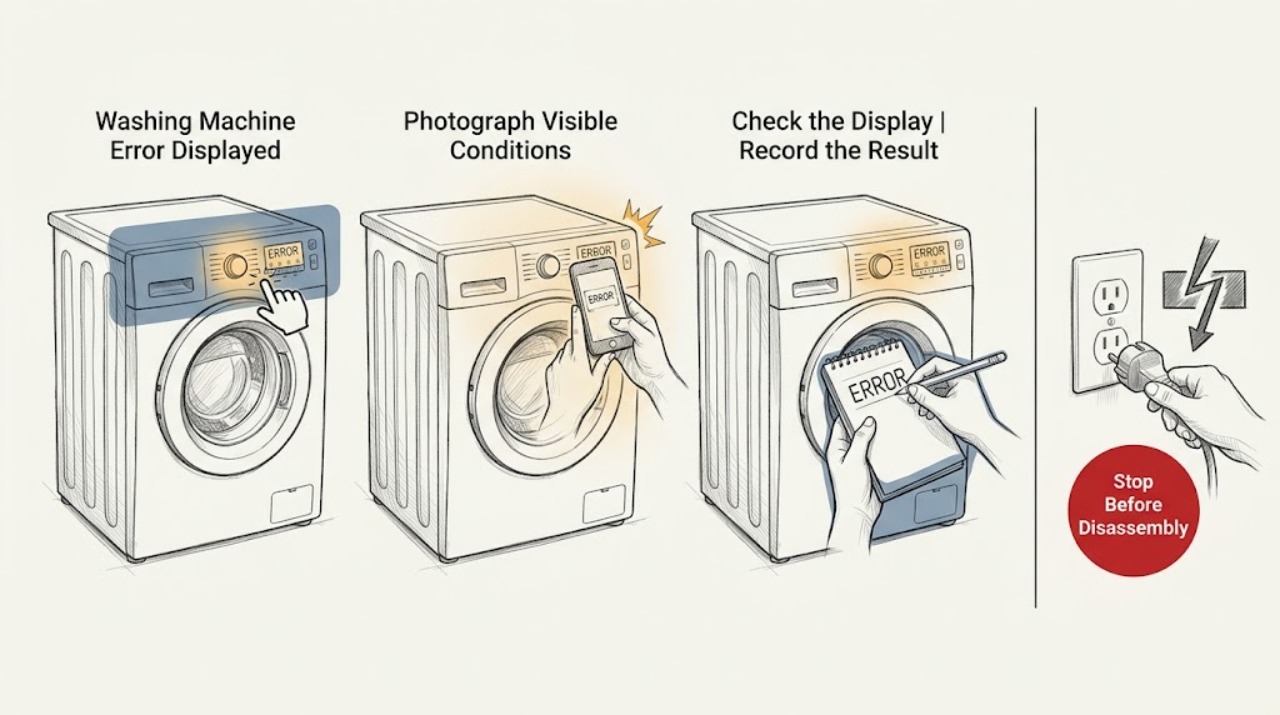
Photograph or transcribe the complete error text, code, symbols, and flashing indicators. Record the model number, whether the washer is front-load or another configuration, the selected program, and whether the message appeared during filling, washing, heating, draining, or spinning.
Expected result: The message is a named water, drain, door, heating, foam, motor, control, or Waterproof-system fault, or it is an unfamiliar Fault message.
Next step: Open the matching Miele support article or operating instructions and follow only the branch for the exact message; do not substitute a code from another model.
Why this matters
Why: Miele's washer support is organized by exact display messages, and its manuals warn that the meaning and remedy depend on the model.
-
Check 2
Check the visible operating state without reaching into the machine: note whether the display is dark, the door is locked, the drum is still, the controls respond, and water is present on or beneath the washer. Do not open a door against a lock or reach toward a moving drum.
Expected result: The machine is unpowered, the door will not release, water is visible, the drum is moving, or the controls and drum appear normal.
Next step: If water or movement creates a hazard, use the stop conditions below. Otherwise continue with the exact message branch and retain the observed state for service.
Why this matters
Why: Power, door, leak-protection, and motion conditions can change the safe next step before any code-specific check is attempted.
-
Check 3
If the display says F20 or Heating fault, watch whether the time display is paused while the selected temperature is being reached. Compare the selected program and temperature with the model manual; do not remove panels or test the heater.
Expected result: The time resumes after the target temperature is reached, or F20/Heating fault returns and the program cannot complete.
Next step: Allow the documented temperature wait once. If the fault returns, use the exact model's single reset instruction if provided; otherwise stop and arrange Miele service.
Why this matters
Why: Miele says Thermostop can pause the remaining time while the set temperature is reached; a returning fault indicates a technical heating problem rather than a normal wait.
-
Check 4
For a water-inlet message, inspect the faucet and hose externally: confirm the supply is open, the inlet hose is not kinked or looped, and the connection is dry. If the manual permits cleaning an inlet filter, close the faucet first and follow that model's procedure.
Expected result: The faucet is closed, the hose is kinked, the inlet filter is visibly restricted, water pressure is low, or the external supply path is clear.
Next step: Correct only an external, model-supported issue and check the connection for leaks. If the message persists or the supply cannot be made safe, stop and use qualified service or plumbing help.
Why this matters
Why: Miele identifies a closed faucet, restricted or kinked hose, blocked inlet filter, and low water pressure as possible water-inlet causes.
-
Check 5
For a drainage message, look at the drain hose routing and the visible filter-access area without opening it while hot water or pressure is present. Note whether the hose is kinked or too high and whether the washer retains water; use the manual before any filter or pump cleaning.
Expected result: The hose is kinked or routed too high, the drum retains a large amount of water, the filter or pump area is restricted, or the drain path looks clear.
Next step: Do not force open a hot or pressurized access point. If the manual's low-risk drain procedure is appropriate and the water is cool, follow it exactly; otherwise arrange service.
Why this matters
Why: Miele links drainage faults to restricted hoses, excessive delivery height, or a blocked drain filter and pump; retained hot water can scald.
-
Check 6
If the display says Waterproof system activated, inspect the floor and nearby connections from a safe standing position and note any water. Do not restart the washer or investigate underneath the cabinet.
Expected result: Water is present, the floor is dry, or the Waterproof message remains without a clear visible leak.
Next step: Close the water supply if safely reachable, keep the washer out of use, and contact Miele service. Do not override the protection or repeatedly run a cycle.
Why this matters
Why: Miele treats the Waterproof system as a water-protection event and directs the water supply to be closed and service to be contacted; a lack of visible water does not authorize internal investigation.
-
Check 7
For Check dosage, foam, load, motor, or spinning messages, record detergent type and amount, load size, the cycle stage, and whether the machine walked, struck the cabinet, or stopped before spin. Check only the visible load distribution and level if the drum is stationary.
Expected result: Excess foam is visible, the load is concentrated or oversized, the washer is not level, transport hardware may still be present, or the message persists with a balanced load.
Next step: Use the manual's dosage and load guidance once. If the washer walks, strikes, leaks, or the code returns, stop further cycles and arrange qualified service.
Why this matters
Why: Miele associates foam messages with excessive detergent and spinning or motor symptoms with load, leveling, transport, or other model-specific conditions.
-
Check 8
If the exact message instructs a reset, perform no more than the one reset described for that model, then record whether the same message returns. Do not combine several reset sequences from different Miele manuals.
Expected result: The program completes normally, or the same code or a new safety-related code returns.
Next step: If the message returns, stop using the washer and provide the technician with the full message, model, program stage, visible water, and reset result.
Why this matters
Why: Miele permits a limited restart for some messages but routes persistent heating, control, door, leak, or technical faults to service.
Use your observations
Decision map
Find the observation that best matches what you see, then follow the next safe action.
-
PATH 01Next step
What you see
The message is F20 or Heating fault and the time display is paused while the target temperature is being reached.
Do this next
Allow the documented wait once. If F20 returns or the program cannot continue, stop and arrange service.
Why this path and its safety boundary
Why it matters: This can be Thermostop behavior rather than an immediate component failure.
-
PATH 02Next step
What you see
The message concerns water inlet, and the faucet is closed, hose kinked, or inlet filter restricted.
Do this next
Correct the model-supported external issue with the faucet closed during any hose/filter work, then check for leaks before a normal retry.
Why this path and its safety boundary
Why it matters: The external water path can explain the fault.
-
PATH 03Next step
What you see
The message concerns drainage and water remains in the washer or the drain hose is kinked or too high.
Do this next
Wait for safe conditions and follow the exact model's drain procedure, or arrange service if the access point is hot, pressurized, blocked, or unclear.
Why this path and its safety boundary
Why it matters: A restricted or incorrectly routed drain path is plausible, with scald risk if the water is hot.
-
PATH 04Next step
What you see
The display says Waterproof system activated, or water is present around the washer.
Do this next
Close the water supply if safely reachable, keep the appliance out of use, and contact Miele service.
Why this path and its safety boundary
Why it matters: Treat this as a leak-protection event rather than a normal inlet or drain adjustment.
-
PATH 05Next step
What you see
The message concerns foam, spin, load, motor, or level and the drum is stationary.
Do this next
Apply only the matching manual guidance once; persistent walking, impact, or code recurrence requires service.
Why this path and its safety boundary
Why it matters: Detergent amount, load distribution, level, or transport hardware may be relevant, depending on the model.
-
PATH 06Next step
What you see
The exact message is unfamiliar, a technical fault returns, or the washer does not respond normally.
Do this next
Stop using the washer and arrange qualified Miele service with the exact code, model, and cycle-stage record.
Why this path and its safety boundary
Why it matters: The public generic checklist is no longer a safe diagnosis.
Helpful context
Understand the symptom
Why the exact code matters
Miele publishes many washer messages, and the same general symptom can have different causes on different models. A heating message may describe a temporary temperature wait or a technical fault. A water message may concern supply, drainage, or leak protection. Keep the full display text, symbols, model, and cycle stage together instead of searching a shortened code without its context.
Use a safe decision path
Begin with the message and visible conditions, not with parts. Check faucets, hoses, the door, detergent amount, drain routing, and the machine's level only where the displayed message and the exact manual support that check. Internal heaters, locks, motors, controls, and waterproof components require qualified diagnosis.
Only after diagnosis
Potential parts
- water inlet valve or inlet filter
Consider only after the exact message and qualified diagnosis show a restricted or failed inlet path rather than a closed faucet or kinked hose.
Confirm the complete model number and Miele fit information before ordering. - heating element or temperature sensor
Consider only on a model with the relevant heating system and only after a returning heating fault is professionally diagnosed.
Do not infer part fit from F20 alone; model and service diagnosis are required. - drain pump or drain filter
Consider only when the exact drain message persists after safe hose and accessible-filter checks and diagnosis identifies the drain assembly.
Confirm model-specific assembly and safety instructions before selecting a part. - door lock or water-protection component
Consider only after a qualified technician identifies a failed lock or leak-protection component from the exact message and visible conditions.
These components vary by model; do not bypass or substitute the safety system.
When checks do not resolve it
Need a professional?
Arrange qualified Miele service when an error returns after the exact model's single reset, when the code is a technical, heating, door, motor, control, or Waterproof-system fault, when water cannot be safely cleared, or whenever smoke, burning odor, arcing, overheating, walking, impact, or repeated trips occur.
Common questions
FAQ
What should I do first when my Miele washer shows an error?
Record the complete message or code, model number, indicators, selected program, and cycle stage. Then use the exact Miele manual or support article; do not interpret a shortened code from another model.
Does F20 always mean the Miele washer heater is broken?
No. Miele says F20 or Heating fault can appear while Thermostop waits for the selected temperature. If the program resumes, that may be the documented wait; if the fault returns, arrange service for a possible heating fault.
What does a Miele Waterproof-system message mean?
Miele treats it as a water-protection event. Close the water supply if safely reachable, keep the washer out of use, avoid reaching into a moving drum, and contact Miele service.
Can I keep using the washer after clearing an error?
Only when the exact model instructions permit one normal restart and the appliance has no leak, motion, heat, odor, smoke, arcing, or electrical safety symptom. A returning code or any safety symptom needs qualified service.
Read the exact guide
Official sources
- Foam during washingMiele USA · Miele washer foam messages, detergent amount, water hardness, and service escalation
- Water inlet faultMiele USA · Miele washer water-inlet messages, faucet, hose, inlet-filter, and water-pressure checks
- WWH 860-US-enMiele USA · Miele washer operating instructions, message-specific cautions, water inlet/drainage, Waterproof system, heating fault, door, power, and model-specific procedures
- Fault F20 or Heating faultMiele USA · Miele washer and washer-dryer F20, Thermostop, heating fault, restart, and service guidance
- Vibrations during spinningMiele USA · Miele washer vibration, level, transport-safety-device, firm-base, and walking checks
- Dashes “- - -” in display and indicator lights flashMiele USA · Miele washer Waterproof system activation, water shutoff, motion safety, and service guidance
- Exclamation mark and Technical fault flashMiele USA · Miele washer technical-fault display, code reveal, restart, and service escalation
- Water drainage faultMiele USA · Miele washer drainage messages, hose routing, drain filter, drain pump, and scald/leak cautions
- Troubleshooting for Display messages & light indicators problem with Miele WasherMiele USA · Miele washer display-message categories, including heating, inlet, drainage, door, foam, motor, and Waterproof-system topics
Community feedback
Share a repair observation
Share a plain-text repair observation. Accepted observations are published automatically; this page may take a moment to update.