
On this page
Start here
Quick answer
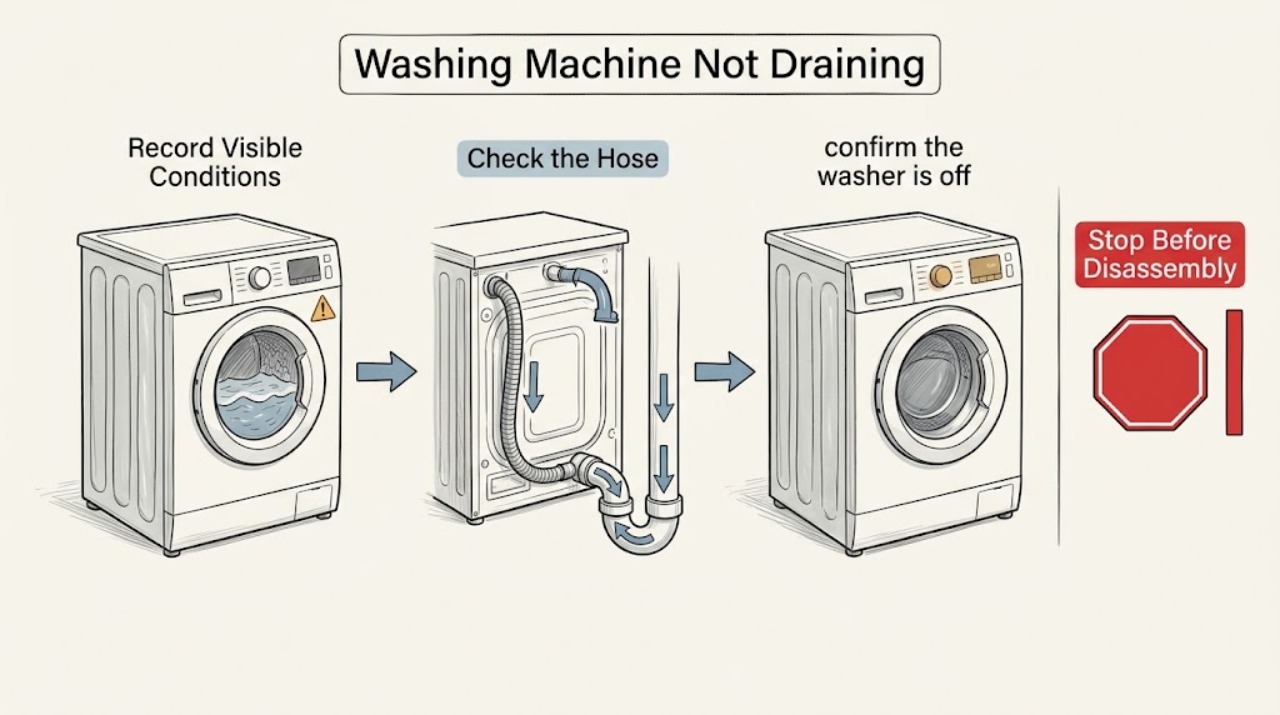
If a Miele washing machine is not draining, first note the program stage and whether the water is hot, then check the visible drain hose for kinks, loops, an excessive rise, or a household drain that is backing up. A Drain fault can also come from a blocked drain filter or pump, but retained water may be hot and the filter can release a large volume, so use the exact model instructions and do not tilt the machine. A brief gurgle at the start or end of a pump sequence can be normal. Stop for water near electrical equipment, a leak, hot or pressurized water, smoke, a burning odor, arcing, a walking machine, or an abnormal pump sound that persists; arrange qualified Miele service.
Work through in order
Diagnostic checks
Use only checks that match the exact appliance or system and its official guide.
-
Check 1
Record the complete model number, selected program, point at which the cycle stopped, exact display text or indicator, whether water remains in the drum, and whether the water may be hot. Wait until the drum is stationary before looking through the door.
Expected result: The display says Drain fault, the Drain indicator flashes, the program stopped during wash or spin, or the machine has no message but retains water.
Next step: Use the exact Miele operating instructions for the recorded model and message. Do not open a filter or door while the drum is moving or the water may be scalding.
Why this matters
Why: The same symptom can be a hose restriction, blocked filter or pump, household drain issue, excess foam, or a technical fault; Miele's remedy is message- and model-specific.
-
Check 2
With the washer stopped, inspect the visible drain hose from the appliance to the standpipe, sink connection, or floor drain. Look for kinks, loops, crushing, a loose connection, a very high hose end, or water backing up at the household drain.
Expected result: The hose is kinked or routed too high, the household drain backs up, the connection leaks, or the visible route is clear.
Next step: Correct only a visible hose-routing issue without tilting the machine, or arrange plumbing help for a backed-up household drain. If the hose is damaged, stop using the washer and arrange replacement or service.
Why this matters
Why: Miele identifies a kinked hose and an excessive delivery height as causes of a drainage fault; a backing-up standpipe or sink indicates the restriction may be beyond the washer.
-
Check 3
If the model instructions allow a drain-filter check, confirm the washer is off, the floor is dry, the drum is stationary, and a suitable container and towels are ready before opening the access flap. Do not begin if the water may be hot or if the area is near wet electrical equipment.
Expected result: The manual supports the procedure and the water is safe to handle, or the water is hot, the area is wet, the filter is pressurized, or the procedure is not in the manual.
Next step: Follow the model procedure only when all safety conditions are met. Otherwise close the access area if safe, keep the appliance out of use, and arrange qualified service.
Why this matters
Why: Miele warns that a blocked drain can leave a large amount of water behind and that hot wash water can scald; the drain filter must not be treated as a casual access point.
-
Check 4
During the model-approved filter and pump check, inspect for lint, coins, buttons, or other foreign objects and observe whether the pump impeller moves freely as the instructions describe. Refit every filter on the correct side and tighten it before any normal trial.
Expected result: The filter or pump path is blocked, an impeller cannot move freely, the filter will not seat or tighten, or the path is clear.
Next step: Remove only accessible debris permitted by the manual, close and check the access flap for leaks, and stop if the impeller, filter, or housing is damaged or remains restricted.
Why this matters
Why: Miele links a restricted drain to the filter or pump and warns that an incorrectly seated or loose filter can leak.
-
Check 5
If the machine reports foam, Check dosage, or a cycle that repeatedly pauses before draining, record the detergent type, automatic-dosing setting if present, water hardness setting, and load size. Do not add more detergent to force the cycle forward.
Expected result: Excess foam is visible, the dose exceeds the package or model guidance, the load is unusually small or heavily soiled, or the drain remains restricted with an appropriate dose.
Next step: Use the model's dosage guidance on a later load only after the machine is safe and empty. If the same drain symptom remains, arrange service rather than repeating full hot cycles.
Why this matters
Why: Miele identifies excessive detergent and incorrect dosing as causes of foam; foam can delay or complicate the drain stage without proving that the pump has failed.
-
Check 6
Listen from a safe standing position during one model-approved drain observation, without reaching into the machine. Distinguish a short gurgle at the beginning or end of the pump sequence from a harsh, repeated, empty hum, grinding, or silence with retained water.
Expected result: There is only the brief gurgle Miele describes, the pump runs but water does not leave, the sound is harsh or intermittent, or there is no pump sound.
Next step: Stop the cycle if the sound is harsh, the machine walks, water leaks, or the drum remains full. Record the sound and stage for qualified Miele service; do not tilt or open the cabinet.
Why this matters
Why: A brief gurgle can be normal, but a persistent abnormal sound or no flow after the hose and accessible filter path are clear points to a pump, obstruction, control, or household drain diagnosis.
-
Check 7
After one safe, model-approved external or filter-path correction, run only the model's appropriate drain or short verification program and watch for renewed water retention, a Drain fault, a leak, or a return to normal draining.
Expected result: The machine drains and completes, drains slowly, leaves water behind, or immediately reports the fault again.
Next step: Stop further cycles when the fault returns or water remains. Provide the technician with the exact code, program stage, hose route, filter findings, water temperature, and sound description.
Why this matters
Why: A successful single verification supports a cleared restriction; recurrence indicates a deeper drain, pump, control, or plumbing problem that cannot be isolated safely from outside.
Use your observations
Decision map
Find the observation that best matches what you see, then follow the next safe action.
-
PATH 01Next step
What you see
The hose is kinked, looped, damaged, or routed above the model's permitted delivery height.
Do this next
Correct the external route without tilting the washer, then check every connection for leaks. Arrange service if the hose is damaged or the fault remains.
Why this path and its safety boundary
Why it matters: The visible drain route can explain slow or absent drainage.
-
PATH 02Next step
What you see
The sink or standpipe backs up while the washer drains.
Do this next
Stop using the washer and obtain plumbing help; do not keep adding water to a backed-up drain.
Why this path and its safety boundary
Why it matters: A household drain restriction is possible rather than a washer-only fault.
-
PATH 03Next step
What you see
The drain filter or pump path contains debris and the water is cool, the drum is still, and the exact manual supports access.
Do this next
Follow the model's filter procedure, contain the water, refit the filter correctly, and stop if there is damage, pressure, heat, or a leak.
Why this path and its safety boundary
Why it matters: An accessible restriction may be causing the drain failure.
-
PATH 04Next step
What you see
A brief gurgle occurs only at the start or end of the pump sequence and water drains normally.
Do this next
No drain repair is indicated by that sound alone; monitor the next normal cycle for flow and program completion.
Why this path and its safety boundary
Why it matters: Miele describes that sound as normal pump operation.
-
PATH 05Next step
What you see
Foam is excessive or the dose is not aligned with the model and detergent guidance.
Do this next
Follow the model's dosage guidance and arrange service if the drain fault remains with appropriate dosing.
Why this path and its safety boundary
Why it matters: Detergent and foam may be delaying the drain stage.
-
PATH 06Next step
What you see
The drain path is clear but water remains, the pump sound is abnormal, or the Drain fault returns.
Do this next
Keep the washer out of use and arrange qualified Miele service; do not tilt or disassemble the machine.
Why this path and its safety boundary
Why it matters: A pump, control, deeper obstruction, or household plumbing fault is possible.
Helpful context
Understand the symptom
Separate normal pump sounds from a drain failure
Miele says gurgling at the start and end of a pump sequence can be normal. The useful symptom is whether water leaves the machine and whether the program advances. A full drum, a Drain fault, a flashing Drain indicator, a pump that hums without moving water, or water returning from the household drain points to a different branch than a short normal gurgle.
Protect yourself from retained water
Before any filter or pump-access procedure, identify whether the last program used hot water and whether the drum is stationary. Miele warns about scalding and sudden water release at the drain filter. If the access procedure, water temperature, or electrical condition is uncertain, stop at the external checks and use qualified service.
Only after diagnosis
Potential parts
- drain pump
Consider only after qualified diagnosis finds the pump is abnormal or fails to move water once the hose and accessible filter path are clear.
Confirm the complete model number and Miele fit information before ordering. - drain filter
Consider only when the exact model's filter is damaged, will not seat, or leaks after correct cleaning and refitting.
Filter design and fit vary by model; do not use a generic substitute without confirmation. - drain hose
Consider only when external inspection finds a kink-related weakness, tear, or model-specific hose damage.
Confirm routing requirements and complete model compatibility before selecting a replacement.
When checks do not resolve it
Need a professional?
Arrange qualified Miele service when water remains after the model-approved external and accessible filter checks, a Drain fault returns, the pump is silent or abnormal, a filter will not seat, the household drain is not clear, or any hot-water, leak, walking, odor, smoke, arcing, or electrical symptom appears.
Common questions
FAQ
Why is my Miele washing machine not draining?
Miele points to a kinked or overly high drain hose, a restricted drain filter or pump, and household drainage problems as common paths to check. Retained water may be hot, so use the exact model instructions and stop if the external checks do not explain the failure.
Is a gurgling sound during Miele washer drainage normal?
Miele says a gurgling sound at the start and end of a pump sequence can be normal. It becomes more concerning when water remains, the sound is harsh or repeated, the program stops, or a Drain fault appears.
Can I open the Miele washer drain filter with water inside?
Only when the exact model instructions support it, the drum is stationary, the water is cool, the floor is dry, and you can contain the release safely. Miele warns about scalding, sudden water release, and leaks from an incorrectly seated filter; use service when any condition is uncertain.
What does a Miele Waterproof message mean during a drain problem?
It indicates the water-protection system has reacted to a detected leak. Close the water supply if safely reachable, keep the washer out of use, avoid wet electrical areas, and contact Miele service rather than testing the drain repeatedly.
Read the exact guide
Official sources
- Foam during washingMiele USA · Miele washer foam, detergent dosing, water hardness, load soil and service guidance
- Drain indicator light flashesMiele USA · Miele washer Drain indicator, drain hose, filter, pump, retained-water and service checks
- Gurgling noises during drainingMiele USA · Miele washer normal gurgling sound at the start and end of a pump sequence
- WWH 860-US-enMiele USA · Miele washer operating instructions, model-specific drainage, filter, water, safety, and service procedures
- Troubleshooting for All problem with Miele WasherMiele USA · Miele washer support categories and model-specific display, drain, leak, noise, and service paths
- Water drainage faultMiele USA · Miele washer drainage fault, hose height and kinks, retained water, drain filter, drain pump, scald and leak cautions
Community feedback
Share a repair observation
Share a plain-text repair observation. Accepted observations are published automatically; this page may take a moment to update.