
On this page
Start here
Quick answer
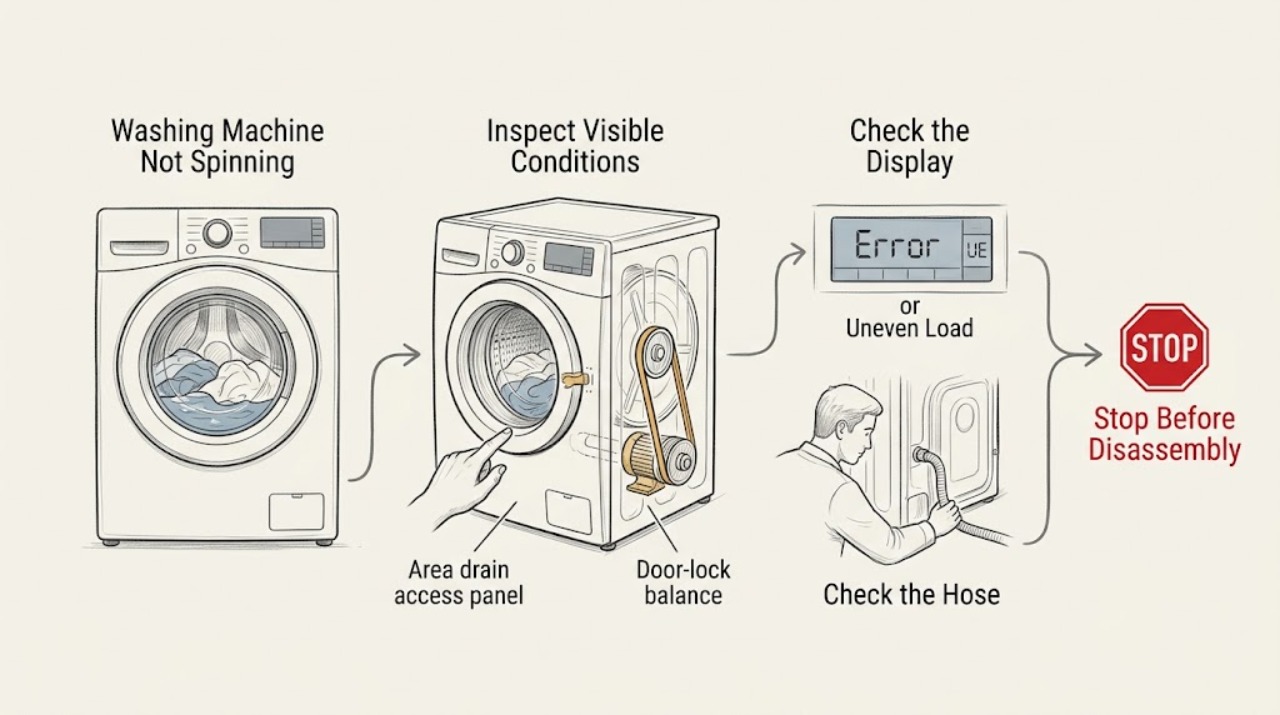
A Miele washer may leave laundry wet because it has not reached the final spin, has reduced speed after detecting an imbalance, has not finished draining, or is being held by a door or program condition. Note whether the drum never turns, turns during washing but not spin, pauses before final spin, or spins slowly, and record the display message and program stage. First check the load and selected spin option, then confirm that water has drained and the drain hose is not kinked or routed too high. Check the door lock and visible water or foam conditions without reaching into a moving drum. If the washer walks, bangs, makes metal-rubbing noise, leaks, smells hot, smokes, arcs, trips the breaker, or leaves hot water in the drum, stop using it. Do not tilt the machine, perform a live electrical check, or assume a motor or suspension part has failed; persistent faults need Miele Service.
Work through in order
Diagnostic checks
Use only checks that match the exact appliance or system and its official guide.
-
Check 1
Record the exact Miele model, program, selected spin speed, display message, and stage at which spinning stops. Observe whether the drum never turns, turns during wash or rinse but not final spin, pauses and then resumes slowly, or completes a slow spin with wet laundry. Note whether the machine was just installed or moved.
Expected result: The failure is tied to filling, washing, draining, door locking, final spin, or a displayed message rather than being a general no-power condition.
Next step: Use the exact model manual and the matching display message before changing settings or considering parts. Continue to the drain and load checks only if the drum is stationary and there is no hazard sign.
Why this matters
Why: A Miele washer can intentionally reduce or block spinning when a safety, balance, drain, door, or commissioning condition is present. The exact model and stage determine which manual branch applies.
-
Check 2
Check the load and spin selection from the controls. If one bulky item or a small group is present, redistribute it with a suitable mix of large and small items; if the exact program offers a spin-speed choice, confirm it is not set to no spin or a deliberately low speed. Do not open the door while the drum is moving.
Expected result: The washer reports or behaves like an imbalance, the drum spins slowly, the selected speed is low or disabled, or the load remains wet after a balanced permitted spin selection.
Next step: Run the exact manual's permitted spin or rinse-and-spin selection once with the load balanced. If the washer still will not spin, check drainage and the door condition rather than repeatedly restarting it.
Why this matters
Why: Miele explains that an uneven load can cause the machine to reduce final-spin speed. A low or disabled speed can also leave laundry wet without a drive failure; a balanced load that still cannot spin points to the next branch.
-
Check 3
Confirm that the washer has drained before the spin stage. From outside, look for standing water, a drain indicator or message, a kinked drain hose, a hose end routed too high, or water backing up at the standpipe. Do not open a filter or drain hot suds unless the exact model manual provides the procedure and the machine is off, stationary, cool enough, and able to drain into a controlled container.
Expected result: Water remains in the drum, the drain hose is kinked or high, the site drain backs up, the drain filter or pump area is blocked, or the tub is empty but the washer still will not spin.
Next step: Correct only a visible hose-routing issue allowed by the manual or arrange qualified plumbing/service help. If the drain path is clear and the drum is empty, continue to the door and balance checks.
Why this matters
Why: Miele links restricted drainage and excessive drain height with failure to complete spin. Remaining hot water also creates a scalding and door-release risk, so a drain issue must be resolved before another spin attempt.
-
Check 4
Check the door and lock state from outside. Confirm the door is fully closed, the latch area is free of trapped fabric, and no lock or door-fault message is shown. If the exact manual documents a normal cancel or unlock sequence, use it once only after the drum has stopped and the water level is safe; never force the door.
Expected result: The washer will spin after a normal door closure or manual-authorized unlock, or the lock remains engaged, the door is misaligned, or a door-fault message returns.
Next step: Leave the washer out of service for a persistent lock, damaged seal or door, or a returned door-fault message. Do not reach into the drum or run another cycle to force a lock test.
Why this matters
Why: A washer must keep the door secured during high-speed spin. A persistent door-lock fault is a service condition, not evidence that the lock should be bypassed.
-
Check 5
Check the installation and movement history without moving the washer. Look for a visible lean, gaps under a foot, loose leveling locknuts, evidence that the washer walks during spin, or a recent installation where the exact manual's transport-device instructions were not followed. Use a level only if it can be placed safely without reaching behind or under the appliance.
Expected result: The washer is not level, moves or bangs, sits on a flexible or unstable base, or was recently installed or moved; alternatively, it is level and stable but still fails to spin.
Next step: If leveling requires lifting, tilting, pulling out a built-in unit, or accessing concealed parts, stop and use a qualified installer or Miele Service. Do not continue spinning a machine that walks or bangs.
Why this matters
Why: Miele states that all four feet must support a level machine and that a poor base or loose locknuts can cause movement during spinning. A stable, correctly installed machine with persistent failure needs a different branch.
-
Check 6
Listen and observe only during a permitted, supervised attempt after the load, drain, door, and installation checks are safe. Distinguish a normal pause or low-speed distribution attempt from harsh walking, repeated impact, a metallic rubbing sound, a pump that cannot clear water, or a drum that will not turn at all. Stop the attempt at the first abnormal sound or movement.
Expected result: The washer completes spin normally, repeatedly reduces speed, makes metal-rubbing or impact noise, leaks, or remains unable to turn despite an empty and drained drum.
Next step: Stop the washer and contact Miele Service for persistent no-spin, rubbing, impact, leak, or drive symptoms. Do not open the cabinet or attempt a live test.
Why this matters
Why: Miele treats rubbing noise as a technical fault and directs the owner to service. Repeated mechanical impact or inability to turn after external conditions are corrected can indicate a drive, bearing, suspension, or control problem that is not a user adjustment.
Use your observations
Decision map
Find the observation that best matches what you see, then follow the next safe action.
-
PATH 01Next step
What you see
The washer is in first commissioning and shows a water-inlet condition before any spin is available.
Do this next
Follow the exact Miele commissioning procedure; Miele documents that the factory spin lock prevents spinning until water has been taken in and an initial wash program has been completed.
-
PATH 02Next step
What you see
The drum is full of water or a drain message appears.
Do this next
Do not force a spin. Check only visible hose routing and the exact model's safe drainage procedure; hot suds, a blocked filter, or an unsafe access condition requires cooling and qualified help.
-
PATH 03Next step
What you see
The washer spins slowly or leaves wet laundry after an uneven load, low spin setting, or distribution pause.
Do this next
Balance the load with suitable large and small items and confirm the permitted spin setting. If the symptom repeats with a balanced load, continue to drainage and installation diagnosis.
-
PATH 04Next step
What you see
The washer walks, bangs, or shows a visible lean or unstable base.
Do this next
Stop using the washer. Have the four-foot leveling, locknuts, base, and transport-device status checked according to the exact Miele installation instructions; do not tilt or pull out the appliance yourself.
-
PATH 05Next step
What you see
The door will not lock, a door-fault message returns, or the latch or seal is damaged.
Do this next
Do not bypass the lock or reach into the drum. Leave the washer off and contact Miele Service.
-
PATH 06Next step
What you see
The drum is empty and drained, external conditions are correct, but it still will not spin or it makes rubbing or impact noise.
Do this next
Treat the symptom as a technical fault and arrange Miele Service. Do not remove panels, inspect live components, or order a motor or suspension part without model-specific diagnosis.
Helpful context
Understand the symptom
“Not spinning” can mean no drum movement at all, no final high-speed spin, or a deliberate slow spin after the washer detects an unsafe condition. Miele's own troubleshooting separates balance, leveling, drain routing, first commissioning, door or fault messages, and unusual drum noise. Identify the stage before considering a part.
Keep every check external and controlled. Do not put a hand into a moving drum, force a locked door, tilt the washer, remove cabinet panels, or measure live voltage. If water is hot or close to electrical parts, wait for qualified help rather than trying to make the machine spin.
Common questions
FAQ
Why does a Miele washing machine leave clothes wet without a completed spin?
Miele identifies imbalance, leveling, and restricted drainage as separate causes. Confirm the program and spin setting, rebalance the load, and make sure the drain path is correct before considering a technical fault.
Can I open the Miele washer door when it will not spin?
Only when the drum is stationary and the water is safe. Hot water, a locked door, or a full drum requires the exact Miele drainage or service procedure; never force the lock or reach into a moving drum.
Should I keep running a Miele washer that bangs during spin?
No. Stop if it walks, bangs violently, or produces metallic rubbing. Miele links movement to leveling and base conditions and treats rubbing noise as a technical fault requiring service.
Read the exact guide
Official sources
- Miele Washer | A rubbing noise can be heard when the drum of the washing machine/washer-dryer rotates.Miele USA · Miele washer abnormal drum rubbing noise
- Operating and Installation InstructionsMiele USA · Miele WWH 860 washing machine operating, installation, leveling, drainage, and safety instructions
- Miele Washer | The laundry is still wet after washing. The washing machine has not spun the laundry.Miele USA · Miele washer wet laundry and reduced or missing spin guidance
- Miele Washer | There are vibrations during the spin cycle of the washing machine.Miele USA · Miele washer spin vibration, leveling, transport-device, and base guidance
- Miele Washer | Water inlet fault appears in the washing machine display during initial commissioning and the washing machine does not perform a spin cycle.Miele USA · Miele washer initial commissioning spin lock
- Miele Washer | Water drainage fault appears in the washing machine display. The drain is restricted.Miele USA · Miele washer drain hose, pump, filter, and hot-suds safety guidance
- CPSC Guide to Home Wiring HazardsU.S. Consumer Product Safety Commission · Household electrical hazard recognition and qualified-service boundaries
- Miele Washer | Fault F37 appears in the washing machine display. The washing machine is not aligned correctly.Miele USA · Miele washer F37, leveling, and drain-height guidance
Community feedback
Share a repair observation
Share a plain-text repair observation. Accepted observations are published automatically; this page may take a moment to update.