
On this page
Start here
Quick answer
Record when the Moffat refrigerator noise occurs and where it comes from before treating it as a failure. Compressor, fan, refrigerant movement, and automatic defrost sounds can be normal, while a new scraping sound, repeated water-valve buzz without a water supply, or vibration against a wall deserves a targeted check. Keep hands and tools away from powered fans and arrange service for a persistent abnormal sound.
Before you begin
Safety first
- Do not touch powered fans, probe wiring, or remove covers without model instructions. Unplug only from a dry, safe position before an explicitly permitted external check.
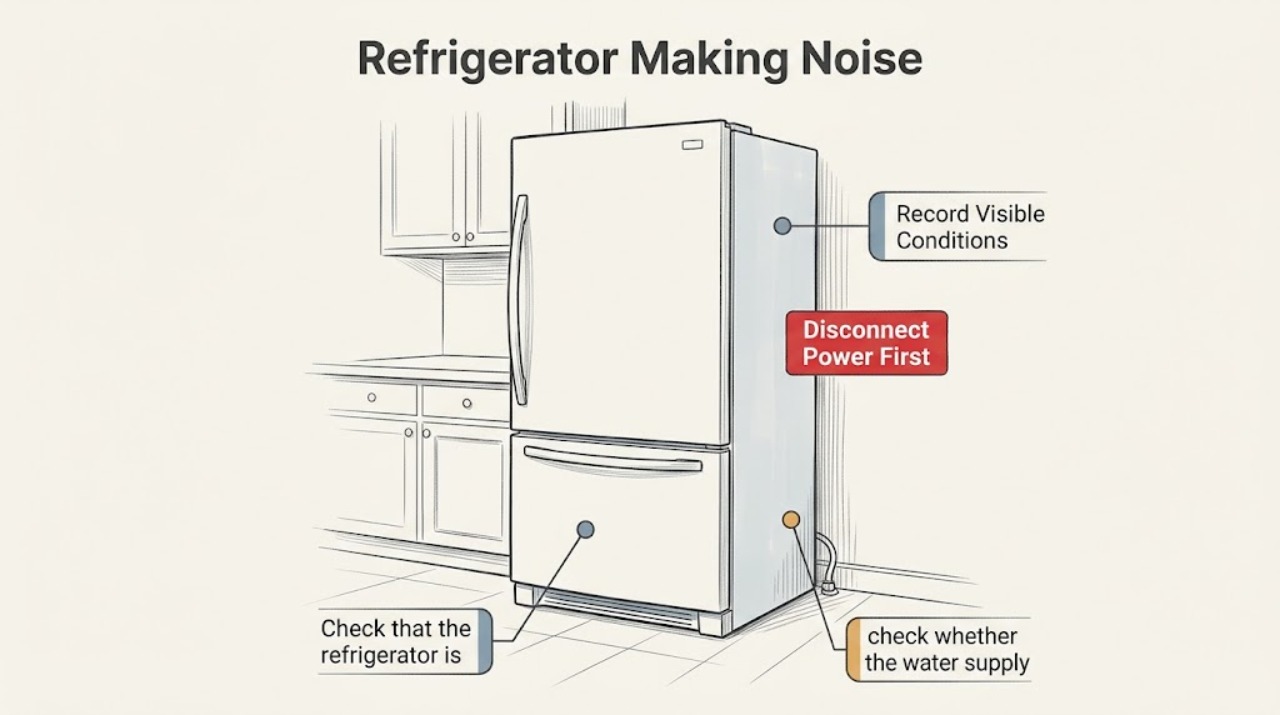
Work through in order
Diagnostic checks
Use only checks that match the exact appliance or system and its official guide.
-
Check 1
Listen from the front, freezer, and lower rear without touching moving parts. Record whether the sound is a brief click, hum, airflow, crack, buzz, scrape, or vibration and whether it follows startup, defrost, or a door event.
Expected result: The sound matches a brief operating or defrost event, or it is new, continuous, or scraping.
Next step: Continue only with the matching external check and stop if there is a burning odor, smoke, heat damage, or exposed moving part.
Why this matters
Why: The Moffat manual identifies several brief operating sounds as normal; a new or contact-like sound needs a separate check.
-
Check 2
Check that the refrigerator is level, not touching a wall or cabinet, and free of loose objects on top or shelves. Confirm drawers and shelves are seated correctly.
Expected result: The cabinet or an object vibrates against another surface, or the unit and removable parts are stable.
Next step: Remove only the loose external object and restore clearances according to the Moffat manual. Do not tilt or dismantle the appliance.
Why this matters
Why: Contact and leveling can amplify normal compressor or fan vibration; stable placement makes an internal fan or compressor issue more likely if the noise remains.
-
Check 3
If the sound is a periodic buzz and the model has an ice maker or water valve, check whether the water supply is open and whether the ice maker is enabled. Do not reach into the ice-making mechanism.
Expected result: The water supply is off while the ice maker is on, or the supply is connected and the buzz remains abnormal.
Next step: If the model permits, turn the ice maker off until water is connected. Request service for a recurring buzz, leak, or control fault.
Why this matters
Why: Official guidance says an enabled ice maker can buzz when it calls for water that is unavailable; a connected supply with persistent noise needs service diagnosis.
-
Check 4
For a scraping or rattling sound from underneath or the freezer, switch the refrigerator off and unplug it only from a dry, safe position before looking for an accessible obstruction. Do not remove covers unless the exact manual permits it.
Expected result: The sound stops when the appliance is off, an external obstruction is visible, or the sound remains unexplained.
Next step: Remove only a plainly loose external object without touching wiring or blades. Arrange service for fan contact, a damaged divider, or a sound that returns.
Why this matters
Why: A fan-blade contact or loose external part can make a contact sound; an unexplained repeat may involve a protected fan or compressor area.
Use your observations
Decision map
Find the observation that best matches what you see, then follow the next safe action.
-
PATH 01Next step
What you see
The sound is a brief click, airflow, compressor hum, or crack during automatic defrost and cooling is normal
Do this next
Monitor it and arrange service if the sound becomes new, continuous, or changes character.
Why this path and its safety boundary
Why it matters: The pattern is consistent with documented operating sounds rather than a proven failure.
-
PATH 02Next step
What you see
A buzz repeats while an ice maker is on but its water supply is off
Do this next
Turn the ice maker off according to the model instructions until water is connected; service a persistent buzz or leak.
Why this path and its safety boundary
Why it matters: The water valve may be calling for unavailable water.
-
PATH 03Next step
What you see
A scrape, fan-contact sound, smoke, burning odor, or heat damage appears
Do this next
Stop using the refrigerator, isolate power only if safe, and arrange qualified service without opening powered covers.
Why this path and its safety boundary
Why it matters: The sound is outside normal operation and may involve a moving part or electrical hazard.
Helpful context
Understand the symptom
Timing is more useful than loudness
A brief click at startup, airflow sound, or crack during defrost can be normal. A new sound tied to a door, ice-maker fill, or fan speed is more informative, so note the timing and location before moving the refrigerator.
When checks do not resolve it
Need a professional?
Arrange service for a new scraping or fan-contact sound, persistent unexplained noise, a returning vibration after leveling, a buzz with a connected water supply, or smoke, heat, or burning odor.
Safety scope: Do not touch powered fans, probe wiring, or remove covers without model instructions. Unplug only from a dry, safe position before an explicitly permitted external check.
Have this ready
- Provide the Moffat model, sound description, location, timing, whether cooling changes, leveling/clearance observations, and any water-supply or ice-maker status.
Common questions
FAQ
Are clicks and cracks from a Moffat refrigerator normal?
They can be. The Moffat manual lists compressor-start clicking and cracking during automatic defrost among normal sounds. A new or continuous sound still deserves service diagnosis.
Why does a Moffat refrigerator buzz when the ice maker is not making ice?
If the model has an ice maker, an enabled valve may buzz while calling for water that is turned off. Turn the ice maker off according to the manual until the supply is connected, and service a persistent buzz.
Read the exact guide
Official sources
- Refrigerator - Unusual NoisesGE Appliances · Refrigerator normal and unusual noise patterns, water-valve buzz, fan contact, and service guidance
- Moffat MBE19D* / UR-BCD520WE1-SQ Owner's ManualGE Appliances Canada / Moffat · This manual applies directly only to the models it lists. This article has no specific model, so it is used only for general visible checks and safety boundaries; use the appliance's own manual for specific controls and parts.
Community feedback
Share a repair observation
Share a plain-text repair observation. Accepted observations are published automatically; this page may take a moment to update.