
On this page
Start here
Quick answer
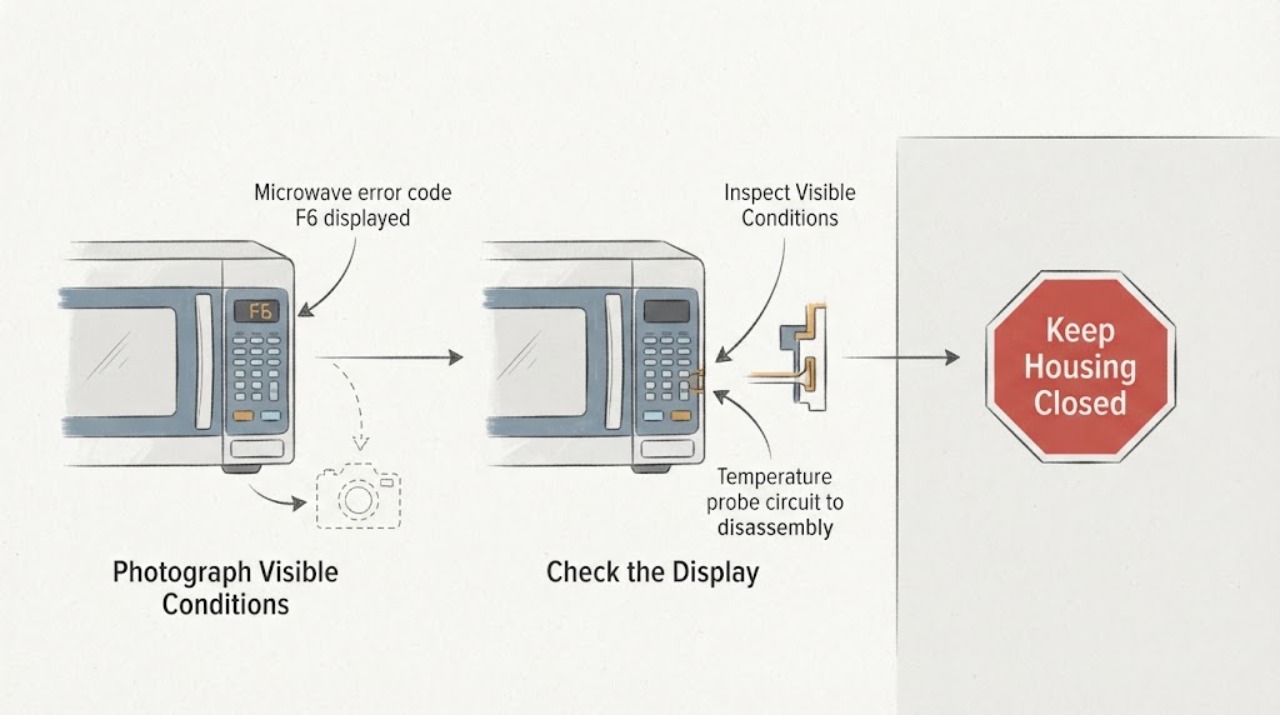
For the GE Appliances microwave fault-code family used in official support for Monogram models, F6 means a shorted temperature probe. The support page says microwave fault codes should be diagnosed by a trained service technician and notes that switching off the microwave's supplying breaker or fuse for 30 seconds may clear a code in some cases. First photograph the complete F6 display and rating-plate model, because Monogram has different countertop, drawer, built-in, and convection microwave platforms with model-specific manuals. If F6 returns after one safe 30-second power-off attempt, the oven is not cleared for continued troubleshooting: stop using it and arrange authorized service. Do not open the cabinet, access the probe, or work around microwave high voltage.
Work through in order
Diagnostic checks
Use only checks that match the exact appliance or system and its official guide.
-
Check 1
From outside the microwave, photograph the complete display and rating plate. Record whether the code is exactly F6, F6E0, F6 with extra characters, or a different message, along with the model, suffix, serial number, market, and whether the unit is countertop, drawer, built-in, over-the-range, or convection.
Expected result: The display is exactly F6 and the model is identifiable, or the display format, model, or microwave type is uncertain.
Next step: Continue only when the complete display and model are recorded. If identity is uncertain, use the exact Monogram owner manual or service route and keep the oven off if it is behaving abnormally.
Stop if: Do not enter a hidden diagnostic mode, pry the control panel, or use another brand or microwave platform's F6 procedure.
Why this matters
Why: Official Monogram owner pages show different microwave platforms and model-specific manuals, while the official fault table is a common microwave reference. An unmatched code format cannot safely inherit F6's meaning or reset instruction.
-
Check 2
If the exact display is F6 and there is no immediate hazard, leave the microwave door closed and note whether the code appeared during a temperature-probe or sensor-cooking function, at startup, after a power event, or during a normal Cook cycle. Do not insert, remove, or reposition an internal probe unless the exact manual explicitly identifies an owner-accessible probe connection.
Expected result: F6 appears during a probe-related function, appears immediately at startup, appears during ordinary heating, or its onset is unknown.
Next step: Keep the full event history for service and do not run repeated heating cycles to reproduce the code. Do not select a probe, board, or other part from F6 alone.
Stop if: Do not open the cabinet, access wiring, remove panels, or attempt any microwave high-voltage or sensor continuity test.
Why this matters
Why: The official fault table identifies F6 as a shorted temperature probe, but the onset alone cannot determine whether the probe, wiring, connector, or electronic control is responsible.
-
Check 3
Only when the oven is otherwise dry and intact, there is no smoke, odor, arcing, door damage, water near electrical parts, or repeated trip, switch off the supplying breaker or fuse for 30 seconds as the official support article describes. Restore power once and observe the display without starting a Cook cycle.
Expected result: F6 clears and the display returns normally, F6 returns immediately, the display becomes erratic, or the breaker/fuse trips again.
Next step: If F6 returns or power behavior is abnormal, leave the microwave isolated and arrange authorized Monogram/GE service. If it clears, use the exact model manual before any normal use and stop if the code returns.
Stop if: Do not repeat the reset, bypass a breaker, use an extension cord to test the appliance, or start an empty or repeated heating cycle.
Why this matters
Why: The official article says a 30-second power-off may clear a fault code in some cases; a returning F6 remains an unresolved probe/control fault and a repeat trip is an electrical safety boundary.
-
Check 4
Prepare a service handoff with the F6 photo, complete Monogram model and serial number, microwave type, market, onset and power history, probe-cooking context if any, whether the single 30-second reset was attempted, and any cold-food, arcing, odor, or door symptoms. Keep the cabinet closed while waiting.
Expected result: F6 persists or returns, the exact model documentation does not match the display, the microwave starts but does not heat normally, or any physical or electrical hazard is present.
Next step: Arrange Monogram-authorized or qualified microwave service. Stop use immediately for smoke, burning odor, sparks, damaged door or cavity, water near electrical parts, or repeated protective-device trips.
Stop if: Do not remove the outer cover, probe the magnetron or capacitor area, defeat the door interlock, or order a probe/control board from F6 alone.
Why this matters
Why: A persistent fault needs model-specific diagnosis of the temperature-probe circuit and control system. Cold food, arcing, odor, door damage, or power trips are separate safety signals that are not solved by resetting F6.
Use your observations
Decision map
Find the observation that best matches what you see, then follow the next safe action.
-
PATH 01Next step
What you see
The complete display is F6, the Monogram model is identified, and the code clears after the one safe 30-second power-off attempt without any hazard.
Do this next
Use the exact model manual before normal cooking and monitor closely; arrange service if F6 returns or the microwave behaves abnormally.
Why this path and its safety boundary
Why it matters: The official support article allows that a power reset may clear a fault code in some cases, but clearing the display does not prove that the temperature-probe circuit is healthy.
-
PATH 02Next step
What you see
F6 returns immediately or during the next normal operation after the reset, or the model is a different Monogram platform than the documentation being used.
Do this next
Stop use, keep the cabinet closed, and arrange Monogram-authorized service with the model, code photo, and event history.
Why this path and its safety boundary
Why it matters: The fault remains unresolved; F6 points to the temperature-probe circuit in the official table, but the exact component and repair path are model-specific.
-
PATH 03Next step
What you see
The microwave shows smoke, burning odor, sparks or arcing, a damaged or misaligned door, water near electrical parts, a hot cord or plug, or a repeated breaker/fuse trip.
Do this next
Stop using the microwave. Disconnect power only from a safe position if possible, keep the door and cabinet closed, and obtain qualified microwave or electrical service.
Why this path and its safety boundary
Why it matters: This is a microwave electrical, fire, or containment boundary, not a temperature-probe troubleshooting branch.
Helpful context
Understand the symptom
What F6 means in the official microwave fault table
The opened GE Appliances microwave support article lists F6 as a shorted temperature probe. It also says that fault codes help technicians diagnose the microwave and that a trained service technician should be called to diagnose and correct an electronic fault. This points to the probe circuit or its related control path, not to a user-adjustable cooking setting. The table is a common microwave support reference, so the exact Monogram model and display format still need to be confirmed before applying it.
Confirm the Monogram platform before resetting
Monogram owner support identifies materially different products, including a built-in microwave such as ZCWK22U2WSS and a microwave drawer such as ZWL1126SRSS, each with its own owner manual and support route. Older countertop and built-in/convection models also have different controls. Record the complete model, suffix, serial number, market, and whether the display says F6, F6E0, or another code; do not borrow a reset or probe procedure from a different platform.
The reset and safety boundary
If there is no smoke, burning odor, arcing, damaged door, water near electrical parts, or repeated breaker trip, the official support article allows that switching off the supplying breaker or fuse for 30 seconds may clear a fault code. Treat this as one normal power reset, not a repair or a reason to repeat the test. If F6 returns, keep the cabinet closed and arrange authorized service; a microwave contains hazardous high-voltage parts even when it appears unpowered.
When checks do not resolve it
Need a professional?
Arrange Monogram-authorized or qualified microwave service when F6 returns after the single 30-second power-off attempt, the exact model documentation does not match, or the code accompanies cold food, arcing, smoke, burning odor, door damage, water near electrical parts, or a repeated breaker/fuse trip. Keep the cabinet closed and stop immediately for any hazard.
Have this ready
- Complete F6 display photo, Monogram model and suffix, serial number, microwave type and market, onset and power history, probe-cooking context, result of the one reset, and any heating, door, odor, spark, or protection-trip observations.
Common questions
FAQ
What does F6 mean on a Monogram microwave?
The official GE Appliances microwave fault table lists F6 as a shorted temperature probe. Because Monogram has several microwave platforms and model-specific manuals, confirm the complete model and display format before applying the table.
Can I clear Monogram F6 by switching off power?
If there is no smoke, odor, arcing, door damage, water near electrical parts, or repeated trip, the official support page says switching off the supplying breaker or fuse for 30 seconds may clear a fault code in some cases. Do it once only; if F6 returns, arrange service instead of repeating the reset.
Can I replace the temperature probe or open the microwave?
No. F6 identifies a shorted probe condition in the official table, not a confirmed user-replaceable part. Microwave probe, control, and high-voltage work should be diagnosed by a trained technician with the exact model documentation.
Read the exact guide
Official sources
- User Manual & Care for ZCWK22U2WSSGE Appliances / Monogram · Opened official Monogram owner-center page to confirm model-specific manuals and service routing for a built-in microwave; it does not define F6 for every Monogram platform.
- User Manual & Care for ZWL1126SRSSGE Appliances / Monogram · Opened official Monogram owner-center page to confirm that drawer microwaves have a distinct model-specific manual and support route; it does not define F6 for every Monogram platform.
- Microwave - Error, Fault or Function CodesGE Appliances · Opened official GE Appliances microwave support page; it lists F6 as a shorted temperature probe and provides a limited 30-second power-off possibility, but directs electronic fault diagnosis to a trained technician and does not select a model-specific replacement part.
Community feedback
Share a repair observation
Share a plain-text repair observation. Accepted observations are published automatically; this page may take a moment to update.