
On this page
Start here
Quick answer
First identify whether the Monogram oven is completely inactive, starts but never warms, preheats slowly, or reaches some heat but not the selected temperature. Confirm the correct Bake or Broil mode, temperature and Start command, then check the household breaker or fuse and the exact model manual. A self-clean latch, Sabbath mode, incorrect mode, blocked airflow, or a normal cycling element can look like a heating failure. On an electric model, with power safely isolated, a visibly cracked or broken bake element is a service clue; on a gas model, a normal red igniter glow without heat or no glow points to a qualified gas-appliance diagnosis. Do not remove panels, test live circuits, bypass a door or safety control, manually light gas, or continue testing after gas odor, delayed ignition or boom, abnormal flame, smoke, burning odor, arcing, overheating, or repeated breaker trips.
Before you begin
Safety first
- Owner checks are limited to controls, breaker or fuse observations, cool accessible door and airflow checks, and a visual electric-element inspection only after confirmed power isolation and model instructions. Do not operate switches in a gas-smelling area, manually ignite, test energized circuits, bypass safety devices, move a built-in oven, or open gas or electrical compartments.
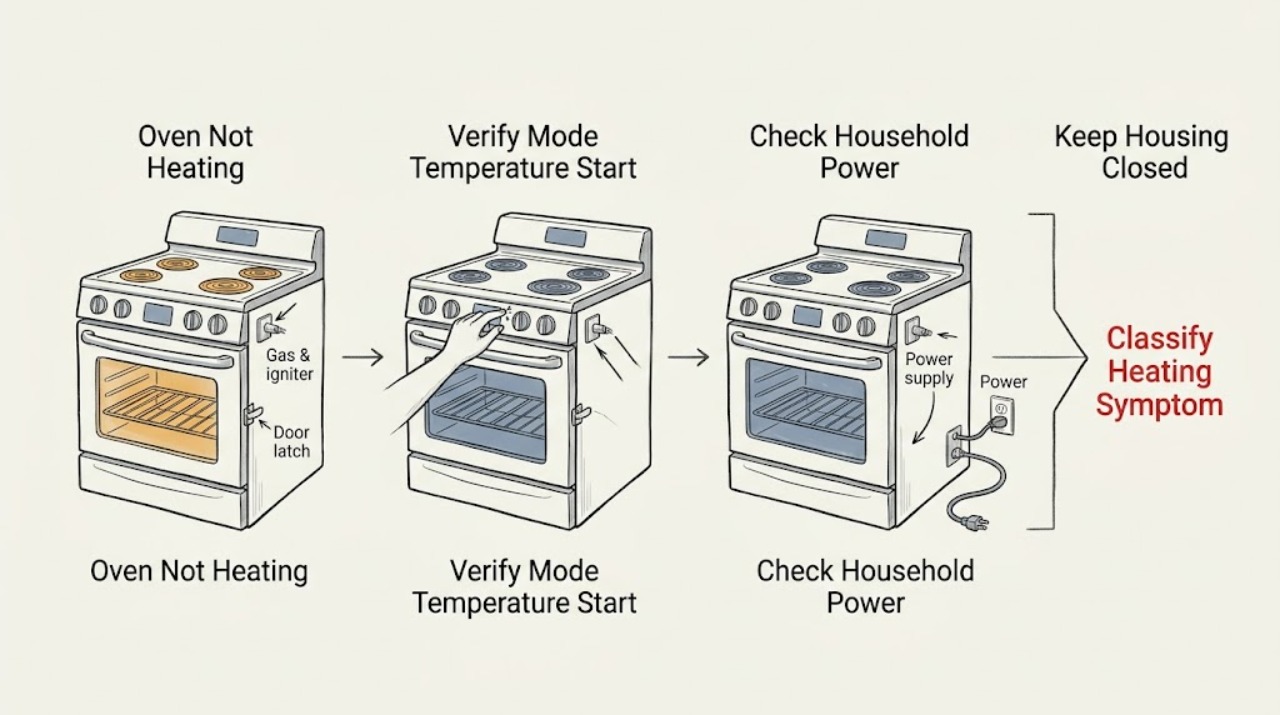
Work through in order
Diagnostic checks
Use only checks that match the exact appliance or system and its official guide.
-
Check 1
With the oven cool and no hazard present, note whether the Monogram display and interior light work, whether Bake or Broil starts, whether the preheat indicator appears, and whether the cavity gains any heat at all.
Expected result: Record one of four states: no display or response; display but no start; a cycle starts but remains cold; or the oven warms slowly or unevenly.
Next step: Use the matching checks below and preserve the exact model and fuel type. Do not open the appliance to identify a component.
Stop if: Stop immediately for gas odor, smoke, arcing, a burning smell, an unusually hot control area, damaged glass, or repeated breaker trips.
Why this matters
Why: No display suggests a supply or control-state issue; a cycle that starts but stays cold points toward the applicable heating path; slow or uneven heat can be settings, airflow, door sealing, sensor, or normal cycling rather than a completely failed heater.
-
Check 2
Check the control panel or knobs against the exact Monogram manual: select Bake or Broil, set a deliberate temperature, and press Start when the model requires it; confirm that a timer, Delay Start, Control Lock, or Sabbath mode is not preventing the cycle.
Expected result: The oven may begin a normal cycle, show a preheat indication, remain in a delayed or locked state, or show an error/fault code.
Next step: If the cycle starts, allow the model's normal preheat period without repeatedly opening the door. If it does not, photograph the complete code and consult the exact manual or Monogram support.
Stop if: Do not guess at a code, defeat a control lock, force a latch, or keep initiating cycles when the oven smells of gas, smoke, or burning material.
Why this matters
Why: A missing Start command, wrong function, delayed schedule, lock, or Sabbath mode can make a working oven appear not to heat. An error code or a correctly started cycle with no heat needs model-specific diagnosis.
-
Check 3
Check the household breaker or fuse serving the Monogram oven without removing covers or touching wiring; if the breaker is tripped, perform only the single reset permitted by the installation and owner instructions.
Expected result: The breaker is on and stable, the display returns after a reset, the display remains dead, or the breaker trips again.
Next step: If the breaker will not stay on or the appliance remains dead, leave it off and arrange an electrician or qualified Monogram service inspection. Record whether other circuits are affected.
Stop if: Do not repeatedly reset a tripping breaker, use an extension cord, access a built-in connection, or continue if there is heat, an electrical odor, visible damage, or arcing.
Why this matters
Why: A stable reset can clear a control-state glitch. A dead display can indicate loss of supply or control power; a repeat trip indicates an electrical fault or overload, not a reason to keep resetting.
-
Check 4
When the oven is cool, confirm that the door closes normally, the self-clean latch is fully unlocked after any cleaning cycle, racks are seated correctly, vents are not blocked, and foil or liners are not covering the rack or cavity airflow path.
Expected result: The latch is locked, the door or gasket is damaged or misaligned, a rack or liner blocks circulation, or the door and airflow look normal.
Next step: Remove only cool, loose items that the exact manual permits. If the latch will not release after cooling or the gasket, glass, or frame is damaged, stop and request service.
Stop if: Do not force the door, pry the latch, remove the gasket, cover vents, or run self-cleaning as a test for a heating failure.
Why this matters
Why: A locked self-clean door can inhibit operation on applicable models, while a damaged gasket or blocked airflow can cause heat loss or poor results. A normal door and unobstructed vent do not rule out a heater or control fault.
-
Check 5
For a cycle that starts, keep the door closed and compare the observed warm-up with the exact Monogram manual and the selected mode; distinguish a delayed preheat from a cavity that never warms.
Expected result: The oven reaches temperature after a normal interval, takes substantially longer than expected, cycles heat on and off, or never produces heat.
Next step: Record the mode, set temperature, time to warm, and any error message. If a long preheat persists, perform only the documented one-time reset and then arrange service if it remains abnormal.
Stop if: Do not repeatedly run empty high-heat cycles, calibrate around a failed heater, or continue when smoke, burning odor, abnormal flame, or uncontrolled temperature appears.
Why this matters
Why: GE Appliances gives different expected preheat ranges by oven type and notes that elements cycle to maintain temperature. A long or absent preheat after settings and power checks points toward supply, sensor, heating, ignition, or control service.
-
Check 6
For an electric Monogram model only, switch the oven off and isolate its power at the breaker or fuse as directed by the exact manual, then make a visual inspection of the accessible bake element for a crack, blister, break, or obvious burn mark; do not remove it.
Expected result: The element is visibly damaged, looks intact, or the appliance is built in and power isolation or access is uncertain.
Next step: If visibly damaged, leave power isolated and provide the model information to Monogram service for the correct part and repair. If intact or access is uncertain, restore nothing beyond the manual's instructions and arrange qualified diagnosis.
Stop if: Do not touch terminals, remove panels, probe wiring, restore power with exposed parts, or perform this check on a gas or combination model without model-specific instructions.
Why this matters
Why: GE Appliances identifies a cracked or broken bake element as a service clue. An intact-looking element does not prove that the element, relay, sensor, wiring, or supply is good, and an uncertain isolation state makes inspection unsafe.
-
Check 7
For a gas Monogram model only and only when there is no gas odor or abnormal ignition, use the exact manual to identify whether Bake or Broil is selected and observe from a safe position whether the applicable igniter shows the model's normal indication; do not attempt to light the burner manually.
Expected result: The gas supply is known to be available, the igniter shows the expected indication but heat does not develop, the igniter shows no indication, or the ignition behavior is delayed, loud, or abnormal.
Next step: Stop the cycle and arrange qualified Monogram gas-appliance service for any failed or abnormal ignition. Keep the model, fuel type, timing, and visible behavior for the technician.
Stop if: If gas is smelled, ignition is delayed, there is a boom, yellow or abnormal flame, smoke, or symptoms of carbon-monoxide exposure, stop immediately, leave if needed, and contact the gas supplier or emergency responders from a safe location.
Why this matters
Why: GE Appliances states that gas ovens need both gas supply and electrical ignition; no expected igniter indication can point to an igniter, control, or electrical fault, while an indication without heat requires qualified gas-appliance diagnosis. Delayed ignition, a boom, or abnormal flame is unsafe to reproduce.
-
Check 8
For a Monogram oven that warms but cooks slowly, check the recipe mode, convection conversion setting, rack and pan spacing, door-opening frequency, and visible gasket condition without disassembling the door or vent.
Expected result: Convection conversion lowered the set temperature, pans or foil restrict airflow, the door is opened often, the gasket is torn, or these conditions are normal.
Next step: Correct only the documented placement or setting issue and repeat a normal recipe test once. If the gasket is damaged or heating remains poor, request service rather than compensating with unsafe heat.
Stop if: Do not cover the shelf with foil, block the vent, pull a built-in oven from the cabinet, or operate with damaged glass, gasket, wiring, or uncontrolled heat.
Why this matters
Why: GE Appliances explains that convection conversion can change the set temperature, cookware placement affects circulation, and a torn gasket can let heat escape. These factors explain poor cooking results but not a cavity that stays completely cold.
-
Check 9
If the safe checks do not restore heating, stop using the oven and prepare the Monogram model and serial information, fuel type, mode, set temperature, preheat behavior, error code, breaker history, and any visible signs for qualified service.
Expected result: The fault is resolved by a documented low-risk setting or reset, or heating remains absent, intermittent, unsafe, or model-specific.
Next step: Use the official Monogram support path or a qualified appliance technician and follow the exact model instructions. Keep the oven out of service until the technician clears it.
Stop if: Do not replace a part based on appearance alone, bypass a safety device, open the control area, test energized circuits, or keep operating after a safety symptom.
Why this matters
Why: Persistent no-heat symptoms can involve a sensor, relay, control, element, igniter, valve, wiring, supply, grounding, or combustion path that cannot be safely diagnosed by a general owner check.
Use your observations
Decision map
Find the observation that best matches what you see, then follow the next safe action.
-
PATH 01Safety boundary
What you see
The display and interior light are dead, the breaker is tripped, or the breaker trips again after one documented reset.
Do this next
Leave the oven off, record the breaker behavior, and arrange an electrician or qualified Monogram service inspection.
Why this path and its safety boundary
Why it matters: The symptom is primarily a power or control-supply problem, and a repeat trip may indicate an electrical fault.
Safety stop: Do not keep resetting, use an extension cord, access wiring, or continue if there is heat, smoke, an electrical smell, or arcing.
-
PATH 02Safety boundary
What you see
The controls have power but the oven will not begin a cycle.
Do this next
Verify the exact model's control sequence and record the complete code or message; request service if the correct sequence does not start the cycle.
Why this path and its safety boundary
Why it matters: Mode, temperature, Start, Delay Start, Control Lock, Sabbath mode, door latch, or an error state may be preventing heating.
Safety stop: Do not force controls or the door latch, guess at a fault-code meaning, or continue when smoke, gas, burning odor, or arcing is present.
-
PATH 03Safety boundary
What you see
An electric oven starts but the accessible bake element is visibly cracked or broken after power is safely isolated.
Do this next
Keep power isolated and provide the exact model information to Monogram service for a correct replacement and inspection.
Why this path and its safety boundary
Why it matters: The element is a credible service clue, but other components may also be involved.
Safety stop: Do not remove terminals, open panels, or restore power with exposed or damaged parts.
-
PATH 04Safety boundary
What you see
A gas oven has no expected igniter indication, shows an indication without heat, or has delayed ignition or abnormal flame.
Do this next
Keep the appliance off and arrange qualified Monogram gas-appliance service. Report a gas odor or emergency sign to the gas supplier or emergency responders first.
Why this path and its safety boundary
Why it matters: Gas supply, igniter, control, valve, combustion, or installation needs qualified diagnosis; delayed or abnormal ignition is a safety issue.
Safety stop: Do not manually light, bypass ignition, adjust gas parts, repeat a boom or delayed ignition, or operate with yellow flame, smoke, or gas odor.
-
PATH 05Safety boundary
What you see
The oven eventually warms but takes much longer than the model guidance, cooks unevenly, or does not maintain the selected temperature.
Do this next
Correct documented placement or mode issues, record preheat timing, and request service when the condition persists after one safe reset if the manual permits.
Why this path and its safety boundary
Why it matters: Settings, convection conversion, rack or pan placement, door sealing, supply, sensor, heating, or normal cycling may be involved.
Safety stop: Do not use extreme temperatures, block airflow, leave the oven unattended to force heat, or continue with smoke, odor, damaged gasket, or uncontrolled temperature.
-
PATH 06Safety boundary
What you see
There is a gas odor, hissing, delayed ignition or boom, abnormal or yellow flame, smoke, or possible carbon-monoxide symptoms.
Do this next
Stop using the appliance, leave the building if the odor or symptoms warrant it, and contact the gas supplier or emergency responders from a safe location according to local emergency guidance.
Why this path and its safety boundary
Why it matters: Treat this as a possible gas or combustion emergency rather than a no-heat repair.
Safety stop: Do not touch electrical switches, use a flame, operate the oven, search for a leak, or re-enter until qualified responders clear the area.
Helpful context
Understand the symptom
Separate no heat from slow or apparently uneven heat
A Monogram oven that never warms needs a different path from one that eventually cooks but takes too long. Record whether the display responds, whether the oven announces preheat, whether Bake and Broil behave differently, and whether the cavity is merely cycling. GE Appliances notes that gas and electric ovens cycle elements or burners on and off to maintain an average temperature; a changing temperature is not automatically a failed heater. Use the exact Monogram model manual for controls, fuel configuration, and any model-specific fault code.
Fuel type changes the safe checks
A Monogram electric oven may have a bake or broil element, control, relay, sensor, or supply fault. A gas model also depends on gas supply, ignition and combustion. Do not apply a gas-oven igniter check to an electric model or assume that a cooktop burner proves the oven burner is safe. If gas is smelled, the source is uncertain, or ignition is delayed, stop treating the problem as a heating test and follow the gas-emergency path.
What a safe endpoint looks like
Owner checks can establish settings, power symptoms, door-latch position, visible residue, and whether an electric element is visibly damaged after power is isolated. They cannot prove a control board, sensor, relay, igniter, gas valve, regulator, wiring, grounding path, or combustion condition is safe. When the simple checks do not restore heating, preserve the model, fuel type, error display, and timing for Monogram support or a qualified appliance technician.
Safety boundary
Stop conditions
- Stop and leave the area or building as appropriate for any gas odor, hissing, delayed ignition, boom, abnormal flame, smoke, or suspected carbon-monoxide symptoms; contact the gas supplier or emergency responders from a safe location.
- Do not touch electrical switches, use a flame, manually light gas, search for a leak, bypass a door or safety control, or repeat an abnormal ignition test.
- Stop after a breaker trips again, an electrical odor or arc appears, controls become unusually hot, or wiring, glass, gasket, or other structural parts are damaged.
- Do not remove panels, probe energized circuits, alter gas supply or regulator components, or dismantle an element, igniter, valve, sensor, or control as an owner test.
- Keep the oven out of service when safe checks do not restore heat; use the exact Monogram model documentation and qualified service for model-specific diagnosis.
Only after diagnosis
Potential parts
- electric bake or broil element
Consider this category only if the exact electric model and a qualified diagnosis confirm a failed element or a visibly damaged element is documented after power isolation.
Confirm the exact Monogram model and element configuration before ordering; do not treat an intact-looking element as proof that other controls or wiring are good. - gas oven igniter or burner assembly
Consider this category only when a qualified technician confirms an ignition or burner fault on a gas model after checking supply and installation conditions.
Match the exact Monogram model and fuel configuration; never manually light, bypass, or replace gas components as a home test. - oven temperature sensor or control component
Consider this category only after qualified diagnosis shows that settings and supply are correct but temperature control, sensing, or cycle control is faulty.
Confirm exact model fitment and the technician's diagnosis; do not open the control area or substitute a generic component.
When checks do not resolve it
Need a professional?
Use Monogram support or a qualified appliance technician when the oven has no heat after the control, power, door, and model-appropriate checks; when an electric element is damaged; when a gas igniter or burner does not behave normally; when an error code remains; or when the oven needs internal access, electrical testing, gas work, or combustion diagnosis. Use the gas supplier or emergency responders immediately for gas odor, hissing, delayed ignition, abnormal flame, smoke, or possible carbon-monoxide symptoms.
Safety scope: Owner checks are limited to controls, breaker or fuse observations, cool accessible door and airflow checks, and a visual electric-element inspection only after confirmed power isolation and model instructions. Do not operate switches in a gas-smelling area, manually ignite, test energized circuits, bypass safety devices, move a built-in oven, or open gas or electrical compartments.
Common questions
FAQ
Why does my Monogram oven turn on but not heat?
Verify the mode, temperature, Start command, lock or Sabbath state, and household power first. Then follow the electric or gas branch for the confirmed model. A failed element, sensor, control, supply, igniter, valve, or wiring fault may remain and needs qualified diagnosis when the safe checks do not restore heat.
How long should a Monogram oven take to preheat?
Preheat time depends on the oven type, selected temperature, starting and room temperature, racks, and installation supply. Use the exact Monogram manual and compare the behavior without repeatedly opening the door. A much longer-than-expected preheat that persists after settings and one permitted reset should be serviced.
Can I check the bake element myself?
On an electric model, you may make only a visual check of an accessible bake element after the oven is off and power is safely isolated as the exact manual directs. A crack or break is a service clue. Do not remove panels, touch terminals, probe wiring, or perform this check on a gas or combination model without model-specific instructions.
What if my Monogram gas oven has no heat but the burners work?
A gas cooktop can work while the oven's supply, igniter, valve, control, or burner path has a fault. If there is no gas odor or abnormal ignition, record the model-specific igniter indication and arrange qualified gas-appliance service for an unresolved problem. Never manually light or bypass ignition.
When is a Monogram oven not heating an emergency?
Stop immediately for gas odor, hissing, delayed ignition or a boom, abnormal flame, smoke, burning or electrical odor, arcing, repeated breaker trips, uncontrolled heat, damaged glass, or possible carbon-monoxide symptoms. Leave or isolate the area as appropriate and contact the gas supplier or emergency responders from a safe location for gas-related signs.
Read the exact guide
Official sources
- Range & Wall Oven - Oven Will Not Come OnGE Appliances · Official GE Appliances support guidance for range and wall-oven operating checks; the installed Monogram model manual controls for exact features and fuel configuration.
- Gas Range - What is Normal Operation vs What Requires ServiceGE Appliances · Official GE Appliances gas-range operating guidance; use only as a safety distinction for a confirmed gas Monogram model.
- Gas Range - Gas OdorsGE Appliances · Official GE Appliances gas-odor guidance; use the emergency boundary for a Monogram gas oven when the source or odor is uncertain.
- Support & Service | Monogram AppliancesMonogram Appliances · Official Monogram support portal for model-specific documentation and service routing.
- Gas Range & Wall Oven - Oven Will Not Come OnGE Appliances · Official GE Appliances gas range and wall-oven support guidance; only apply gas checks to a Monogram model confirmed to be gas and follow its exact manual.
- Gas Range - Oven Does Not Heat, But The Burners HeatGE Appliances · Official GE Appliances guidance for a gas range whose surface burners work but oven does not heat; use only for a confirmed gas Monogram configuration.
- Range & Wall Oven - Oven Temperature Is Not CorrectGE Appliances · Official GE Appliances temperature guidance for ranges and wall ovens; apply with the exact Monogram model's cooking and calibration instructions.
- Range & Wall Oven - Preheat Time Too LongGE Appliances · Official GE Appliances preheat guidance for ranges and wall ovens; exact Monogram model, voltage, fuel, and installation instructions control.
Community feedback
Share a repair observation
Share a plain-text repair observation. Accepted observations are published automatically; this page may take a moment to update.