
On this page
Start here
Quick answer
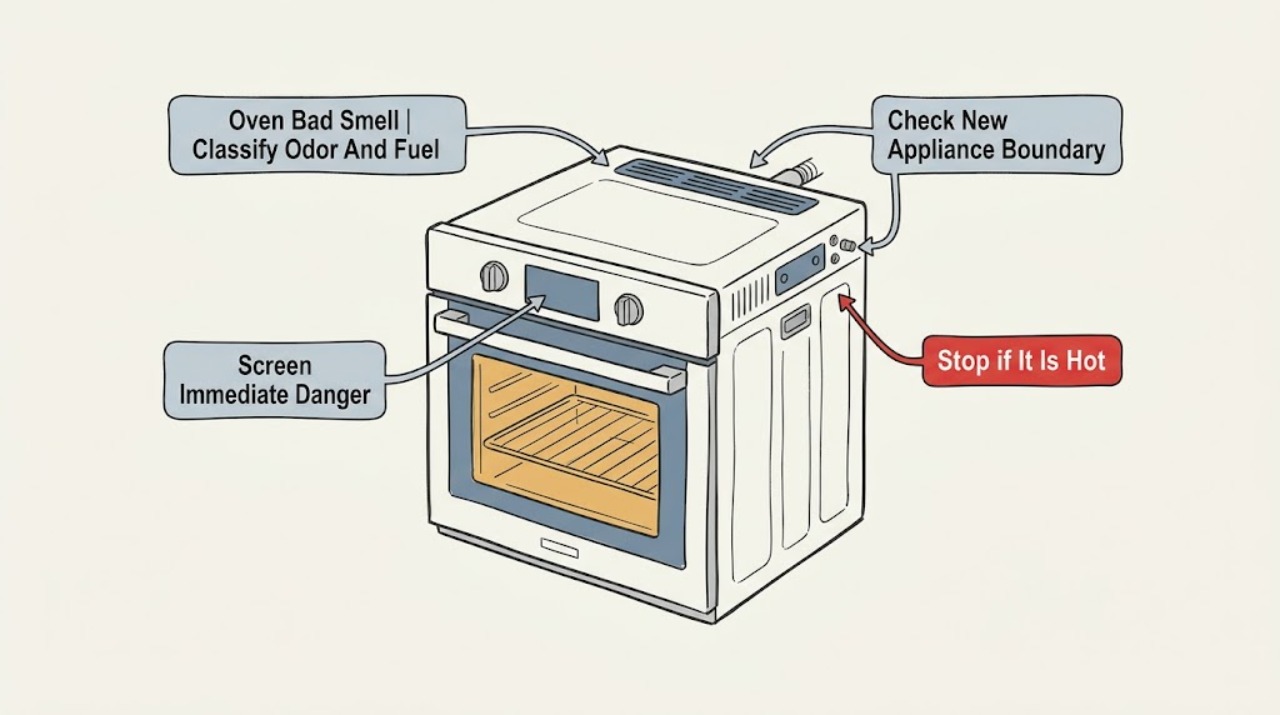
Do not treat every oven smell as the same problem. First identify whether the oven is gas, electric, dual-fuel, or unknown, and whether the smell is gas-like, electrical or burnt plastic, food or grease, cleaning chemical, or a mild new-appliance odor. A brief odor during first use can come from factory residue or packaging, but a gas smell when the oven is off, a persistent or worsening gas odor, smoke, arcing, an electrical burning smell, abnormal flame, or a carbon-monoxide alarm is a stop condition. Turn the oven off using its normal control if safe, avoid flames and electrical switches when gas may be present, leave for a safe location, and use emergency or gas assistance. For a non-hazardous food or new-oven odor, inspect only after the cavity is cool, remove visible packaging or residue, clean only as the model manual permits, and ventilate. Do not use self-clean, open panels, scrape heating elements, mix cleaners, or keep testing an unexplained smell. If the odor returns after safe cleaning or its source is uncertain, use qualified appliance service.
Before you begin
Safety first
- The homeowner should limit the work to fuel identification, normal control shutoff when safe, dry-distance observation, cool-cavity inspection, and model-approved cleaning. Professionals handle gas, combustion, venting, internal electrical, igniter, burner, element, and control diagnosis.
Work through in order
Diagnostic checks
Use only checks that match the exact appliance or system and its official guide.
-
Check 1
From a safe position, record the oven fuel type, model if visible, when the smell occurs, and its character: gas-like, electrical or burnt plastic, food or grease, chemical, or mild new-appliance odor. Do not deliberately heat the oven again to compare smells.
Expected result: The fuel type is gas, electric, dual-fuel, or unknown; the smell occurs while off, during ignition or preheat, during cooking, during self-clean, or after the oven is turned off.
Next step: Use the emergency stop branch for gas, smoke, electrical, abnormal flame, or CO signs. Otherwise keep the oven off until cool and continue with non-invasive inspection and model-specific guidance.
Why this matters
Why: Fuel and timing change the risk. A gas-like smell while off is not a normal cooking residue. A brief new-appliance odor may have a manufacturer-supported explanation, while a smell tied to a hot control, smoke, or arcing points to an electrical hazard. Self-clean can create expected fumes but does not explain every odor.
-
Check 2
Check only from a safe distance for a persistent gas odor, hissing, smoke, sparks or arcing, a hot or discolored control area, an abnormal flame, a CO alarm, or symptoms such as headache, dizziness, nausea, shortness of breath, confusion, or unusual fatigue. Do not touch the oven, open its door to investigate, or operate switches when gas may be present.
Expected result: Any gas, smoke, arcing, abnormal flame, heat damage, CO alarm, or possible exposure symptom is present; or none is observed.
Next step: For gas or suspected CO, leave and use emergency or gas assistance from a safe location. For smoke, fire, arcing, or severe electrical heat, keep clear and use emergency assistance. Do not return the oven to operation until the responsible professional confirms it is safe.
Why this matters
Why: These signs can indicate gas release, combustion failure, fire, electrical fault, or CO exposure. The absence of a visible sign does not prove safety, especially because CO is odorless and hidden faults cannot be seen.
-
Check 3
If the oven is newly installed, cool, free of hazard signs, and the odor is mild and temporary, inspect the cavity and racks for shipping film, cardboard, ties, packaging, or protective material without removing fixed parts. Ventilate as the manual allows and keep food out during any manufacturer-directed first-use cycle.
Expected result: Packaging or residue is visible; the odor is fading after the documented first uses; or the smell is strong, worsening, persistent, or accompanied by smoke beyond the model guidance.
Next step: Remove only loose packaging and clean only as the manual directs. If the odor is not fading, stop heating and arrange manufacturer-qualified appliance service. Move pet birds away from fumes because manufacturer guidance warns that birds can be highly sensitive.
Why this matters
Why: New parts, insulation, protective coating, or shipping material can cause a temporary odor. Persistent or intense odor is not automatically a normal break-in event, especially if material is melting, smoke is heavy, or the fuel type is gas.
-
Check 4
After the oven is fully cool and no gas or electrical hazard is present, use a light to inspect the cavity floor, racks, broiler or roasting pan, door area, and visible vent openings for food, grease, foil, liners, plastic, or cleaning residue. Do not touch heating elements, igniters, insulation, seals, or wiring.
Expected result: A spill or greasy residue is close to a heat source; foil or a liner covers the floor or blocks an opening; plastic or a foreign object is present; or the cavity is visibly clean.
Next step: Remove only loose, cool items and follow the model cleaning instructions. Do not scrape or soak fixed components. If plastic has melted, smoke returns, or the cavity is clean but the odor persists, stop use and request service.
Why this matters
Why: Food and grease can smoke or smell when heated. Foil or a liner can trap residue and interfere with airflow or combustion on applicable ovens. A clean cavity with a continuing burnt or chemical odor makes a hidden electrical, gas, venting, or component issue more likely.
-
Check 5
With the oven cool and isolated from use, clean removable racks and accessible residue only by the model manual's approved method. Use ventilation, protect skin and eyes as directed by the product label, and never combine cleaners or pour liquid into vents, controls, burners, igniters, or heating elements.
Expected result: The odor disappears after residue is removed; the odor returns on normal heating; a chemical smell remains; or the cleaner contacts an electrical or gas component.
Next step: Do not operate until all surfaces are dry and the manual permits use. If the smell returns, chemical exposure occurred, or liquid reached a component, stop and obtain qualified appliance guidance. Never start self-clean solely to burn off an unknown substance.
Why this matters
Why: Improvement after safe residue removal supports a food or grease source. Recurrence with heat suggests a hidden spill, component, venting, ignition, or electrical issue. Chemical residue near heat can create fumes and must not be chased with another product.
-
Check 6
For a confirmed gas oven with no emergency signs, note whether a faint odor occurs only briefly as a normal ignition begins, whether the oven fails to establish heat, or whether odor continues while off or after a failed start. Do not use a match, repeatedly cycle the control, open the door during a suspected delayed ignition, or inspect an internal burner.
Expected result: The odor is brief and fades with normal ignition; it is persistent or strong; ignition is delayed with a bang or flare; the flame is abnormal; or the oven does not ignite.
Next step: Stop immediately for persistent odor, delayed ignition, bang, flare, abnormal flame, or failed combustion with gas present. Leave and use gas or emergency assistance from a safe location. A qualified technician must assess the igniter, burner, valve, regulator, airflow, and venting.
Why this matters
Why: A short ignition odor can occur on some gas models, but persistent odor, delayed ignition, a flare, abnormal flame, or failed ignition can leave unburned gas or signal a gas-system or combustion fault. CPSC testing documents hazardous delayed ignition and flare-ups in some gas ovens.
-
Check 7
For an electric or dual-fuel oven, note from a safe distance whether the smell begins near the control area, plug, outlet, cord, heating element, or cavity and whether there is smoke, discoloration, buzzing, crackling, a hot surface, or a tripped breaker. Do not remove covers, pull a built-in oven, or perform live electrical tests.
Expected result: The odor is electrical or burnt plastic; a cord, outlet, control, or panel is hot or discolored; a breaker trips; or the odor appears only after food residue heats.
Next step: Turn the appliance off using the normal control if safe and keep it out of service. If a breaker trips, do not repeatedly reset it. Arrange qualified appliance or electrical inspection; use emergency help for smoke, fire, or arcing.
Why this matters
Why: Electrical odor, heat, damage, sound, or a trip can indicate an overheating connection, failed element, control, wiring, or appliance fault. A food odor should not leave electrical damage or repeatedly trip a protective device.
-
Check 8
Record the model and fuel type, exact odor description, when it begins, whether the oven is off or heating, the visible cavity condition, any smoke or flame change, alarm or symptom, cleaning or self-clean history, and any breaker event. Do not reproduce the odor to collect more evidence.
Expected result: The smell is resolved after a documented, low-risk cleaning or new-oven cycle; or it persists, recurs, has no clear source, or occurs with a hazard sign.
Next step: Give the record to a qualified appliance technician. Include the manual and model information so the technician can determine whether a recall, approved cleaning process, ignition system, venting path, or component inspection applies.
Why this matters
Why: A resolved food or new-oven odor supports a low-risk explanation. A recurrent or unexplained odor requires model-specific diagnosis because gas, combustion, electrical, venting, and component faults can look similar at the surface.
Use your observations
Decision map
Find the observation that best matches what you see, then follow the next safe action.
-
PATH 01Next step
What you see
There is a persistent gas-like odor, hissing, a CO alarm, possible exposure symptoms, delayed ignition, bang, flare, or abnormal flame.
Do this next
Stop using the oven, avoid ignition sources and electrical switches, leave for a safe location, and use emergency or gas assistance. Do not look for the leak, relight, open the oven door to investigate, or return until professionals confirm safety.
-
PATH 02Next step
What you see
The odor is burnt electrical or plastic, or there is smoke, arcing, buzzing, a hot or discolored control, a damaged cord or outlet, or a repeated breaker trip.
Do this next
Turn the appliance off from a safe position if possible, keep clear, do not reset the breaker repeatedly or open the appliance, and obtain qualified appliance or electrical service. Use emergency assistance for active smoke, fire, or arcing.
-
PATH 03Next step
What you see
The oven is new, the odor is mild and temporary, no hazard sign is present, and packaging or protective material may remain.
Do this next
Remove loose packaging, ventilate, and follow the exact model's first-use procedure without food. Stop if the odor is strong, worsening, persistent, or accompanied by heavy smoke.
-
PATH 04Next step
What you see
The oven is cool and safe, and visible food, grease, foil, liner, or cleaning residue is near a heat source.
Do this next
Remove only loose cool material and clean with the model-approved method. Do not block vents, damage a gasket, use mixed cleaners, or start self-clean to investigate.
-
PATH 05Next step
What you see
The cavity is clean, the new-oven period has passed, the smell returns with heating, or no safe source can be identified.
Do this next
Keep the oven out of service and arrange qualified appliance diagnosis. Gas and internal electrical or combustion work are not consumer repairs.
-
PATH 06Next step
What you see
The smell occurs during self-clean or after heavy soil is heated, without gas or electrical emergency signs.
Do this next
Stop if smoke or heat is excessive, keep vents clear, ventilate as the manual allows, and follow the model's self-clean safety instructions. Do not use self-clean as a test for an unexplained odor.
Helpful context
Understand the symptom
Identify the appliance before interpreting the odor
A gas oven can produce combustion and ignition odors that an electric oven cannot, while an electric oven can produce an overheated wire, control, or plastic odor. A dual-fuel range has both boundaries. If the fuel type or model is unknown, read the rating label or manual without moving the appliance or opening a panel. Do not assume a smell is harmless because the cooktop, clock, or oven light still works.
Use the smell pattern as a safety screen, not a diagnosis
A faint, temporary new-oven odor is different from a sharp electrical odor, a rotten-egg-like gas odor, or smoke from a localized spill. A gas leak and carbon monoxide are not interchangeable: CO has no odor, so a normal sense of smell cannot clear a combustion appliance. If anyone feels dizzy, nauseated, unusually tired, short of breath, or confused, leave and seek emergency help rather than continuing to identify the source.
Cleaning is conditional
After the oven is cool and no gas or electrical danger is present, visible food residue and removable racks can be addressed using the model manual. Do not line the floor with foil, block vents, damage a gasket, pour liquid into controls, or mix household cleaners. A self-clean cycle creates additional heat, smoke, and fumes and should not be used to investigate an unexplained or hazardous smell.
Safety boundary
Stop conditions
- Stop immediately for persistent gas odor, hissing, delayed ignition, a bang or flare, abnormal flame, or suspected gas release; leave and seek safe-location gas or emergency help.
- Treat a CO alarm or possible headache, dizziness, nausea, shortness of breath, confusion, or unusual fatigue as an emergency; leave and do not rely on smell to rule out CO.
- Stop for smoke, arcing, buzzing, crackling, burnt electrical or plastic odor, a hot or discolored control, damaged cord or outlet, fire, or a repeated breaker trip.
- Do not open panels, remove fixed burners or elements, adjust gas controls, manually ignite an unknown model, or perform live electrical checks.
- Do not mix cleaning chemicals, block oven vents, line the floor with foil, damage the door gasket, or use self-clean to investigate an unexplained smell.
Only after diagnosis
Potential parts
- Gas oven igniter or burner assembly
Only relevant when a qualified technician confirms a gas-oven ignition, delayed-lighting, or burner fault after ruling out normal first-use odor and visible residue.
Gas ignition parts differ by model and fuel configuration. Confirm the exact approved component and installation method with a qualified professional. - Heating element or electrical control
Consider only after professional inspection links the odor to an overheated element, control, connection, or wiring fault rather than food or cleaning residue.
Match the exact appliance model and electrical design; do not open the appliance or substitute a component by appearance. - Door gasket or venting component
This category is relevant only when the technician finds damaged sealing or an airflow or venting condition that explains odor, smoke, or combustion behavior.
Confirm the model, fuel type, door design, and manufacturer instructions before replacement; do not move or damage a gasket during cleaning.
When checks do not resolve it
Need a professional?
Use emergency or gas assistance for gas odor, hissing, delayed ignition, flare, smoke, fire, arcing, or a carbon-monoxide alarm or possible exposure. Arrange qualified appliance service for any persistent or recurrent smell, any unexplained burnt or chemical odor, abnormal flame, ignition concern, or model-specific cleaning or first-use question. Use qualified electrical service for a hot or damaged outlet, cord, control, wiring concern, or repeated breaker trip.
Safety scope: The homeowner should limit the work to fuel identification, normal control shutoff when safe, dry-distance observation, cool-cavity inspection, and model-approved cleaning. Professionals handle gas, combustion, venting, internal electrical, igniter, burner, element, and control diagnosis.
Common questions
FAQ
Is a smell from a new oven normal?
A mild odor or small amount of smoke during the first uses can be caused by new parts, insulation, protective material, or shipping residue. Remove loose packaging, ventilate, and follow the exact manual. Strong, worsening, persistent, gas-like, or electrical odors are not a break-in test; stop and obtain help.
How can I tell a gas smell from a food smell?
You cannot safely prove the difference by reheating the oven. A persistent gas-like odor, hissing, failed or delayed ignition, or odor while the oven is off requires evacuation and gas or emergency assistance. Food or grease residue is considered only after the oven is cool and no hazard sign is present.
Can an electric oven have a gas-like smell?
An electric oven has no gas burner, so a gas-like odor should not be dismissed as normal electric operation. Check the fuel type without unsafe access, leave if the odor is strong or persistent, and have the appliance and surrounding area assessed.
Should I run the self-clean cycle to remove an oven smell?
No, not for an unexplained or hazardous smell. Self-clean produces significant heat, smoke, and fumes. Consider it only when the exact manual supports it, the oven is otherwise safe, the cavity is not heavily soiled, and ventilation and pet-bird precautions are in place.
Can carbon monoxide be present without an odor?
Yes. CPSC explains that CO has no smell or color and that gas ranges and ovens can be potential sources. Treat an alarm or possible symptoms as an emergency, leave for fresh air, and do not use the appliance until professionally assessed.
Read the exact guide
Official sources
- Protect Your Family from Carbon Monoxide PoisoningU.S. Consumer Product Safety Commission · CO sources, gas ranges and ovens, alarms, and possible exposure symptoms
- Odors and Smells of Newly Installed Range or OvenWhirlpool · Representative manufacturer guidance on new-oven odor, packaging, ventilation, food residue, self-clean smoke, foil, and model instructions
- Gas Range Delayed Ignitions - Tests and Examinations of RangesU.S. Consumer Product Safety Commission · Gas-oven delayed ignition, unburned gas accumulation, flare-up, igniter, and airflow hazards
- Range and Oven SafetyU.S. Consumer Product Safety Commission · General household range and oven safety resource
- Range & Wall Oven - Smoke and Odor from a New OvenGE Appliances · Representative manufacturer guidance on smoke and odor from new gas or electric ovens and model-specific cleaning instructions
- Why does my oven smell like gas?Whirlpool · Representative manufacturer gas-oven odor guidance, including food residue, venting, igniter, new-oven odor, and gas-leak escalation
Community feedback
Share a repair observation
Share a plain-text repair observation. Accepted observations are published automatically; this page may take a moment to update.