
On this page
Start here
Quick answer
If an oven is suspected of producing carbon monoxide (CO), or a meter has shown about 240 ppm in the home, treat the situation as an emergency rather than an oven-adjustment problem. Move people and pets outside to fresh air, call local emergency services or a poison center from outside, and do not re-enter until emergency personnel say it is safe. Do not keep running the oven, restart it to reproduce the reading, adjust gas or air, reset an alarm, or take another reading inside. The assigned topic has no brand, model, fuel type, instrument, or measurement location, so the number cannot identify a failed component; after the home is cleared, a qualified technician or the responsible utility/fire authority must inspect the appliance and venting.
Before you begin
Safety first
- Do not continue operating or retesting the oven, enter to adjust gas or air, open panels, measure live circuits, bypass safety devices, or infer a burner, regulator, vent, control or sensor failure from the reported number.
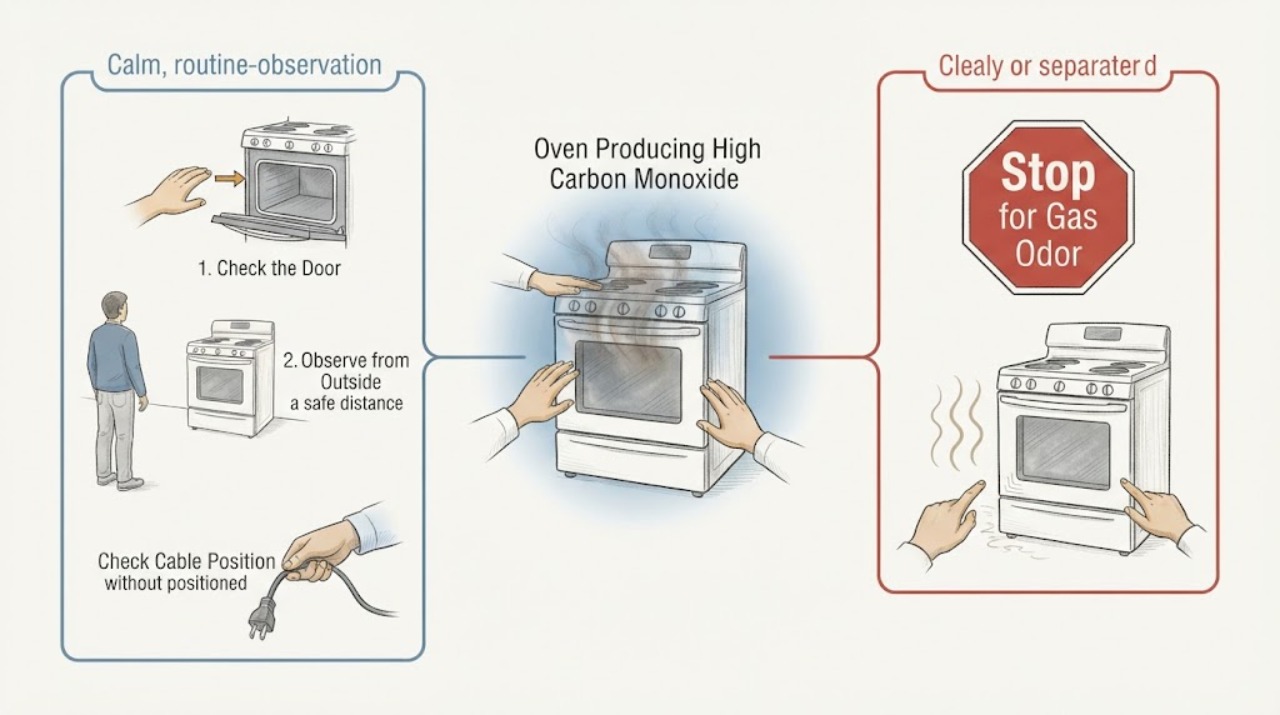
Work through in order
Diagnostic checks
Use only checks that match the exact appliance or system and its official guide.
-
Check 1
If a CO alarm sounds, a monitor reports a high reading, or anyone may have CO symptoms, stop the troubleshooting attempt and move every person and pet to fresh air outdoors. Account for everyone from outside and call local emergency services or a poison center from the fresh-air location.
Expected result: There is an alarm, a reported reading such as about 240 ppm, or symptoms including headache, dizziness, weakness, nausea, vomiting, chest pain, shortness of breath, confusion or loss of coordination.
Next step: Stay outside and follow emergency medical or fire-authority instructions. Do not return to collect items or investigate the oven until responders say the home is safe.
Why this matters
Why: This is a possible CO exposure. CO is odorless and colorless, and exposure can become life-threatening without a reliable smell or visible warning.
-
Check 2
Do not keep the oven running, restart it to reproduce the number, increase the temperature, adjust gas or air, relight a burner, reset an alarm, open the oven door as a test, or take another indoor reading while the home is not cleared.
Expected result: The reported high reading or alarm is present, but the brand, model, fuel, instrument and measurement location are unknown.
Next step: Leave the appliance out of service and provide the reported time, reading, alarm behavior and symptoms to emergency responders and the qualified technician. Do not attempt an internal inspection.
Why this matters
Why: The available information cannot distinguish an oven issue from another combustion source or venting problem, and continued operation could extend exposure.
-
Check 3
After emergency personnel or the responsible authority has cleared re-entry, identify the oven from its rating label only from a safe position and arrange inspection by a qualified appliance, HVAC, gas-utility or other locally authorized professional as applicable. Ask that the oven, combustion air, venting and other fuel-burning appliances be considered together.
Expected result: The technician can confirm the oven's fuel type, model, installation and vent path, or the oven cannot be identified without opening panels or approaching an unsafe area.
Next step: Keep the oven out of service until the qualified professional identifies the source and gives a safe return-to-use decision. Do not remove panels, alter combustion settings or bypass a safety device.
Why this matters
Why: A matching model and installation context are required for any appliance-specific manual or service decision; missing identity does not justify a component or adjustment guess.
-
Check 4
Once the home has been cleared, verify that CO alarms are installed and maintained according to their manufacturer instructions, including coverage near sleeping areas and on each level where applicable. Treat an alarm as a warning device, not as proof that an oven is safe after one quiet test.
Expected result: An alarm is missing, expired, not powered, incorrectly placed, or has sounded again after re-entry; or alarms are present and maintained but the appliance has not been inspected.
Next step: Follow the alarm manufacturer's replacement and testing instructions, leave again if an alarm sounds, and keep the oven out of service until the source is professionally assessed.
Why this matters
Why: Alarm coverage reduces the chance of an unnoticed exposure but cannot identify the source or replace professional inspection of a fuel-burning appliance and its venting.
Use your observations
Decision map
Find the observation that best matches what you see, then follow the next safe action.
-
PATH 01Next step
What you see
A CO alarm sounds, a monitor reports a high reading such as the reported 240 ppm, or anyone has possible CO symptoms.
Do this next
Move everyone and pets to fresh air, call emergency help from outside, obtain medical care for symptoms, and wait for responders to declare the home safe.
Why this path and its safety boundary
Why it matters: Treat the home as potentially contaminated; the number cannot be used to clear the space or prove that the oven is the only source.
-
PATH 02Next step
What you see
There is no audible alarm, but the oven is suspected of producing CO or a meter reading was obtained.
Do this next
Do not run or retest the oven. Leave if exposure is possible and obtain emergency or qualified professional assessment before re-entry or use.
Why this path and its safety boundary
Why it matters: The absence of an alarm does not prove the home is safe; CO can be odorless and undetectable to the senses, and the measurement context is unresolved.
-
PATH 03Next step
What you see
Emergency personnel have cleared re-entry, but the oven's brand, model, fuel type or vent arrangement is unknown or cannot be confirmed safely.
Do this next
Keep the oven off and have an appropriately qualified local professional identify the appliance and inspect the complete installation before any restart.
Why this path and its safety boundary
Why it matters: Generic advice cannot establish a safe combustion adjustment, compatible part or model-specific repair; another fuel-burning appliance or venting issue remains possible.
-
PATH 04Next step
What you see
A qualified professional has inspected the identified appliance and installation and has documented that the source was corrected or the appliance is safe to return to service.
Do this next
Follow the professional's written return-to-use instructions and continue maintaining CO alarms; stop and leave again if an alarm sounds or symptoms recur.
Why this path and its safety boundary
Why it matters: Only the responsible professional can connect the observed reading to a repaired appliance; this article does not validate a self-test or component replacement.
Helpful context
Understand the symptom
Treat the reading or alarm as a home-safety event
Carbon monoxide has no reliable smell or visible warning. The reported number cannot be interpreted as a safe limit without knowing the instrument, location and exposure time, so do not stay inside to troubleshoot or to repeat the measurement. If anyone has headache, dizziness, weakness, nausea, vomiting, chest pain, shortness of breath, confusion, loss of coordination or unusual sleepiness, treat that as a medical emergency even if an alarm is silent.
Why the oven cannot be diagnosed from this report
The task does not identify whether the oven is gas or electric, whether it is vented, or whether another fuel-burning appliance is operating nearby. An oven may be the suspected source, but the safe first decision is to remove occupants from exposure. Source-backed appliance diagnosis belongs after emergency responders or qualified service personnel have cleared the home.
What to record after the home is safe
From outside or after clearance, preserve the reported reading, time, location, alarm behavior, symptoms and whether the oven was operating. Photograph the rating label only if it can be done without approaching an unsafe appliance. Give the model, fuel type and vent arrangement to the responding authority or qualified technician; do not use those details to restart the oven yourself.
When checks do not resolve it
Need a professional?
Call emergency services or a poison center immediately for a possible exposure or symptoms. After the home is cleared, arrange qualified inspection of the oven, its fuel/venting installation and other possible combustion sources before use.
Safety scope: Do not continue operating or retesting the oven, enter to adjust gas or air, open panels, measure live circuits, bypass safety devices, or infer a burner, regulator, vent, control or sensor failure from the reported number.
Have this ready
- Provide the reported reading and units, time and location, alarm behavior, symptoms, oven brand/model if safely available, fuel type, whether the oven was operating, and any responder instructions. Do not return inside to collect information.
Common questions
FAQ
Is 240 ppm a confirmed oven fault or a safe level?
No. It is a reported reading that should be treated as a potential emergency, but without the instrument, timing, location, fuel type and installation context it cannot identify a component or serve as a clearance threshold. Leave, seek emergency help, and have the source professionally assessed.
Can I open the oven door or run it briefly to see whether the reading returns?
No. Do not continue operating or retest a suspected CO source. Evacuate and let emergency responders or a qualified professional determine when and how the appliance can be examined.
What symptoms should make this an emergency?
Headache, dizziness, weakness, nausea, vomiting, chest pain, shortness of breath and confusion are recognized symptoms; severe exposure can cause loss of coordination, loss of consciousness or death. Move to fresh air and seek emergency medical help without waiting for the oven diagnosis.
Who should inspect the oven after the home is cleared?
The appropriate qualified local professional depends on the installation: an appliance technician, HVAC or gas professional, gas utility, or fire authority may need to inspect the fuel appliance, combustion air and venting. The exact oven model and fuel type must be confirmed before model-specific service or parts are discussed.
Can a CO alarm be used to prove the oven is fixed?
No. Maintain alarms according to their manufacturer's instructions, but an alarm is a warning device and does not replace professional source inspection or emergency clearance. Leave again if it sounds.
Read the exact guide
Official sources
- What to Do to Protect Yourself During a Power OutageCenters for Disease Control and Prevention · Opened CDC page used as corroborating public-safety guidance; the topic is not assumed to involve a power outage, and no outage-specific cause is asserted.
- Carbon Monoxide Safety TipsNational Fire Protection Association · Opened NFPA one-page safety sheet used for the immediate fresh-air and stay-outside response and for professional inspection; no appliance-specific repair is inferred.
- Carbon Monoxide Poisoning BasicsCenters for Disease Control and Prevention · Opened CDC page used for the general home CO emergency and post-clearance professional-service boundary; no model-specific oven procedure is inferred.
- Protect Your Family from Carbon Monoxide PoisoningU.S. Consumer Product Safety Commission · Opened CPSC safety page used for the alarm and symptom guidance; it does not establish a reading threshold or identify an oven component.
Community feedback
Share a repair observation
Share a plain-text repair observation. Accepted observations are published automatically; this page may take a moment to update.