
On this page
Start here
Quick answer
Treat an oven gas smell as a possible gas leak until a qualified professional establishes otherwise. If odor is present now, do not light the oven, operate lights or other electrical controls, search for the leak, move the appliance, or repeat an ignition attempt: leave immediately and contact local gas authorities or emergency services from outside. If there is no current gas odor and the oven is actually electric, a smell may instead be food, cleaner, overheating, or an electrical fault, but smoke, burning plastic, sparking, a hot panel, or a carbon-monoxide alarm still requires stopping use and professional help. After the area is safe, record the exact model, fuel type, when the smell occurred, whether it followed ignition, flame appearance, and any display or breaker event. Do not treat a brief odor during a normal model-specific ignition sequence as permission to keep testing.
Before you begin
Safety first
- This article supports fuel-type confirmation from safe information, exact symptom recording, and ordinary external documentation only. It does not authorize leak searching, flame tests, repeated ignition, moving the appliance, connector or burner work, panel access, live electrical work, or reuse during an unresolved odor.
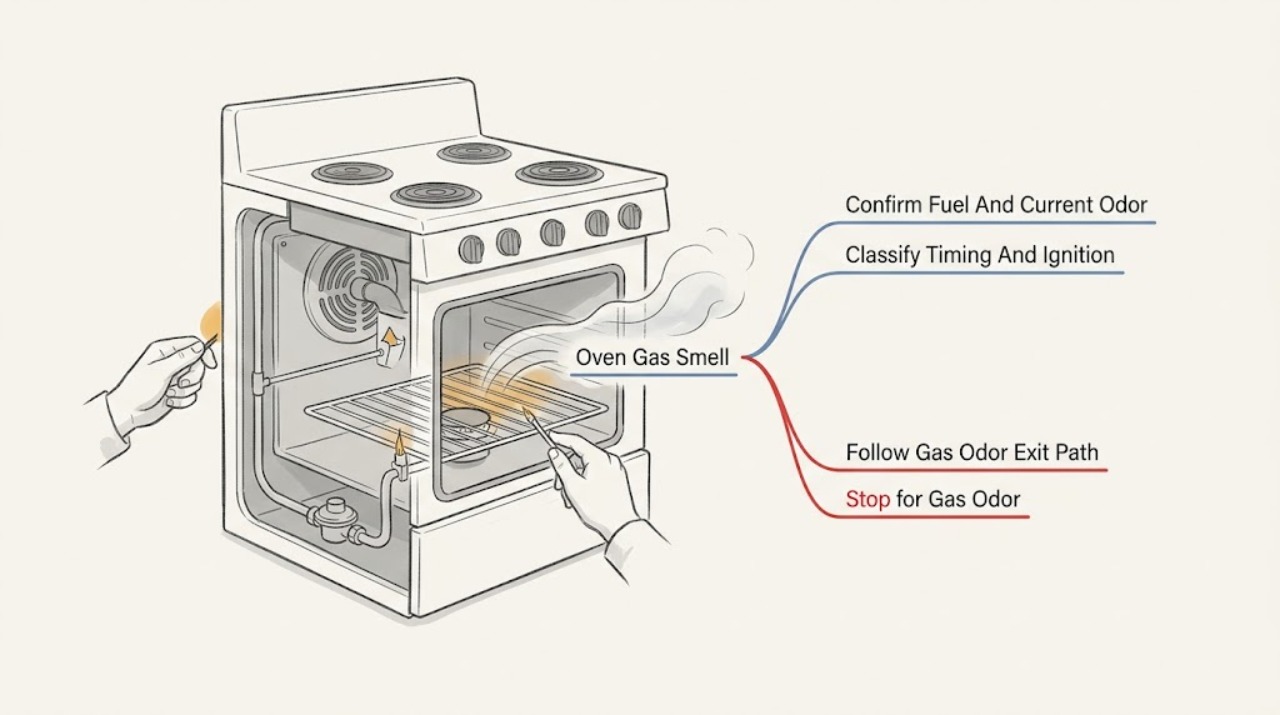
Work through in order
Diagnostic checks
Use only checks that match the exact appliance or system and its official guide.
-
Check 1
From a safe position, record the oven model and determine from its rating information or owner's guide whether it is electric, gas, or dual fuel. Record whether gas odor is present now, whether gas is heard escaping, and whether anyone has symptoms; do not approach the appliance to verify the smell.
Expected result: The oven is gas or dual fuel with current odor, the oven is electric with no gas source, the fuel type is unknown, or gas is heard escaping.
Next step: If odor or escaping gas is present, leave immediately and contact gas or emergency services from outside. If the oven is electric and there is no gas odor, keep it off and continue only with safe odor classification.
Stop if: Stop for any gas odor, escaping-gas sound, smoke, fire, carbon-monoxide alarm or symptoms, sparking, burning-plastic odor, hot controls, or a breaker trip.
Why this matters
Why: Current odor or escaping-gas sound is an emergency branch regardless of the model. An electric oven needs a different odor diagnosis, while an unknown fuel type should not be guessed from appearance.
-
Check 2
If odor is present or gas is heard escaping, stop handling the oven, leave the building by a safe route, and contact local gas authorities or emergency services from outside. Do not operate lights, switches, phones, or other electronics inside and do not try to locate the leak.
Expected result: The area is evacuated and the gas authority or emergency responder has been contacted, or safe evacuation is not immediately possible.
Next step: Remain outside or at another safe location and follow the gas authority or emergency responder's instructions; do not re-enter or reuse the oven on your own.
Stop if: Do not light a match, use a flame, operate an electrical control, use a phone inside, move the oven, inspect a connector, or return while odor or danger persists.
Why this matters
Why: Gas odor is a safety boundary, not a diagnosis to perform at the appliance. The location is not suitable for further checks until qualified responders establish that it is safe.
-
Check 3
Only after the area has been declared safe and no odor remains, use the model record to classify when the smell occurred: before a start command, during a documented ignition sequence, after the control was turned off, during cooking, after cleaning, or with no oven use. Do not repeat ignition to compare the odor.
Expected result: The odor was brief and tied to a model-specific start, persisted after shutdown, returned while idle, followed delayed ignition or an abnormal flame, or occurred in a non-gas oven.
Next step: Keep the oven off for any persistent, unexplained, or ignition-related odor and arrange qualified service; for an electric oven, use the non-gas odor branch without energizing a suspect appliance.
Stop if: Stop for any return of odor, delayed ignition, boom, abnormal flame, smoke, sparking, burning smell, or carbon-monoxide warning or symptom.
Why this matters
Why: Timing helps a professional distinguish a possible operating odor from unburned gas, combustion, cleaning, food, or electrical odor, but timing alone cannot certify safety.
-
Check 4
From ordinary safe access and without moving the appliance, record whether all gas controls are visibly off, whether the display shows a cycle or error, and whether the last observed flame was stable and within its intended burner area. Do not relight, open the oven bottom, remove a burner, or inspect the connector.
Expected result: A control was left on, an error or cycle is displayed, the flame was absent, delayed, yellow or unstable, the flame escaped the burner area, or no visible abnormality is known.
Next step: Leave the oven off and give the exact observation to qualified gas-appliance service; if odor returns, leave immediately and use the gas-emergency path.
Stop if: Do not manipulate a stuck control, relight a burner, remove parts, search for a leak, or continue after odor, smoke, abnormal flame, or electrical symptoms.
Why this matters
Why: A control or model state can explain a user report, but a missing, delayed, or abnormal flame can indicate gas or combustion danger. The absence of a visible clue does not rule out a leak.
-
Check 5
If the exact model is electric and no gas odor is present, record whether the smell followed first use, food or grease, cleaning, self-clean, overheating, a hot control, smoke, or a power event. Keep the oven off and cool before any exterior-only inspection; do not touch elements or open panels.
Expected result: The odor is a temporary food or cleaner smell with no warning, or it is a burning-plastic/electrical odor with smoke, sparking, heat, or a breaker event.
Next step: For a harmless-looking odor that returns or cannot be identified, arrange appliance service. For smoke, burning plastic, sparking, heat, or a trip, keep clear and use qualified electrical or emergency service.
Stop if: Do not run another high-heat or self-clean cycle to test the smell, touch a hot element, open panels, or reset a breaker that trips.
Why this matters
Why: An electric oven has no gas path, but smoke, electrical odor, overheating, or sparking can still create fire or shock risk and cannot be resolved by cleaning alone.
-
Check 6
From outside the appliance area, note whether a carbon-monoxide alarm sounded or anyone developed headache, dizziness, weakness, nausea, or confusion, and whether the oven vent or room has a known obstruction. Do not use a symptom-free person as proof that a gas appliance is safe and do not restart it to assess ventilation.
Expected result: A carbon-monoxide alarm or symptoms occurred, combustion looked abnormal, smoke was present, or there is no such warning.
Next step: Get to fresh air and call emergency services for an alarm or symptoms; keep the oven off and have qualified gas/appliance service assess the appliance and installation before reuse.
Stop if: Stop for a sounding alarm, symptoms, smoke, fire, gas odor, abnormal flame, or any need to enter a combustion or vent path.
Why this matters
Why: CO is not reliably identified by smell, and an alarm or symptoms override all ordinary troubleshooting. An absence of an alarm does not clear a suspected gas leak.
-
Check 7
Prepare a service record with model and serial information, fuel type, odor timing and strength as safely remembered, display and cycle, control state, flame observations, recent installation or cleaning, carbon-monoxide or smoke alarms, and any electrical event. Do not perform another smell or ignition test.
Expected result: The record distinguishes active gas emergency, persistent or ignition-related odor, electric-oven burning odor, food or cleaner odor, or an unexplained smell.
Next step: Keep the oven out of service until qualified service or the gas authority clears it; use emergency response for active gas, fire, smoke, or carbon-monoxide danger.
Stop if: Do not move the appliance, inspect a connector, open gas or electrical panels, relight the burner, or restore power to a suspect appliance.
Why this matters
Why: A precise record helps gas, appliance, or electrical professionals choose a safe inspection path without asking the homeowner to reproduce a hazardous condition.
Use your observations
Decision map
Find the observation that best matches what you see, then follow the next safe action.
-
PATH 01Safety boundary
What you see
Gas odor is present now, gas is heard escaping, or the source cannot be safely ruled out.
Do this next
Leave immediately, avoid flames and electrical controls, and contact local gas authorities or emergency services from outside or another safe location.
Why this path and its safety boundary
Why it matters: This is a gas-emergency branch, not an oven-setting or leak-finding task.
Safety stop: Do not light the oven, operate lights or electronics, use a phone inside, move the appliance, search for the leak, or re-enter while odor or danger persists.
-
PATH 02Safety boundary
What you see
The odor followed ignition, persisted after shutdown, returned without a start command, or occurred with delayed ignition or an abnormal flame.
Do this next
Keep the oven off and arrange qualified gas-appliance service. If odor returns or a gas leak is suspected, use the immediate evacuation branch.
Why this path and its safety boundary
Why it matters: Unburned gas or abnormal combustion is possible; a brief model-specific start odor cannot be assumed safe without exact manufacturer guidance and professional judgment.
Safety stop: Do not repeat ignition, use a match, adjust gas parts, inspect a connector, or continue with a boom, smoke, abnormal flame, carbon-monoxide warning or symptoms.
-
PATH 03Safety boundary
What you see
The exact model is electric and there is no current gas odor, but an odor was noticed after food, cleaner, high heat, smoke, or an electrical event.
Do this next
Keep the oven cool and off; arrange service for a returning or unexplained odor and use electrical or emergency service for smoke, burning plastic, sparking, heat, or a breaker event.
Why this path and its safety boundary
Why it matters: There is no oven gas path, but food or cleaner residue, overheating, or an electrical fault can still require different action.
Safety stop: Do not run self-clean or another high-heat cycle to test the smell, open panels, touch elements, or reset a tripped breaker.
-
PATH 04Safety boundary
What you see
A carbon-monoxide alarm or symptoms, smoke, fire, strong burning odor, electrical arc, or uncontrolled heat accompanies the oven smell.
Do this next
Get to fresh air or leave the area, contact emergency responders from a safe location, and do not reuse the appliance until qualified professionals clear it.
Why this path and its safety boundary
Why it matters: This is an immediate life-safety boundary regardless of whether the oven is gas or electric.
Safety stop: Do not enter smoke, operate controls near fire or gas odor, touch hot or wet equipment, or attempt a reset or repair.
-
PATH 05Safety boundary
What you see
The fuel type, source, or timing is unknown, or the smell returns after the oven is off without a clear safe explanation.
Do this next
Keep the oven out of service, do not move it, and arrange qualified appliance/gas service; if odor returns, evacuate and contact gas authorities from outside.
Why this path and its safety boundary
Why it matters: The available observations are insufficient to clear a gas, combustion, or electrical risk.
Safety stop: Do not use a flame, leak spray, repeated ignition, panel access, or a control reset to identify the source.
Helpful context
Understand the symptom
First confirm whether the oven uses gas
An “oven gas smell” report does not by itself establish the fuel type. Record the model and check its rating information or owner's guide from a safe location. A gas or dual-fuel oven has a gas supply and combustion path; an electric oven does not, so an odor there points toward food, cleaner, overheated material, or an electrical problem instead. Do not move the range to inspect a connector or reach behind it.
Persistent or strong odor is an evacuation decision
If gas odor is present now, stop troubleshooting. The CPSC and Whirlpool both direct people to avoid lighting appliances and electrical switches, leave the building, and contact gas assistance from outside or another safe location. Do not try to prove the source with a flame, a repeated start, a connector inspection, or a household leak test. The professional or utility determines when the appliance and room are safe to use again.
A brief ignition odor still needs context
Some gas appliances can have a short odor associated with an ignition sequence, but the exact model, fuel, burner behavior, and ventilation determine what is expected. An odor that persists after the control is off, returns without a start command, accompanies delayed ignition or an abnormal flame, or occurs with smoke or a carbon-monoxide alarm is not a routine-use branch. Do not continue to light the oven to compare smells.
Safety boundary
Stop conditions
- If gas odor is present or gas is heard escaping, leave immediately and contact local gas authorities or emergency services from outside; do not operate lights, electronics, phones, or ignition sources before leaving.
- Stop for delayed ignition, a boom, abnormal flame, smoke, fire, a carbon-monoxide alarm or symptoms, or a smell that returns after the gas control is off; do not attempt another ignition.
- For an electric oven, stop for burning plastic, sparking, smoke, uncontrolled heat, a hot control, shock, water exposure, or a breaker that trips again; keep it off and use qualified electrical or appliance service.
- Do not move the range, inspect or replace a connector, search for a leak, use a flame or leak test, open gas or electrical panels, adjust a gas component, or run high heat to reproduce an odor.
- Keep the oven out of service and arrange qualified appliance or gas service for persistent, unexplained, or ignition-related odor, unknown fuel type, or any smell that returns after safe external checks.
When checks do not resolve it
Need a professional?
Call qualified gas-appliance service for any persistent, returning, unexplained, or ignition-related odor, an abnormal flame, delayed ignition, or an uncertain fuel or gas path. For current gas odor or heard escaping gas, leave immediately and contact local gas authorities or emergency services from outside. For smoke, fire, carbon-monoxide alarm or symptoms, electrical arcing, burning plastic, uncontrolled heat, or a repeated breaker trip, use emergency or qualified electrical service and do not reuse the oven until cleared.
Safety scope: This article supports fuel-type confirmation from safe information, exact symptom recording, and ordinary external documentation only. It does not authorize leak searching, flame tests, repeated ignition, moving the appliance, connector or burner work, panel access, live electrical work, or reuse during an unresolved odor.
Common questions
FAQ
What should I do first if I smell gas near the oven?
Do not light the oven, operate electrical controls, search for the leak, move the appliance, or repeat ignition. Leave immediately and contact local gas authorities or emergency services from outside or another safe location. Do not re-enter or reuse the oven until qualified responders clear it.
Could an electric oven have a gas smell?
An electric oven has no gas supply, so confirm its fuel type from the model information. A smell may be food, cleaner, overheating, or an electrical fault, but burning plastic, smoke, sparking, uncontrolled heat, a hot panel, or a breaker trip still requires stopping use and professional service.
Is a brief gas odor during oven ignition normal?
Do not assume it is normal. The exact model, ignition sequence, flame behavior, and ventilation matter. A persistent or returning odor, delayed ignition, a boom, abnormal flame, smoke, or odor while idle is a stop condition; do not repeat ignition to compare it.
Can I pull the oven out to inspect the gas connector?
No. CPSC warns that moving a gas appliance to inspect its connector can worsen a connector problem. Keep it in place and have a qualified professional inspect it. If gas is smelled or heard escaping, leave immediately and contact gas authorities from outside.
Read the exact guide
Official sources
- Oven Not Working - GasWhirlpool Product Help · Whirlpool official support; exact model manual controls for other ovens.
- Odors or SmellsWhirlpool Product Help · Whirlpool official cooktop odor guidance used for general gas-safety boundaries; exact oven model instructions control appliance behavior.
- Certain Older Gas Connectors May Be DangerousU.S. Consumer Product Safety Commission · U.S. CPSC general safety guidance; local emergency and gas-utility procedures may differ.
- CPSC Issues Winter Weather Safety Tips to Prevent Fires and Carbon Monoxide PoisoningU.S. Consumer Product Safety Commission · U.S. CPSC general safety guidance; follow local emergency procedures.
Community feedback
Share a repair observation
Share a plain-text repair observation. Accepted observations are published automatically; this page may take a moment to update.