
On this page
Start here
Quick answer
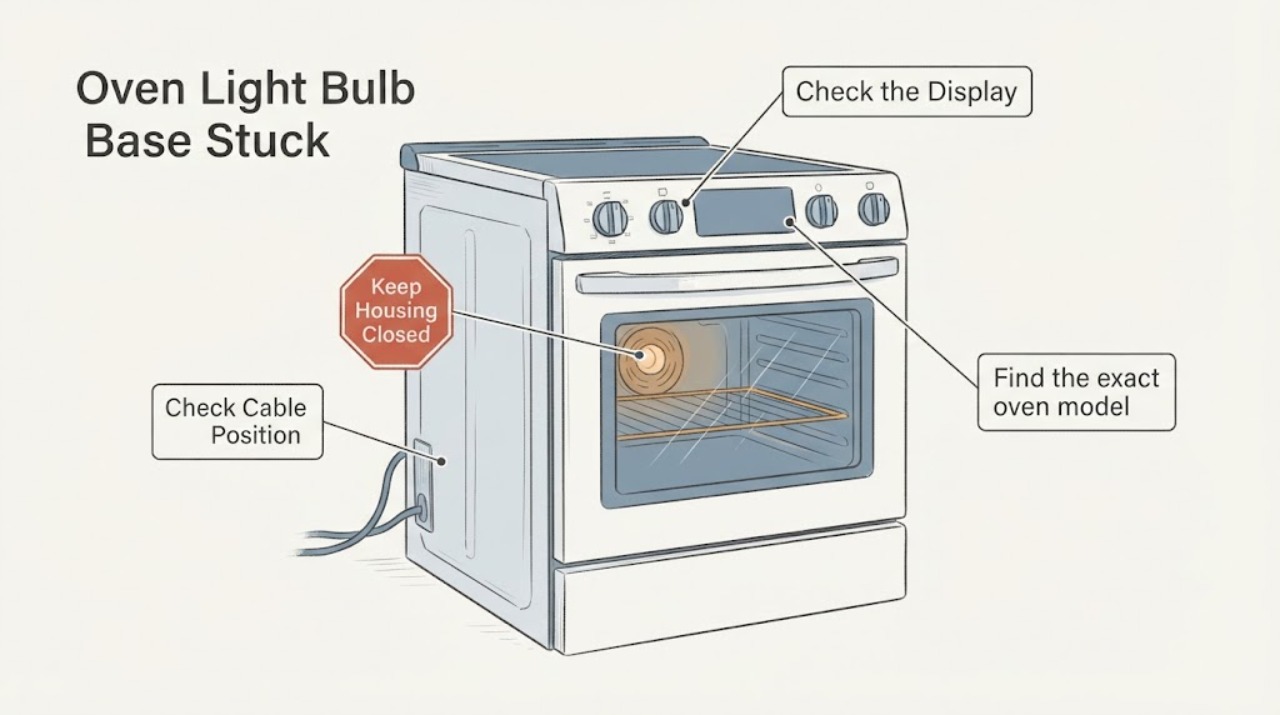
Treat a broken oven bulb base left in its socket as an electrical and sharp-glass hazard until the oven is cool and fully disconnected from power. Do not turn on the light, test the oven, touch the base with pliers, or remove a cover or panel without the exact owner's manual and a verified safe procedure. Record the oven model, keep the appliance out of service if the socket is exposed, the base is damaged, wires are visible, a breaker trips, or there is burning odor, and have a qualified appliance technician remove the base and check the socket. An oven fire or smoke requires the fire response in the manual and emergency services if flames escape; a generic potato, pliers, or bulb-size trick is not a model-safe repair instruction.
Work through in order
Diagnostic checks
Use only checks that match the exact appliance or system and its official guide.
-
Check 1
Stop using the oven light and oven controls, and from a dry, safe position turn the appliance off and disconnect its power using the normal plug or clearly identified circuit disconnect. Do not touch the broken base, socket, bulb glass, cord or rear of the appliance while power may be present.
Expected result: The oven is completely off and cool with no smoke, odor, heat damage or exposed wire, or there is a hot socket, visible wire, burning smell, sparking, tripped protection or moisture near the appliance.
Next step: Keep the appliance isolated and arrange qualified service if any hazard is present. Do not restore power merely to see whether the light or oven still works.
Stop if: Do not handle a wet plug or socket, reach into the lamp opening, or reset a breaker repeatedly after a spark, smell or trip.
Why this matters
Why: A cool, isolated appliance allows safe identification; heat, electrical damage, moisture or repeated protection trips are stop-use conditions rather than a bulb replacement problem.
-
Check 2
Once the oven is cold and power is isolated, look from outside the lamp opening for the model label, the glass cover, remaining bulb glass, exposed wire, charred material or a visibly damaged socket. Do not insert pliers, a screwdriver, a potato, a replacement bulb or any other object.
Expected result: Only the metal base is visible behind an intact cover, or the cover is broken, the socket is loose or scorched, glass is scattered, or wiring is visible.
Next step: Leave all fragments and the base in place, photograph the condition from a safe distance, and request service if the cover, socket, wire or base is damaged. Do not dismantle the lamp assembly.
Why this matters
Why: The visible condition determines whether a manual lookup might contain an owner-safe lamp procedure. A damaged cover, socket or wire needs professional assessment and cannot be cleared by replacing the bulb alone.
-
Check 3
Find the exact oven model and serial information on the rating label or owner documents, then read the manufacturer's bulb and light-socket section. Confirm the specified bulb type and whether the manual permits an owner to remove the cover or replace the lamp after power is disconnected.
Expected result: The manual contains an exact lamp procedure, gives only a service instruction, or cannot be matched because the model is missing or unreadable.
Next step: Follow an exact, explicit owner procedure only if it covers the model and the appliance is fully isolated and cool. Otherwise give the model and serial information to a qualified appliance technician.
Why this matters
Why: Different ovens use different covers, lamp sockets, voltages and access arrangements. A manual for a similar range cannot establish that the stuck base or socket is safe to handle.
-
Check 4
Record when the bulb broke, whether the light was on automatically or by a switch, whether the oven or cooktop was hot, and whether the breaker, fuse, display or other controls changed afterward. Do not energize the oven to obtain a more precise symptom.
Expected result: The light failed without other symptoms, or the event was followed by a pop, smoke, burning odor, loss of display, breaker trip or other control failure.
Next step: Provide the timeline and model number to service and keep the appliance off until inspected. Do not select a socket, fuse, control board or wire from the symptom alone.
Why this matters
Why: An isolated lamp failure may still involve the socket, while a pop, smoke, trip or loss of controls indicates an unresolved electrical fault beyond the bulb base.
-
Check 5
If smoke or flame appears in the oven, do not open the door to investigate. Turn off the heat only if the control can be reached safely, keep the door closed while the contents cool, and leave immediately if flames escape into the room.
Expected result: The event is limited to a stopped light with no fire, the fire remains inside the oven, or flames or smoke escape the oven.
Next step: For an active or spreading fire, leave and call 911 or the local emergency number from outside. After any oven fire, keep the appliance out of service until a licensed professional checks it.
Why this matters
Why: A stuck bulb base is an appliance-service issue when there is no fire; an oven fire that escapes the cavity is an emergency.
Use your observations
Decision map
Find the observation that best matches what you see, then follow the next safe action.
-
PATH 01Next step
What you see
The oven is cool and isolated, the lamp cover and socket look intact, and there is no odor, smoke, exposed wire or tripped protection.
Do this next
Use the exact owner's manual to decide whether the lamp is owner-serviceable. If the base is still stuck or the manual is unavailable, request qualified appliance service instead of trying a generic extraction method.
Why this path and its safety boundary
Why it matters: The immediate hazard is not visible, but the correct bulb base and socket procedure remain model-specific.
-
PATH 02Next step
What you see
The socket is scorched or loose, a wire is visible, the cover is broken, the base is sharp or damaged, or the breaker tripped when the bulb failed.
Do this next
Keep the oven out of service and arrange qualified appliance or electrical inspection. Do not touch the socket, probe the wiring, replace a fuse, or restore power to test it.
Why this path and its safety boundary
Why it matters: The lamp assembly or electrical circuit may be damaged beyond a simple bulb replacement.
-
PATH 03Next step
What you see
An exact manual gives an owner-safe, power-off lamp procedure that matches the oven model and socket design.
Do this next
Follow only that procedure after the oven is cool and fully disconnected. Stop if the base does not release as described, the socket moves, glass breaks, or any wire or heat damage appears, then call service.
Why this path and its safety boundary
Why it matters: The manufacturer has defined the access and replacement boundary for that specific appliance.
-
PATH 04Next step
What you see
Smoke or flames escape from the oven, or the cause is not limited to the lamp and the fire cannot be confidently contained.
Do this next
Leave, close the door behind you if possible, and call 911 or the local emergency number from outside. Do not re-enter to retrieve the oven or investigate the socket.
Why this path and its safety boundary
Why it matters: This is an active fire emergency, not a bulb-removal task.
Helpful context
Understand the symptom
The broken base is more than a burned-out bulb
The original question has no oven brand, model, bulb specification, socket design or indication of whether the glass shattered, the socket is exposed, or the light is switched automatically. A metal base left in a socket can leave sharp edges and an unknown electrical contact. Without the exact manual, it is not safe to assume that the oven light is isolated from the control, that the cooktop or oven can be used normally, or that a generic extractor method fits.
Use the model manual to decide what may be serviced
NFPA directs users to follow the manufacturer's instructions for installing, using and cleaning electrical cooking equipment and to have damaged or overheating appliance parts professionally repaired or replaced. The model and serial information determine the correct bulb, cover, socket arrangement and power-disconnect procedure. If the base cannot be removed by an explicit owner procedure, stop at identification and service triage.
When checks do not resolve it
Need a professional?
Arrange qualified appliance service before using the oven when the bulb base remains stuck, the socket or cover is damaged, wires are exposed, a breaker trips, there is a burning odor or smoke, or the exact model manual does not provide an owner-safe procedure. Call emergency services first for an active fire that escapes the oven.
Have this ready
- Provide the oven brand and model from the rating label, serial information, bulb type if printed in the manual, what broke, whether the glass shattered, whether the light was switched automatically, and any pop, odor, smoke, breaker trip or control loss. Do not request a part by appearance or perform a live test.
Common questions
FAQ
Can I use the oven while the broken bulb base is still in the socket?
There is no model or socket information here to establish that it is safe. Keep the oven out of service until the exact manual or a qualified technician confirms that the lamp assembly is isolated, undamaged and safe; never energize the light or oven just to test the base.
Can I remove the base with pliers or a potato?
Do not use a generic extraction trick. The oven must be fully disconnected and cool, and the exact manual must define the lamp access. If the base, socket, cover or wiring is damaged or the procedure is not documented for the model, use qualified service instead.
What if the oven catches fire while the bulb base is stuck?
USFA says to turn off an oven fire if it is safe, let the contents cool, and leave and call 911 if flames escape. After any oven fire, have a licensed professional check the oven before using it again.
Read the exact guide
Official sources
- Educational Messages Desk Reference: Cooking and Electrical Cooking Equipment SafetyNational Fire Protection Association · General household guidance to follow manufacturer instructions for electrical cooking equipment and have cracked, damaged or overheating appliance parts professionally repaired or replaced.
- Appliance and Electrical Fire SafetyU.S. Fire Administration · General guidance for stoves and electrical appliances: direct wall connection, damaged appliance parts or cords, and safe outlet and power practices.
- Cooking Fire Safety PictographsU.S. Fire Administration · Official guidance for oven fires: turn off the oven, let contents cool, and leave and call 911 if flames escape.
Community feedback
Share a repair observation
Share a plain-text repair observation. Accepted observations are published automatically; this page may take a moment to update.