
On this page
Start here
Quick answer
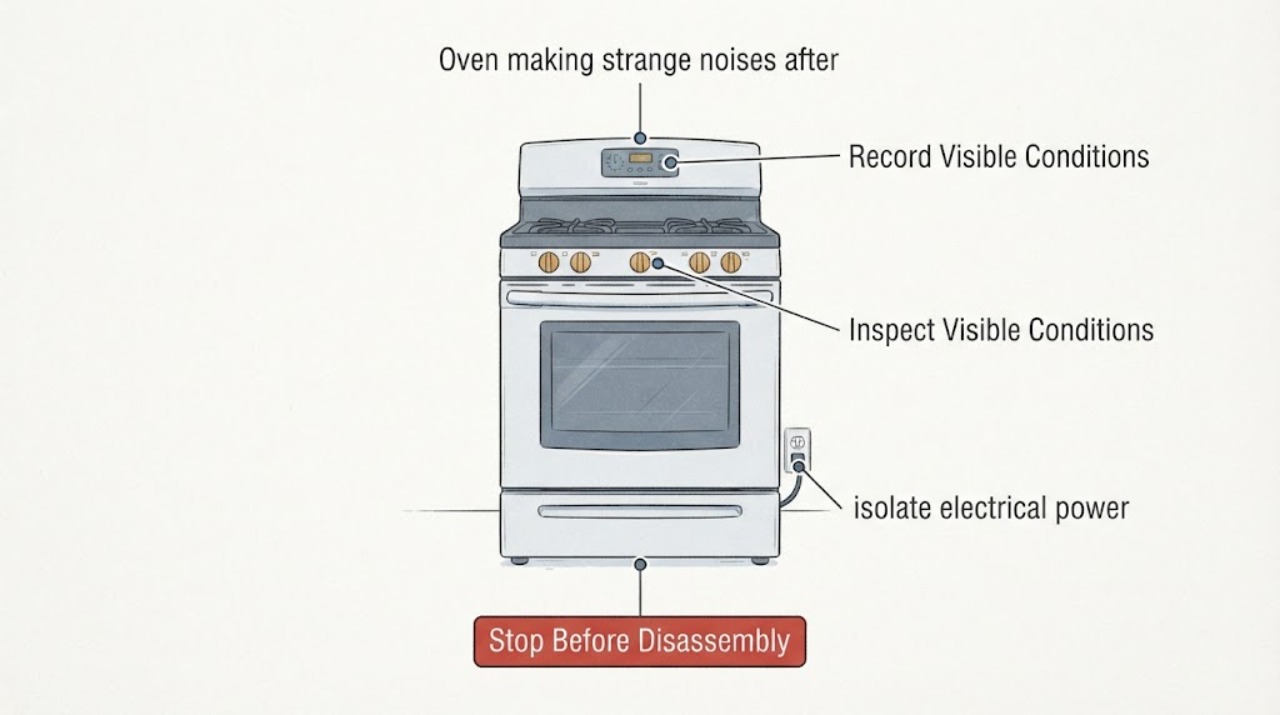
A strange sound from an oven that has been idle does not prove that an animal, fan, motor, or other part is inside or failing. First record whether the sound occurs with every control off, whether it is a hum, click, pop, scrape, bang, or hiss, and whether it comes from the cavity, vent area, or nearby appliance. Manufacturer guidance shows that cooling or convection fans, control clicks, and metal expansion can be normal during or after operation, but that guidance is model-specific and does not explain a persistent scraping or banging from a cold, idle oven. Do not remove panels, reach into hidden spaces, move a built-in oven, or repeatedly power it on to reproduce the sound. If you smell gas or hear gas escaping, leave immediately and contact the gas authority from outside; if there is smoke, burning odor, heat with the controls off, sparking, or an electrical trip, keep the oven off and arrange qualified service.
Work through in order
Diagnostic checks
Use only checks that match the exact appliance or system and its official guide.
-
Check 1
From a safe distance, write down when the sound occurs and describe it as a hum, click, pop, scrape, bang, hiss, or vibration. Note whether every oven, cooktop, and vent control is off, whether the oven is still warm, and whether the sound seems to come from the cavity, vent area, cabinet, or a nearby appliance.
Expected result: The sound is tied to a recent cooking or cooling period, or it occurs while the oven is cold with all controls off; its character and location are either repeatable or unclear.
Next step: Do not choose a part from the sound alone. Continue with only the safe external checks below, and give the timing, location, and sound description to service if it persists.
Why this matters
Why: A stage-linked fan, control click, or expansion sound can fit the normal patterns described by Whirlpool and GE for applicable models. A repeatable scraping, banging, or hissing sound from a cold idle oven is not identified by those general operating descriptions.
-
Check 2
Check from outside the appliance that the oven, cooktop, warming drawer, and any nearby vent controls are actually off. Do not turn the oven on just to reproduce the noise; if a recent cycle ended, allow the appliance to cool and observe whether a fan-like hum stops on its own.
Expected result: The sound stops as the appliance cools, or it continues even though the appliance is cold and all controls are off.
Next step: If it stops and no safety symptom is present, record the pattern and consult the exact manual if it returns. If it continues, leave the oven off and proceed to a safe visual check or qualified service.
Why this matters
Why: A sound that follows a recent cycle can be consistent with cooling or convection-fan behavior on applicable models. Continued noise while cold and idle is not explained by a normal post-cycle fan description and needs model-specific assessment.
-
Check 3
After the oven is cool, isolate electrical power at the plug or breaker only when it is safe and accessible, then use a flashlight to inspect the visible cavity, racks, drawer or broiler area, and vent openings. Do not remove covers, reach into hidden spaces, loosen gas fittings, or pull a built-in oven forward.
Expected result: A loose rack, foil, packaging, crumbs, nesting material, or another object is plainly visible in a user-accessible area, or all visible areas are clear.
Next step: Remove only a loose object that is plainly reachable without tools and without contact with wiring or gas parts. If anything is concealed, damaged, or difficult to reach, keep the oven off and arrange service; do not assume it is an animal or a particular part.
Why this matters
Why: A visible loose object can explain a rattle or scrape, but a clear cavity does not rule in a fan, motor, control, wiring, or concealed foreign object. An unseen object should not be chased by dismantling the oven.
-
Check 4
Check for urgent external symptoms without operating the oven: gas smell or hissing, smoke, a burning or melted-plastic odor, unusual heat while controls are off, sparks, exposed wiring, or a tripped breaker.
Expected result: Any gas, smoke, burning, heat, sparking, exposed wiring, or repeated electrical-trip symptom is present, or none is present.
Next step: For gas smell or hissing, leave immediately without operating electronics and contact local gas authorities from outside. For smoke, burning odor, sparking, exposed wiring, abnormal heat, or repeated trips, leave the oven off and arrange qualified service without repeated test runs.
Why this matters
Why: These symptoms take priority over identifying the sound. A gas leak can create fire or explosion risk, and electrical or heat symptoms require professional assessment; the absence of those signs does not make an unexplained noise safe to diagnose internally.
-
Check 5
Find the oven's complete model and serial information from the rating label or owner documentation, then use the manufacturer's exact manual or support channel to compare the recorded sound and timing.
Expected result: The exact manual provides a model-specific user-level check, or the noise remains unexplained after the visible inspection.
Next step: Follow only a model manual's external user procedure. Otherwise leave the oven off and provide service with the model, sound description, timing, location, and visible-check results; do not order a part from the symptom alone.
Why this matters
Why: Whirlpool directs owners to use the model number to locate manuals and documents, and the fan behavior varies by oven design. Without the model, a general noise page cannot establish a compatible fan, motor, control, or other replacement part.
Use your observations
Decision map
Find the observation that best matches what you see, then follow the next safe action.
-
PATH 01Next step
What you see
The noise occurs only during or shortly after a known cooking cycle, sounds like a fan or light click, and stops as the oven cools.
Do this next
Record the timing and verify the exact model manual before using the oven again. Arrange service if the sound changes to scraping, grinding, banging, or persists while the oven is cold and idle.
Why this path and its safety boundary
Why it matters: That pattern can fit normal cooling or convection-fan operation or temperature-related control and metal sounds on applicable models.
-
PATH 02Next step
What you see
The oven is cold, all controls are off, and a repeated scrape, bang, vibration, or other unexplained noise continues.
Do this next
Keep the oven off, perform only the cool external visual check, and arrange qualified service if the cause is not plainly accessible. Do not remove panels or assume an animal or a failed component.
Why this path and its safety boundary
Why it matters: The general manufacturer examples for cycle-linked fan, click, and expansion noises do not identify this pattern; the source could be external or concealed and remains unconfirmed.
-
PATH 03Next step
What you see
A loose rack or object is visibly reachable in the cavity, drawer, or other user-accessible area, and there is no gas, heat, smoke, or electrical symptom.
Do this next
Remove only the plainly reachable item without tools, reinstall racks correctly, and monitor without a deliberate repeat test. Use service if the sound remains or the item is concealed or damaged.
Why this path and its safety boundary
Why it matters: The visible item may be the source of a rattle or scrape, but removing it does not prove that concealed components are healthy.
-
PATH 04Next step
What you see
Gas is smelled or heard, or the noise is accompanied by smoke, burning odor, sparks, abnormal heat, exposed wiring, or repeated breaker trips.
Do this next
Leave the appliance and area as appropriate. For gas, leave immediately and contact local gas authorities from outside without operating electronics; for smoke or electrical symptoms, keep the oven off and obtain qualified emergency or appliance service.
Why this path and its safety boundary
Why it matters: This is a safety condition rather than a sound-identification problem.
Helpful context
Understand the symptom
A strange noise does not identify an animal or a failed part
No brand, model number, recording, or confirmed location is available, so the sound cannot be mapped to a particular component. An oven that has not been used for about two weeks can still have a sound source outside the cooking cavity, such as a nearby appliance, a vent or control area, or an appliance feature that was recently active. Treat the report as a symptom to characterize rather than evidence that an animal is trapped or that a motor, fan, or control has failed.
Compare the sound with documented operating patterns
Whirlpool says an automatic cooling fan may run while an oven is in use or after a cycle to cool the cavity and electronic controls, and that a convection fan may cycle during preheat or cooking on applicable models. GE similarly describes fan noise as normal on many ranges and wall ovens, with some fans continuing after the oven is turned off. GE also notes that controls may click during temperature regulation and that metal can crack or pop as it expands or contracts during heating and cooling. Those are general manufacturer examples, not a diagnosis for an unbranded oven: a sound that occurs while the oven is cold and has been idle needs a model-specific check or service assessment.
Keep inspection external and preserve the safety boundary
Once the oven is cool and isolated from power if that can be done safely, use a flashlight to look only at the cavity, racks, drawer or broiler area, and visible vent openings. Look for a loose rack, foil, packaging, crumbs, nesting material, or an object that is plainly reachable without removing a panel. Do not reach into hidden cavities, remove the rear or control cover, loosen a gas connection, move a built-in oven, or test an unexplained noise by repeatedly turning the oven on. If a gas smell or hissing is present, follow the CPSC evacuation instruction rather than inspecting the appliance.
When checks do not resolve it
Need a professional?
Keep the oven out of service for an unexplained persistent noise, scraping or grinding, gas smell or hissing, smoke, burning odor, abnormal heat with controls off, sparks, exposed wiring, or repeated breaker trips. Never remove oven panels, loosen gas connections, or repeatedly power the appliance to reproduce the noise.
Have this ready
- Provide the full model and serial information, whether the oven is electric or gas if known, the sound description, timing and duration, apparent location, whether controls were off, whether the oven was recently warm, visible-check results, and any gas, smoke, odor, heat, or electrical symptoms.
Common questions
FAQ
Could an animal be dying inside the oven?
A noise alone cannot establish that an animal is present. Check only visible, user-accessible areas after the oven is cool and safely isolated; do not reach into hidden cavities or dismantle the oven. If there is evidence of an animal or nesting material in a concealed area, leave the oven off and arrange qualified appliance or pest service.
Can a fan or clicking sound be normal after an oven is turned off?
Sometimes. Whirlpool says cooling fans can run during or after a cycle, and GE describes fan sounds, control clicks, and some expansion or contraction sounds as normal in the relevant stages. Those are manufacturer examples for applicable models, so a sound from a cold oven that has been idle needs the exact manual or service assessment.
Should I turn the oven on to find where the noise comes from?
No. Record the sound without a deliberate repeat run, check that controls are off, and inspect only cool visible areas after safe power isolation. Repeated operation is especially inappropriate when there is gas smell, smoke, burning odor, heat, sparking, or an electrical trip.
What should I tell an appliance technician?
Give the complete model and serial information, electric or gas type if known, sound character, timing, duration, apparent location, whether controls were off, whether the oven had recently been warm, and the results of the visible check. Mention any gas, smoke, burning, heat, sparking, wiring, or breaker symptoms immediately.
Read the exact guide
Official sources
- CPSC Issues Winter Weather Safety Tips to Prevent Fires and Carbon Monoxide PoisoningU.S. Consumer Product Safety Commission · Opened CPSC safety guidance used only for the conditional gas-smell or gas-leak stop instruction; it does not identify an oven noise or authorize appliance repair steps.
- Range & Wall Oven - Clicking, Humming, Popping or Fan NoiseGE Appliances · Opened GE guidance used only to distinguish common stage-linked sounds from an unexplained idle-oven sound; it is not treated as a cross-brand model repair diagnosis.
- Range & Wall Oven - Fan NoiseGE Appliances · Opened GE guidance used as a general manufacturer example of model-dependent convection and cooling fan behavior, not as an exact diagnosis or instruction for an unbranded oven.
- Understanding Fan or Humming Noise in OvenWhirlpool · Opened Whirlpool family-level support guidance used only to explain possible cooling or convection fan patterns and the need for model-specific documents; no brand or model was supplied for this task.
Community feedback
Share a repair observation
Share a plain-text repair observation. Accepted observations are published automatically; this page may take a moment to update.