
On this page
Start here
Quick answer
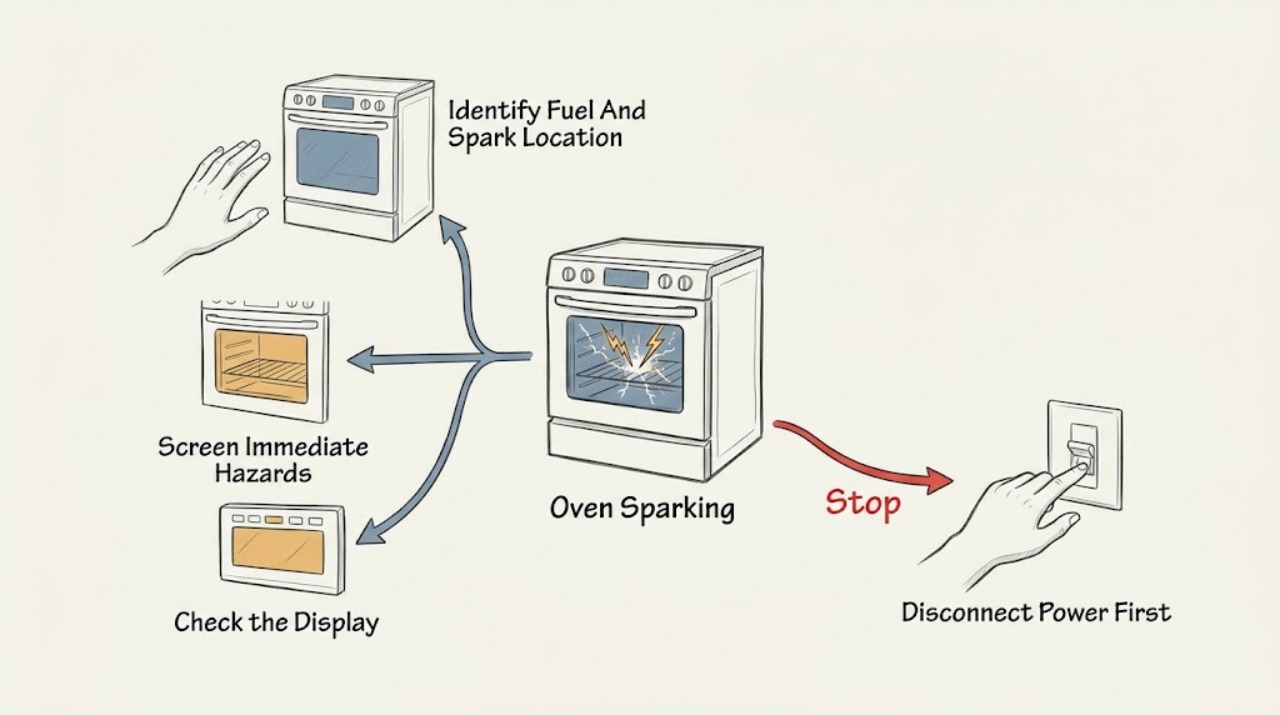
An oven spark can be normal only in a model-documented gas ignition sequence and only when it is brief, localized, and followed by stable combustion. A spark, flash, crackle, or arc from the cavity, control area, cord, outlet, element, or wiring is not a normal test result. First identify whether the appliance is gas, electric, dual-fuel, or unknown and note exactly when the spark occurs. Turn the oven off using the normal control if safe, stop for any gas odor, hissing, delayed ignition, abnormal flame, smoke, burning odor, heat, repeated clicking, visible arc, or tripped breaker, and leave for gas or emergency assistance when appropriate. Do not open panels, use a match, touch an element or igniter, keep cycling the controls, or perform live electrical tests. If there is no immediate emergency but sparking continues or the source is uncertain, keep the oven out of service and use a qualified appliance technician or electrician.
Before you begin
Safety first
- The user should limit work to identifying the appliance, normal control shutoff when safe, dry-distance observation, and model-documented settings. Professionals handle igniters, burners, valves, elements, controls, wiring, gas supply, combustion, and energized diagnosis.
Work through in order
Diagnostic checks
Use only checks that match the exact appliance or system and its official guide.
-
Check 1
From a safe position, identify the fuel type and model if visible, then note whether the spark appears at a gas igniter, inside the cavity, near an element, at the control area, near a cord or outlet, or outside the oven. Do not move the appliance or remove a cover.
Expected result: The oven is gas, electric, dual-fuel, or unknown, and the spark is brief and localized or repeated and remote from the expected ignition area.
Next step: Use the matching gas or electric branch only if no hazard sign is present. Keep the oven off and arrange service when the spark source cannot be confidently identified.
Why this matters
Why: A brief model-documented gas ignition event may be part of normal operation. A repeated or misplaced spark can indicate an ignition, control, element, connection, or wiring fault. Unknown fuel or location increases uncertainty and removes permission for model-specific testing.
-
Check 2
Look and listen from a safe distance for gas odor, hissing, a bang or flare, abnormal flame, smoke, burning odor, visible arcing, buzzing or crackling, a hot or discolored outlet or control, or a tripped breaker. Do not touch the appliance, open the door during a suspected gas fault, or operate switches when gas may be present.
Expected result: Any gas, combustion, smoke, heat, arcing, electrical damage, or repeated-trip sign is present; or no immediate hazard is observed.
Next step: Stop immediately for gas or combustion signs, leave, and use gas or emergency assistance from a safe location. For smoke, fire, arcing, or shock danger, keep clear and use emergency assistance. Otherwise proceed only with dry, model-documented observations.
Why this matters
Why: These signs can indicate unburned gas, delayed ignition, fire, overheating, or an energized fault. The absence of a sign does not prove that an internal ignition or wiring fault is safe.
-
Check 3
With the oven cool and no hazard sign present, use the normal controls to confirm the intended Bake or Broil mode, temperature, clock, delayed-start, Control Lock or Demo state, and fully closed door. Do not force a latch, bypass an interlock, or leave the oven running while investigating a spark.
Expected result: A mode, lock, timer, delayed start, open door, or self-clean latch is visibly preventing the expected cycle; or the controls are correct but sparking remains.
Next step: Clear only a state described by the exact manual and make no more than one ordinary start attempt if the appliance is safe. Stop for any spark outside the documented sequence and arrange service.
Why this matters
Why: A control or door state can make the ignition sequence appear abnormal or prevent heat from beginning. Correct settings do not clear a continuing spark or an internal control, igniter, element, or wiring fault.
-
Check 4
From a dry, unobstructed position, observe the breaker or fuse indicator, accessible cord, and outlet for a trip, looseness, scorch mark, discoloration, moisture, or heat. Do not open a panel, pull a built-in oven, use an adapter or extension lead, or perform an energized meter check.
Expected result: The breaker trips, the outlet or cord is damaged, the connection is wet or hot, or visible power appears normal while the spark continues.
Next step: Do not repeatedly reset a tripped breaker. Keep the appliance isolated and arrange qualified electrical or appliance service; use emergency help for smoke, fire, or active arcing.
Why this matters
Why: A power or connection fault can create arcing and can affect both gas ignition controls and electric heating. Normal power at the display does not rule out a dangerous internal fault.
-
Check 5
For a confirmed gas oven only, compare the observed timing with the exact manual's normal ignition description without deliberately repeating a failed start. Note whether the spark is accompanied by a stable flame and heat, continues after ignition, or occurs without a normal heat request.
Expected result: A brief documented ignition occurs and stable heat follows; clicking or sparking continues without heat; a spark occurs when the control is off; or ignition is delayed with a bang or flare.
Next step: Stop for continuous or misplaced sparking, failed ignition, delayed ignition, bang, flare, odor, or abnormal flame. Keep the door closed, leave if gas is suspected, and obtain qualified gas-appliance service; never use a match or open internal parts.
Why this matters
Why: Stable ignition after a documented brief event is different from continuous or misplaced sparking. Continued sparking, ignition without a heat request, delayed ignition, or a flare can indicate control, igniter, valve, burner, wiring, or accumulated-gas danger.
-
Check 6
For a confirmed electric oven only, observe from outside whether the spark is at a heating element, control area, cord, outlet, or another location during one normal start only if the model manual permits it and no hazard sign is present. Do not touch, scrape, remove, or reposition an element or access wiring.
Expected result: A visible element arcs, a control or outlet sparks, the spark appears only after heating begins, or no location can be seen.
Next step: Turn the oven off and leave it out of service. Arrange qualified appliance or electrical inspection; use emergency assistance for smoke, fire, repeated arcing, or shock risk.
Why this matters
Why: An element or connection that arcs can cause fire or shock and needs professional inspection. A hidden spark is still a fault even if the cavity looks normal. Do not assume a visible spark is harmless because the oven remains warm.
-
Check 7
Check whether a CO alarm has sounded and whether anyone has headache, dizziness, nausea, unusual fatigue, shortness of breath, confusion, or loss of coordination. Do not rely on smell to clear a gas oven and do not remain inside to collect more observations.
Expected result: An alarm or symptom is present; soot or moisture appears around a vent; or no such sign is observed.
Next step: Leave for fresh air and use emergency or medical assistance from a safe location when an alarm or symptom occurs. Do not operate the oven again until the appliance and venting are professionally assessed.
Why this matters
Why: CO is odorless and colorless, and combustion faults can be hidden. An alarm or symptom changes the event to an exposure emergency rather than an oven repair question.
-
Check 8
Record the model, fuel type, spark location and timing, selected mode, display or code, door state, breaker behavior, whether the cooktop works, and any odor, flame, smoke, heat, or alarm. Do not repeat the spark to improve the record.
Expected result: The spark was a single documented gas ignition event followed by stable heat; it returns; it occurs without a heat request; or its source is unknown.
Next step: Keep the oven unused and provide the record to a qualified appliance technician. Include the manual and model information; use an electrician for supply or outlet concerns and gas or emergency assistance for fuel or combustion danger.
Why this matters
Why: A normal, model-specific ignition event is a narrow possibility. Returning, misplaced, or unexplained sparking requires diagnosis because gas and electrical faults can be hidden behind the same symptom.
Use your observations
Decision map
Find the observation that best matches what you see, then follow the next safe action.
-
PATH 01Next step
What you see
Gas odor, hissing, delayed ignition, bang, flare, abnormal flame, CO alarm, or possible exposure symptoms occur.
Do this next
Stop using the oven, avoid flames and electrical switches, leave for a safe location, and use gas or emergency assistance. Do not relight, open the door to investigate, or return until professionals confirm safety.
-
PATH 02Next step
What you see
The spark is at an element, outlet, cord, control, or wiring, or there is a burning odor, smoke, heat, buzzing, crackling, or a breaker trip.
Do this next
Turn the oven off from a safe position if possible, keep clear, do not reset repeatedly or open the appliance, and obtain qualified appliance or electrical service. Use emergency assistance for active smoke, fire, or arcing.
-
PATH 03Next step
What you see
The appliance is gas and a brief spark occurs only in the exact normal ignition sequence, with stable flame and heat and no odor or warning sign.
Do this next
Treat it as potentially normal only for that model and continue ordinary use only as its manual permits. Stop and obtain service if it continues, changes location, fails to light, or produces a delay, odor, bang, or flare.
-
PATH 04Next step
What you see
The oven has a lock, delayed start, wrong mode, open door, or self-clean state that explains why the expected cycle is not beginning.
Do this next
Clear only the model-documented setting and make one safe start attempt. A spark outside the documented sequence still requires the oven to remain off.
-
PATH 05Next step
What you see
Fuel type, spark location, or normal ignition behavior cannot be confirmed.
Do this next
Do not perform further tests or choose a part. Keep the oven off and request qualified appliance service, with electrical or gas assistance according to the professional's findings.
-
PATH 06Next step
What you see
Sparking returns after a safe, model-documented observation or the oven will not heat normally.
Do this next
Stop use and provide the event record to a qualified appliance technician. Internal ignition, burner, element, control, wiring, and combustion work are not consumer repairs.
Helpful context
Understand the symptom
A gas ignition spark is a narrow exception
Some gas ovens use a documented spark or hot-surface ignition sequence. That does not make every spark safe: repeated clicking, sparks that continue after ignition, a flash in the wrong place, a gas odor, delayed ignition, or an unstable flame requires stopping. Electric and dual-fuel ovens can also arc at an element, control, cord, receptacle, or wiring. The model manual and the exact location and timing determine what can be observed safely.
Do not open the door to investigate a delayed ignition
CPSC testing found conditions in which gas accumulated in an oven before igniting and produced a hazardous flare when the door was opened. If a gas oven clicks without a normal stable start, stop using it and keep the door closed while you move away. Do not repeat the cycle, use a lighter, or inspect the burner through an opened cavity.
Fuel and electrical safety are linked
Gas ignition often uses electrical controls or an igniter, so a gas oven can have both fuel and electrical hazards. An electric oven has no gas burner, so a gas-like odor should not be dismissed as electrical sparking. A CO alarm or symptoms are an emergency even when no smell is present.
Safety boundary
Stop conditions
- Stop immediately for gas odor, hissing, delayed ignition, bang, flare, abnormal flame, smoke, or suspected combustion failure; leave and seek safe-location gas or emergency help.
- Treat a CO alarm or possible headache, dizziness, nausea, shortness of breath, confusion, or unusual fatigue as an emergency; leave and do not use the oven again until assessed.
- Stop for electrical burning odor, arcing, buzzing, crackling, heat, discoloration, a damaged cord or outlet, or a repeated breaker trip.
- Do not open panels, touch elements or igniters, loosen gas fittings, use a match, bypass a door interlock, or perform live electrical tests.
- Do not keep cycling the oven or open a gas-oven door to investigate a delayed or failed ignition.
Only after diagnosis
Potential parts
- Gas igniter or burner ignition assembly
Relevant only when a qualified technician confirms a gas model's ignition sequence is failing, sparking abnormally, or delaying flame establishment after ruling out settings and supply.
Gas ignition systems differ by model and fuel configuration. Confirm the exact approved component and installation method with a qualified professional. - Electric heating element or terminal connection
Consider only when professional inspection links the spark to an element or connection and confirms the supply and control path are appropriate.
Match the exact model and electrical design; do not touch or replace an element or terminal while energized. - Oven control or wiring assembly
Relevant only after a technician identifies a control or wiring fault causing sparking, unintended ignition, repeated trips, or failure of the intended sequence.
Exact model, fuel type, panel design, and manufacturer-approved service procedure must be confirmed before replacement.
When checks do not resolve it
Need a professional?
Arrange qualified appliance service for any recurring or misplaced spark, failed or delayed ignition, abnormal flame, no heat after safe checks, unknown fuel or model behavior, or suspected element, igniter, control, wiring, or burner fault. Use qualified electrical service for a damaged outlet, cord, supply, or breaker concern. Use gas or emergency assistance for gas odor, hissing, flare, smoke, fire, a CO alarm, or possible exposure.
Safety scope: The user should limit work to identifying the appliance, normal control shutoff when safe, dry-distance observation, and model-documented settings. Professionals handle igniters, burners, valves, elements, controls, wiring, gas supply, combustion, and energized diagnosis.
Common questions
FAQ
Is a spark from a gas oven normal?
Only a brief, model-documented ignition event followed by stable flame and heat may be normal. Continued clicking, sparking in the wrong location, gas odor, delayed ignition, a bang, flare, or abnormal flame requires stopping and professional help.
What should I do if an oven sparks and smells like gas?
Stop using it, avoid flames and electrical switches, leave for a safe location, and use gas or emergency assistance. Do not look for the leak, use a match, relight the oven, or open the door to investigate.
Can an electric oven spark?
Yes. An electric oven can arc at an element, control, cord, outlet, or wiring. Turn it off from a safe position, do not touch or open it, and obtain qualified appliance or electrical inspection.
Why does an oven spark after the controls are turned off?
Sparking after a heat request ends or when no normal cycle is selected is not a normal ignition observation. Keep the oven out of service and have the controls, supply, ignition, and wiring inspected.
Does no gas smell mean a sparking gas oven is safe?
No. Carbon monoxide has no smell or color, and a delayed or incomplete combustion fault may not smell like gas. A CO alarm, symptoms, abnormal flame, smoke, or repeated spark requires leaving and emergency or professional assessment.
Read the exact guide
Official sources
- Protect Your Family from Carbon Monoxide PoisoningU.S. Consumer Product Safety Commission · Carbon-monoxide sources, gas ranges and ovens, alarms, and exposure symptoms
- Gas Range Delayed Ignitions - Tests and Examinations of RangesU.S. Consumer Product Safety Commission · Gas-oven delayed ignition, accumulated unburned gas, flare-up, igniter, and airflow hazards
- Oven Not Working - Cooktop Working - Not Clicking - Product HelpWhirlpool Product Help · Representative manufacturer guidance for gas oven door, gas shutoff, grounded power, and model-specific ignition checks
- Oven Not Pre-Heating - Wall OvenWhirlpool Product Help · Representative manufacturer guidance for oven installation, electrical supply, breaker, and stop-use boundary
- Why is my oven not heating up?Whirlpool · Representative manufacturer guidance distinguishing electric elements, gas igniters, door seals, sensors, and professional replacement
- Oven Not Heating - Powering On - ElectricWhirlpool Product Help · Representative manufacturer guidance for electric oven door, control lock, Demo, delayed start, and model instructions
- Range and Oven SafetyU.S. Consumer Product Safety Commission · General household range and oven safety resource
Community feedback
Share a repair observation
Share a plain-text repair observation. Accepted observations are published automatically; this page may take a moment to update.