
On this page
Start here
Quick answer
A gas oven that seems far too hot or cold while baking should be measured and observed before anyone changes a calibration setting. Ovens cycle the burner on and off, so a single thermometer reading during preheat is not the same as the average baking temperature. Use the center rack, a reliable oven thermometer, a fully preheated oven and the same test position for repeated readings; keep the door closed except for a quick check. Also verify that the door closes and seals, the rack and pan are positioned as the recipe requires, and no foil or cookware blocks heat circulation. Calibration controls and limits are model-specific. Do not use a generic button or knob sequence on an unidentified gas oven. If the mismatch is persistent and large, the burner does not ignite normally, there is a gas smell, soot, flame rollout, a CO alarm, or the oven will not turn off, stop using it and arrange qualified gas-appliance service.
Work through in order
Diagnostic checks
Use only checks that match the exact appliance or system and its official guide.
-
Check 1
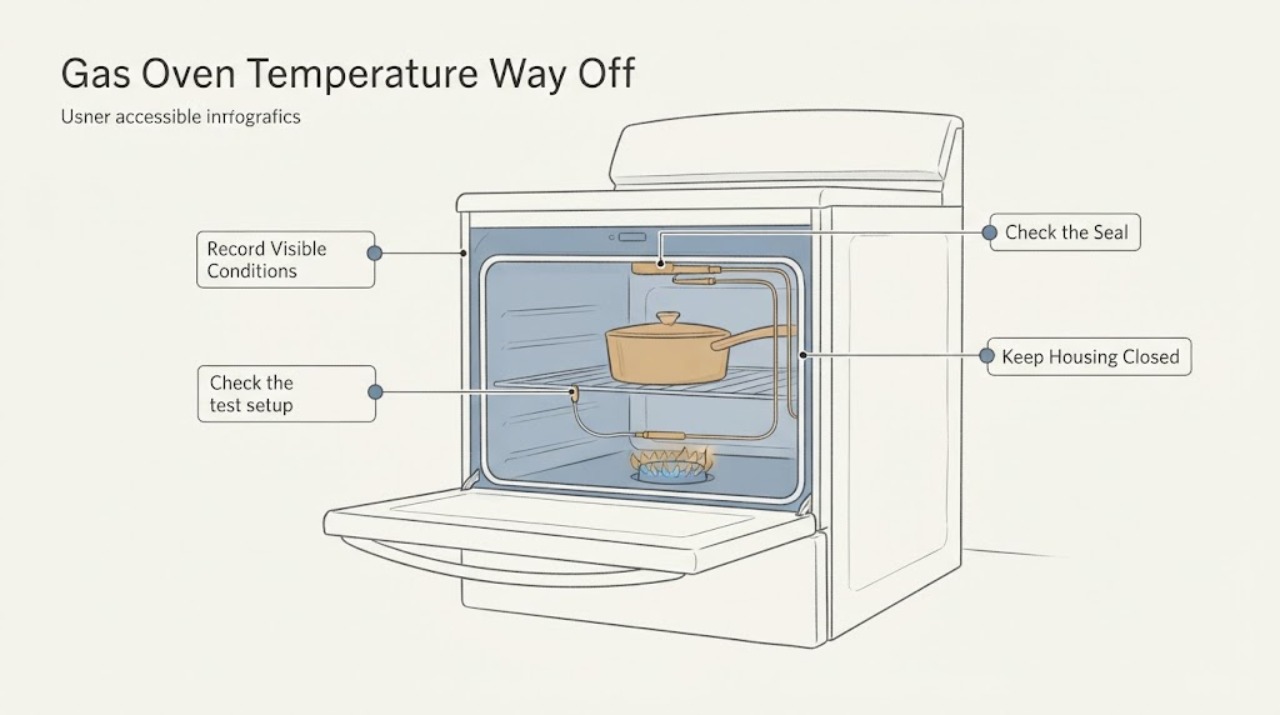
Place a reliable oven thermometer at the center of the middle rack, set the oven to the recipe's temperature, allow the oven to finish its normal preheat, and record several readings without repeatedly opening the door.
Expected result: The reading moves above and below the setting as the burner cycles, settles near the setting over repeated checks, or remains consistently far from it.
Next step: Repeat the same test with the same thermometer and rack position. If the offset remains large, use the exact owner's manual or qualified service; do not use a generic calibration sequence.
Why this matters
Why: A rise-and-fall pattern can be normal cycling; a repeatable offset after the oven is fully preheated is stronger evidence of calibration or heating trouble.
-
Check 2
Check the test setup from outside the hot cavity: use the rack position specified by the recipe, keep space around the pan, and remove foil or liners that block heat circulation.
Expected result: The pan is close to a wall or burner, the rack is in an unusual position, foil blocks a rack or oven floor, or the setup is consistent with the recipe.
Next step: Correct only the accessible rack, pan and circulation setup, then repeat the controlled bake test. Do not compensate for a setup error by changing the calibration offset.
Why this matters
Why: Cookware, rack placement and blocked circulation can change browning and local temperature without proving that the thermostat is wrong.
-
Check 3
Inspect the door closure and visible gasket from outside while the oven is cool; note tears, a door that does not close firmly, or heat escaping around one edge.
Expected result: The door seals normally, or the gasket/door is visibly damaged or fails to close evenly.
Next step: If the gasket or door is damaged, stop relying on calibration and arrange appliance service. Do not bend the door, remove the gasket, or run a high-temperature test to compensate.
Why this matters
Why: Heat loss can make baking slow or uneven, while a damaged gasket or door needs a model-specific repair rather than a temperature offset.
-
Check 4
Compare the controlled thermometer readings with the baking result over more than one recipe or test batch, keeping rack, pan, preheat and door-opening habits consistent.
Expected result: The oven is consistently hot or cold across controlled tests, or only one pan, recipe, rack position or food type is affected.
Next step: Save the readings and model label for service. If the model manual provides a calibration function, follow only that exact procedure and its stated limits; otherwise have a technician evaluate it.
Why this matters
Why: A repeatable cavity offset supports a calibration or service decision; a single recipe or pan result can be caused by cookware, placement or recipe conditions.
-
Check 5
Stop the test immediately if there is a gas odor, delayed ignition, soot, flame rollout, smoke, a CO alarm, headache, dizziness, or an oven that continues heating after being turned off.
Expected result: A combustion or control safety symptom occurs, or the oven is only inaccurate while otherwise operating normally.
Next step: Turn the appliance off if safe, leave the area for strong gas odor or alarm symptoms, follow the gas supplier/emergency process, and arrange qualified service. Do not relight, tune or open the oven.
Why this matters
Why: A gas or CO concern is a safety event, not a calibration problem; normal-looking temperature readings cannot clear it.
Use your observations
Decision map
Find the observation that best matches what you see, then follow the next safe action.
-
PATH 01Next step
What you see
The thermometer shows a normal rise and fall around the setting, and controlled baking is consistent once preheat and rack placement are repeated.
Do this next
Keep the tested rack and cookware setup, follow the recipe's preheat instructions, and do not change calibration just to remove a normal cycle swing.
Why this path and its safety boundary
Why it matters: The observed variation is compatible with normal burner cycling or measurement conditions rather than proof of a failed thermostat.
-
PATH 02Next step
What you see
Repeated, controlled readings and baking results remain consistently hot or cold, with no gas or combustion warning signs.
Do this next
Locate the exact model manual and use only its calibration instructions, or schedule qualified oven service. Do not use a sequence from another brand or model.
Why this path and its safety boundary
Why it matters: A calibration adjustment or heating-control service may be appropriate, but the correct method and allowed range depend on the unidentified model.
-
PATH 03Next step
What you see
The door gasket is torn, the door does not close evenly, circulation is blocked, or the result changes with rack/pan setup.
Do this next
Correct only the accessible setup issue and arrange service for a damaged door or gasket. Re-test before considering any model-specific calibration.
Why this path and its safety boundary
Why it matters: Heat loss or cooking setup is a more immediate explanation than a calibration offset.
-
PATH 04Next step
What you see
There is gas odor, delayed ignition, soot, flame rollout, smoke, a CO alarm or symptoms, or the oven will not turn off.
Do this next
Stop using the oven, leave the area when appropriate, follow emergency or gas-supplier instructions, and obtain qualified service before any further operation.
Why this path and its safety boundary
Why it matters: The appliance presents a gas, combustion or control safety risk that temperature testing cannot resolve.
Helpful context
Understand the symptom
Confirm a real temperature problem instead of chasing the preheat peak
A gas burner normally cycles as the oven approaches and maintains the set temperature. That means the first high reading after preheat can be different from the later average, and a thermometer near a wall or pan can report something different from the center of the cavity. Test the same way more than once before calling the oven miscalibrated. The exact size of a normal swing and every calibration control depend on the model.
Treat baking results as supporting evidence
Uneven browning or slow baking can come from rack position, pan material, blocked circulation, frequent door opening or a door gasket that leaks heat. A repeatable under- or over-temperature result across a controlled test is stronger evidence than one recipe. Do not adjust a calibration offset until the test setup and the oven model's manual support that adjustment.
Gas and carbon-monoxide symptoms change the decision
Temperature accuracy is not a safe proxy for combustion quality. A gas smell, delayed ignition, soot, unusual flame behavior, smoke, a CO alarm, headache or dizziness requires stopping the appliance and using the household gas and emergency process. Do not keep baking to collect more readings and do not attempt to tune gas pressure, clean an igniter, or open the burner area without qualified service.
Common questions
FAQ
Is a single high thermometer reading proof that the gas oven is too hot?
No. Ovens cycle the burner and temperatures rise and fall during a bake cycle. Repeat the measurement after full preheat with the thermometer centered on the middle rack and keep the door closed as much as practical.
Can I use another oven's button sequence to calibrate this one?
No. Calibration controls and limits vary by model. Use the exact owner's manual or a qualified technician; a generic sequence can change the setting incorrectly or hide a heating or safety fault.
What if the oven is far off but there is no gas smell?
Repeat a controlled test and check the door, rack, pan and circulation setup. If the offset remains large, stop compensating with recipes and arrange qualified service or follow the exact model manual's calibration guidance.
When should I stop using a gas oven immediately?
Stop for gas odor, delayed ignition, soot, flame rollout, smoke, a CO alarm, symptoms such as headache or dizziness, or an oven that remains on after being turned off. CPSC identifies gas ovens as possible CO sources and says never to use a gas range or oven for heating; follow emergency and qualified-service procedures.
Read the exact guide
Official sources
- How to calibrate an ovenWhirlpool · Opened official Whirlpool article. It is used for general verification principles and the warning that gas-oven calibration depends on controls and should use the exact manual; no Whirlpool procedure, part or model is presented as universal.
- Range & Wall Oven - Oven Temperature Is Not CorrectGE Appliances · Opened official GE Appliances consumer guidance. It is used only for general oven behavior and test-method cautions; no GE model, calibration sequence, part or brand-specific diagnosis is transferred to this unbranded task.
- Protect Your Family from Carbon Monoxide PoisoningU.S. Consumer Product Safety Commission · Opened CPSC safety page. It supports the stop-use and CO-alert boundary for a gas oven; it does not diagnose temperature calibration or authorize appliance repair.
Community feedback
Share a repair observation
Share a plain-text repair observation. Accepted observations are published automatically; this page may take a moment to update.