
On this page
Start here
Quick answer
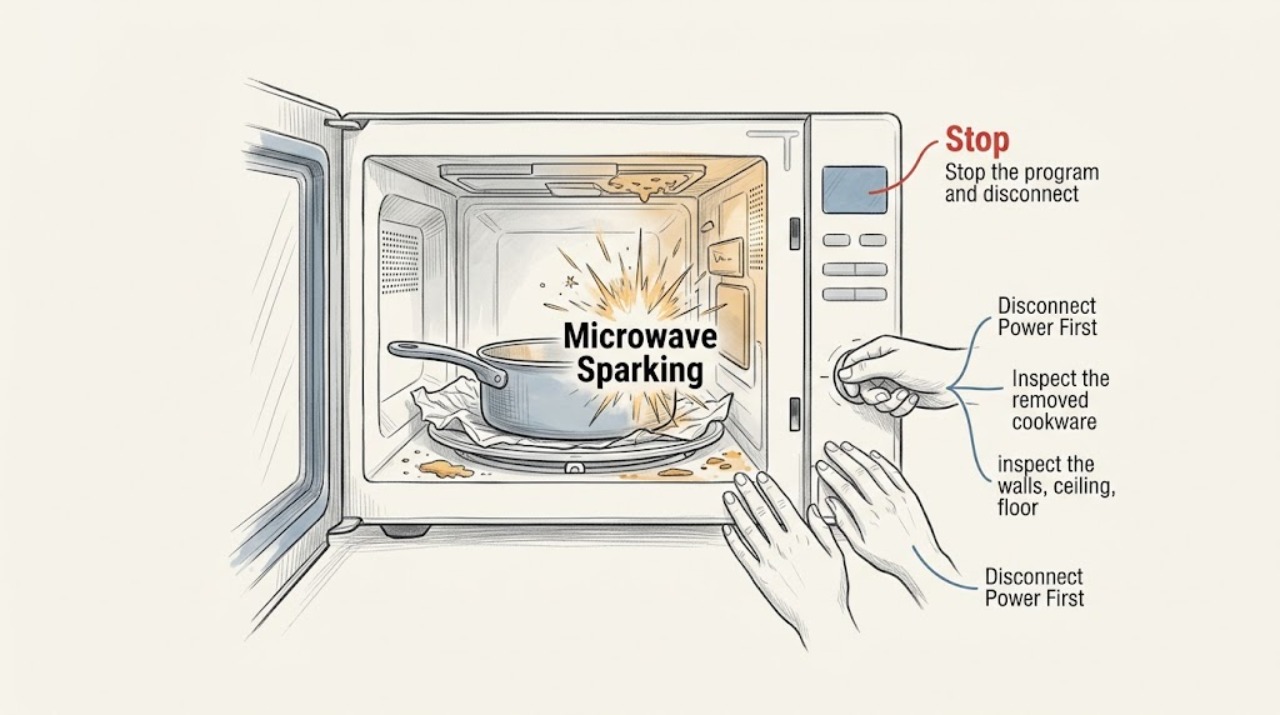
Stop the Panasonic microwave immediately when sparks appear. After it is safe and cool, remove metal containers, foil, twist ties, metal trim, and damaged cookware; inspect and clean visible food residue. If sparking returns with microwave-safe cookware or an empty clean cavity, leave the unit out of service and contact authorized Panasonic support.
Before you begin
Safety first
- Do not operate with the cover removed, scrape cavity coatings, or bypass safety components.
Work through in order
Diagnostic checks
Use only checks that match the exact appliance or system and its official guide.
-
Check 1
Stop the program and disconnect power only if safe; let the cavity cool before removing the container or food.
Expected result: Sparking stops when operation stops, or smoke/odor/visible burn marks remain.
Next step: Keep the oven out of service for any damage or odor and arrange inspection.
Why this matters
Why: The immediate arc has ended, but burn marks, smoke, or odor can indicate cavity or component damage.
-
Check 2
Inspect the removed cookware and wrapping for metal, metallic trim, foil, skewers, twist ties, metallic film, or a damaged layer exposing metal.
Expected result: Prohibited metal or damaged packaging is present, or the load was microwave-safe.
Next step: Do not reuse the unsafe container and clean only accessible residue according to the manual.
Why this matters
Why: Metal can reflect microwave energy and arc; a safe load makes residue, cavity damage, or an internal component more likely.
-
Check 3
With power isolated and the cavity cool, inspect the walls, ceiling, floor, turntable, and visible waveguide-cover area for grease, carbon, chipped coating, or cracks.
Expected result: Residue is removable and no damage is visible, or damage/blackening is present.
Next step: Do not scrape or remove a cover; stop and contact Panasonic if damage is present.
Why this matters
Why: Accessible residue can arc, while damaged coating or a waveguide cover needs service assessment.
-
Check 4
After the cavity is clean and only if the manual permits, observe one short test with microwave-safe glass and water from a safe distance.
Expected result: No spark occurs, or sparking returns with the safe test.
Next step: Stop immediately on any renewed spark and arrange authorized service.
Why this matters
Why: A clean safe test narrows the original cause to the load; recurring arcing indicates an oven-side fault.
Use your observations
Decision map
Find the observation that best matches what you see, then follow the next safe action.
-
PATH 01Next step
What you see
Sparking stops after removing metal cookware
Do this next
Use only cookware permitted by the model manual and never reuse damaged metal-lined packaging.
Why this path and its safety boundary
Why it matters: The load was the supported cause.
-
PATH 02Next step
What you see
Sparking returns with clean microwave-safe cookware
Do this next
Stop operation and request authorized service.
Why this path and its safety boundary
Why it matters: Residue, cavity damage, waveguide cover, or an internal component may be involved.
-
PATH 03Next step
What you see
Sparks are accompanied by smoke or burning odor
Do this next
Leave it out of service and arrange inspection; do not test again.
Why this path and its safety boundary
Why it matters: The oven or load may be damaged.
Helpful context
Understand the symptom
Sparks are a stop signal
A brief arc from prohibited metal is different from repeated arcing in a clean cavity. Do not keep restarting the oven to see whether the spark returns.
When checks do not resolve it
Need a professional?
Arrange authorized service for recurring sparks, an empty-cavity spark, visible cavity/waveguide damage, smoke, burning odor, or a fan/control problem.
Safety scope: Do not operate with the cover removed, scrape cavity coatings, or bypass safety components.
Have this ready
- Provide model number, cookware/wrapping, spark location, visible residue/damage, and whether the safe-load test reproduced it.
Common questions
FAQ
Should I keep using a microwave if it sparks only once?
Stop first and identify the load. If metal or metallic packaging caused it and there is no damage, follow the model manual; any repeat spark requires service.
Can I scrape black marks from the cavity?
Do not scrape coatings or remove the waveguide cover. Clean only accessible residue as the manual permits and arrange service for blackening or damage.
Read the exact guide
Official sources
- Panasonic - Troubleshooting - Physical problem with your Microwave Door, Cavity, Cabinet, Tray (Turntable) or other physical pieces.Panasonic · Panasonic microwave ovens
- Panasonic - Troubleshooting Questions for Safe Usage and Operation of Microwave OvensPanasonic · Panasonic microwave ovens
- Panasonic - Troubleshooting - Microwave power, fan or motor problems.Panasonic · Panasonic microwave ovens
Community feedback
Share a repair observation
Share a plain-text repair observation. Accepted observations are published automatically; this page may take a moment to update.