
On this page
Start here
Quick answer
Check whether warm air is entering through a door gap, whether food blocks airflow, and whether the frost is localized or covering a large area. Panasonic documentation describes automatic defrost on covered models and allows only model-approved manual defrost/cleaning. Never chip ice with a sharp tool; recurring or heavy frost after the external checks needs service.
Before you begin
Safety first
- Do not chip ice, puncture liners, remove panels, or improvise a defrost heater repair.
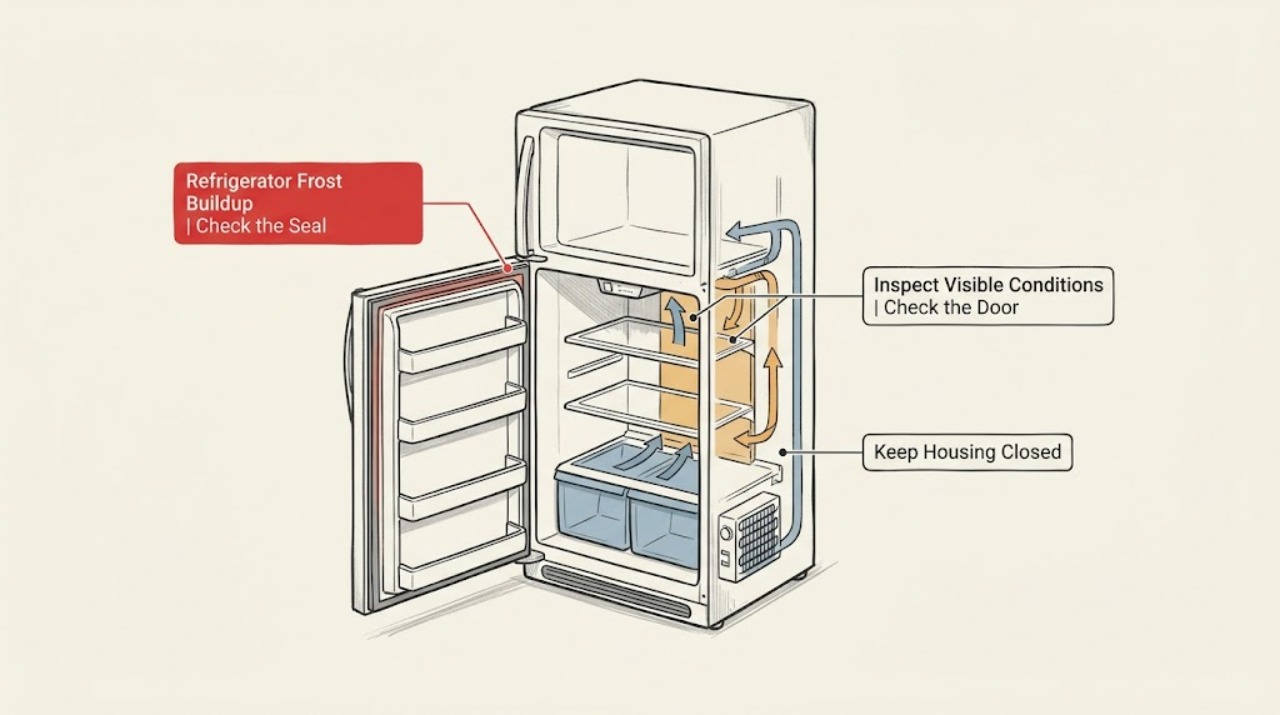
Work through in order
Diagnostic checks
Use only checks that match the exact appliance or system and its official guide.
-
Check 1
Inspect the gasket and close the door slowly around the full perimeter, looking for a gap, dirt, tear, or a package preventing closure.
Expected result: A gap/obstruction exists, or the seal contacts evenly.
Next step: Correct only the accessible obstruction and clean/dry the gasket; do not glue or heat it.
Why this matters
Why: Warm humid air can enter through a poor seal and freeze; an even seal makes airflow or defrost conditions more likely.
-
Check 2
Look for food or containers blocking vents and note whether frost is localized near one vent, the rear wall, or broadly across the compartment.
Expected result: Airflow is blocked or frost is widespread despite clear vents.
Next step: Rearrange items without covering vents and monitor; request service for persistent widespread ice.
Why this matters
Why: Blocked circulation can create local icing; widespread recurring frost needs model-specific defrost diagnosis.
-
Check 3
Check the temperature setting and recent conditions, including a power interruption, hot food load, frequent door opening, or a room-temperature change.
Expected result: The setting is unusually cold or the appliance recently experienced a load/power/ambient change.
Next step: Use the model setting and allow stabilization instead of changing it repeatedly.
Why this matters
Why: Panasonic notes operating conditions and food/door use can alter condensation and frost; a stable normal setting with recurrence points elsewhere.
-
Check 4
Defrost or clean only as the exact manual directs, with food protected and power isolated safely; never puncture, scrape, or pour hot water into hidden channels.
Expected result: Frost clears and stays away, or returns quickly/does not clear.
Next step: Stop DIY work and arrange service for recurrence or inaccessible ice.
Why this matters
Why: A one-time environmental frost event may resolve; rapid recurrence suggests seal, airflow, drain, or defrost fault.
Use your observations
Decision map
Find the observation that best matches what you see, then follow the next safe action.
-
PATH 01Next step
What you see
Frost is concentrated at a door edge and the gasket has a gap
Do this next
Correct the load/clean the gasket and arrange service for damage or persistent gap.
Why this path and its safety boundary
Why it matters: Air leakage is supported.
-
PATH 02Next step
What you see
Frost forms around a blocked vent or crowded wall
Do this next
Clear the documented airflow path and monitor without scraping ice.
Why this path and its safety boundary
Why it matters: Air circulation is restricted.
-
PATH 03Next step
What you see
Heavy frost returns after a model-approved defrost and good seal
Do this next
Arrange qualified Panasonic service.
Why this path and its safety boundary
Why it matters: An internal defrost or airflow issue remains possible.
Helpful context
Understand the symptom
Frost pattern is a decision clue
Frost near a door edge suggests moisture entry; frost around a blocked air route suggests loading or circulation; widespread recurring frost can require defrost-system service. Location matters more than scraping it away.
When checks do not resolve it
Need a professional?
Arrange service for rapid frost recurrence, widespread ice that will not clear, a damaged gasket, water/ice near electrical parts, or an inaccessible blocked drain.
Safety scope: Do not chip ice, puncture liners, remove panels, or improvise a defrost heater repair.
Have this ready
- Provide model number, frost location/pattern, gasket and load condition, setting, recent outage/load, and defrost result.
Common questions
FAQ
Can frost at the door be caused by the gasket?
Yes. A gap lets humid air enter and freeze. Clean and inspect the gasket, but arrange service for a tear or persistent gap.
Can I chip refrigerator frost away?
No. Sharp tools can puncture the liner or hidden tubing. Follow the exact manual's defrost process or request service.
Read the exact guide
Official sources
- Panasonic NRC387 Operating InstructionsPanasonic · Only models covered by the NRC387 manual family; use the exact model manual for other refrigerators
- Panasonic Troubleshooting / refrigerator symptoms and remediesPanasonic · NR-D535 model family and similar documented symptoms; verify the exact model
Community feedback
Share a repair observation
Share a plain-text repair observation. Accepted observations are published automatically; this page may take a moment to update.