
On this page
Start here
Quick answer
A Panasonic refrigerator can make normal clicking, buzzing, trickling, hissing, or popping sounds as the compressor, fans, refrigerant, and defrost system operate. First identify the sound and when it occurs, then check that the cabinet is stable and no tray or item is vibrating. Panasonic says a strange noise that remains after installation and floor checks should be assessed by service; do not remove panels.
Before you begin
Safety first
- Do not remove panels, touch fans, work on refrigerant lines, or move a heavy refrigerator alone.
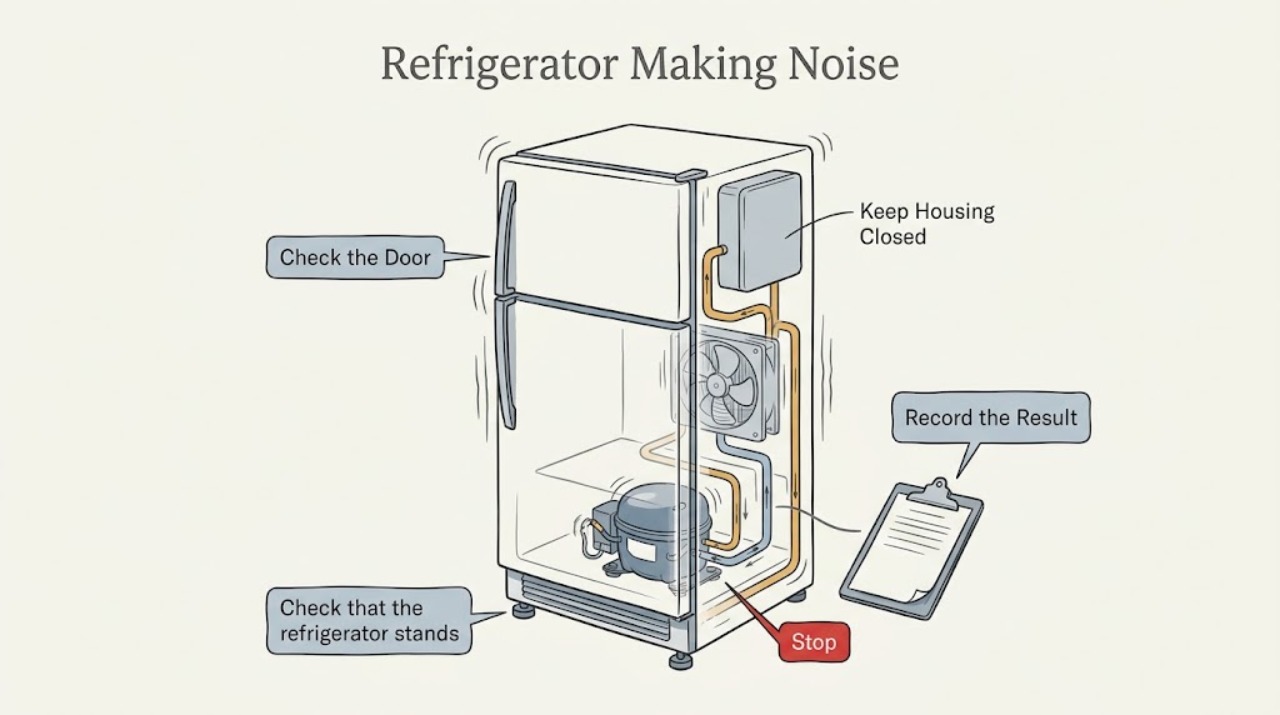
Work through in order
Diagnostic checks
Use only checks that match the exact appliance or system and its official guide.
-
Check 1
Stand beside the closed refrigerator and note whether the sound is a click, hum/buzz, trickle/bubble, hiss, pop, or vibration, and whether it occurs during cooling or after a door opening.
Expected result: The sound matches a short cycle event or is continuous/loud and unrelated to a cycle.
Next step: Record the timing and do not open the cabinet to locate internal parts.
Why this matters
Why: Panasonic lists several short operating sounds as normal; a continuous change in sound is a more useful service clue than the label alone.
-
Check 2
Check that the refrigerator stands firmly and that trays, bottles, shelves, or other loose items are not touching the cabinet or vibrating in a gap.
Expected result: The floor/support is unstable or a loose item vibrates, or the cabinet and items are stable.
Next step: Stabilise only an obvious external item and monitor; do not move a heavy appliance alone.
Why this matters
Why: Panasonic's troubleshooting manual specifically asks whether the floor supports the refrigerator and whether a dropped item causes vibration.
-
Check 3
Check whether the noise changes when the door opens, the fan starts, or an automatic defrost period ends; keep fingers away from vents and fans.
Expected result: The noise follows airflow/defrost or remains unchanged and increasingly loud.
Next step: Capture a short recording and arrange service if the sound is new, harsh, or accompanied by warming or vibration.
Why this matters
Why: Airflow, refrigerant flow, and defrost sounds can be normal, while a new mechanical sound outside those events needs model-specific diagnosis.
-
Check 4
Check the companion symptoms: temperature, display, lights, leaks, burning smell, and repeated breaker trips, without disconnecting internal wiring.
Expected result: Cooling is normal and no safety symptom is present, or cooling/electrical operation is abnormal.
Next step: Stop use for burning smell, smoke, or repeated trips and contact qualified service.
Why this matters
Why: A sound alone can be normal; a sound plus warming, smell, leak, or electrical symptom crosses into service and safety territory.
Use your observations
Decision map
Find the observation that best matches what you see, then follow the next safe action.
-
PATH 01Next step
What you see
A brief click, trickle, hiss, or fan sound occurs during normal cooling/defrost and temperature is stable
Do this next
Monitor rather than replacing a part based on sound alone.
Why this path and its safety boundary
Why it matters: The observation is consistent with Panasonic's listed operating sounds.
-
PATH 02Next step
What you see
Vibration stops after a loose tray/item or external support issue is corrected
Do this next
Keep the appliance stable and monitor for recurrence.
Why this path and its safety boundary
Why it matters: The cabinet or item was contributing to the noise.
-
PATH 03Next step
What you see
Noise is new/continuous or paired with warming, leak, smell, or breaker trips
Do this next
Stop unsafe operation and arrange Panasonic service.
Why this path and its safety boundary
Why it matters: A service-level mechanical, sealed-system, or electrical fault remains possible.
Helpful context
Understand the symptom
Describe the sound before chasing a part
Sound type, location, and timing are more useful than a guess such as ‘bad compressor.’ Listen briefly with the doors closed, then record whether the sound follows cooling, defrost, or cabinet movement.
When checks do not resolve it
Need a professional?
Use only external stability and observation checks; stop for electrical or temperature safety symptoms.
Safety scope: Do not remove panels, touch fans, work on refrigerant lines, or move a heavy refrigerator alone.
Have this ready
- Provide the model, sound recording, timing, location, temperature result, and any vibration, leak, smell, or breaker observation.
Common questions
FAQ
Is bubbling noise normal in a Panasonic refrigerator?
Panasonic lists bubbling or trickling as possible refrigerant or defrost-water sounds. It becomes more concerning when new, continuous, loud, or paired with warming or another symptom.
Should I open a Panasonic refrigerator panel to find a noise?
No. Record the sound and visible companion symptoms, then use Panasonic service for internal fan, compressor, wiring, or sealed-system diagnosis.
Read the exact guide
Official sources
- IS THIS A FAILUREPanasonic · Panasonic refrigerator strange-noise troubleshooting, floor support, installation, and vibration checks
- Panasonic - Troubleshooting - The refrigerator makes noise. - NR-D535Panasonic North America · Panasonic refrigerator normal operating sounds and noise distinctions
Community feedback
Share a repair observation
Share a plain-text repair observation. Accepted observations are published automatically; this page may take a moment to update.