
On this page
Start here
Quick answer
Many Performa refrigerator sounds are normal compressor, fan, refrigerant, water, or defrost sounds. First identify when the sound occurs and whether cooling changes, then check leveling, clearance, and an unconnected ice maker or water line. Grinding, scraping, repeated loud clicking, or noise with warming needs service.
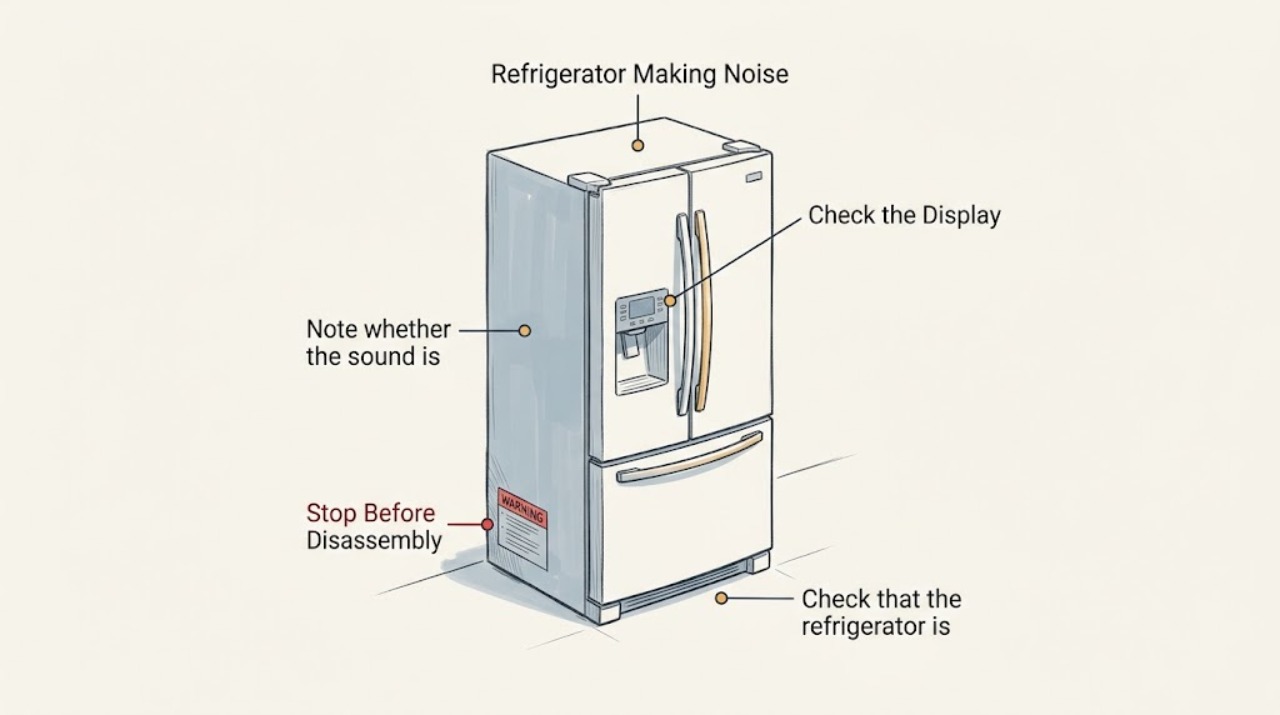
Work through in order
Diagnostic checks
Use only checks that match the exact appliance or system and its official guide.
-
Check 1
Note whether the sound is a hum, buzz, rattle, gurgle, pop, hiss, click, or scrape, and whether it occurs during cooling, defrost, or dispensing.
Expected result: The sound matches a short cycle or is continuous and newly harsh.
Next step: Continue to the external checks for a cycle-linked sound; stop and arrange service for scraping or a sound paired with warming.
Why this matters
Why: Short cycle-linked sounds can be normal; a continuous or abrasive pattern is less likely to be normal operation.
-
Check 2
Check that the refrigerator is stable and level, with no bottles, trim, or cabinet touching it; move only loose external items.
Expected result: The noise changes when a loose item is moved or the cabinet is stabilized, or it does not change.
Next step: Correct the loose item or leveling using the manual; do not remove panels to reach internal components.
Why this matters
Why: A changed sound indicates vibration transfer or leveling; no change makes an internal fan, compressor, or valve more likely.
-
Check 3
If the refrigerator has an ice maker but no connected water supply, check the model control and listen for buzzing during a fill attempt; do not disconnect plumbing under pressure.
Expected result: Buzzing occurs during an attempted fill, or no water/ice function is involved.
Next step: Turn the ice maker off if the model is not connected to water, or have the line/filter checked; call service if buzzing persists.
Why this matters
Why: An unconnected or restricted water path can make a valve buzz; otherwise inspect general cooling and vibration clues.
Use your observations
Decision map
Find the observation that best matches what you see, then follow the next safe action.
-
PATH 01Next step
What you see
The sound is a brief hum, gurgle, pop, or defrost sizzle and temperatures remain normal.
Do this next
Monitor it and keep clearances and leveling correct.
Why this path and its safety boundary
Why it matters: Normal compressor, refrigerant-flow, expansion, or defrost operation is more likely.
-
PATH 02Next step
What you see
Rattle or buzz changes when the cabinet is stabilized, a loose item is moved, or the ice maker is turned off without a water supply.
Do this next
Correct the external cause and monitor; arrange service if the sound returns without that trigger.
Why this path and its safety boundary
Why it matters: Vibration or an unconnected water valve is more likely than a sealed-system failure.
-
PATH 03Next step
What you see
Grinding, scraping, repeated hard clicking, or a new loud noise occurs with warming, frost, or water trouble.
Do this next
Protect food and call qualified appliance service; do not operate with damaged wiring or remove sealed panels.
Why this path and its safety boundary
Why it matters: A fan, compressor-start, defrost, or other component fault may be present.
Helpful context
Understand the symptom
Timing is the diagnostic clue
A brief hum, gurgle, pop, or defrost sizzle can occur during normal cycles. A sound that is continuous, newly harsh, synchronized with vibration, or paired with poor cooling is more useful evidence of a fault.
When checks do not resolve it
Need a professional?
Stop and seek qualified service for grinding or scraping, smoke or burning odor, repeated breaker trips, a loud new noise with warming/frost, or a noise that cannot be localized by safe external checks. Do not open sealed-system or energized compartments.
Common questions
FAQ
Is a humming sound automatically a failure?
No. Compressor and fan operation can produce a hum. It matters more if the sound is new, abrasive, continuous, or paired with warming.
Why does the refrigerator buzz when it is not connected to water?
The water valve may attempt a fill cycle. Follow the model instructions to turn the ice maker off when no water line is connected.
Read the exact guide
Official sources
- Refrigerator Normal Sounds and NoisesWhirlpool Corporation · refrigerator normal hum, buzz, gurgle, pop, rattle, defrost, compressor, fan, and water-valve sounds
- Owner's ManualWhirlpool Corporation / Maytag Appliances · Maytag Performa refrigerator operation, care, temperature, leveling, and ice service
- Not Dispensing Ice or Water - RefrigeratorWhirlpool Corporation · refrigerator ice-maker water supply, filter, line, and pressure checks
Community feedback
Share a repair observation
Share a plain-text repair observation. Accepted observations are published automatically; this page may take a moment to update.