
On this page
Start here
Quick answer
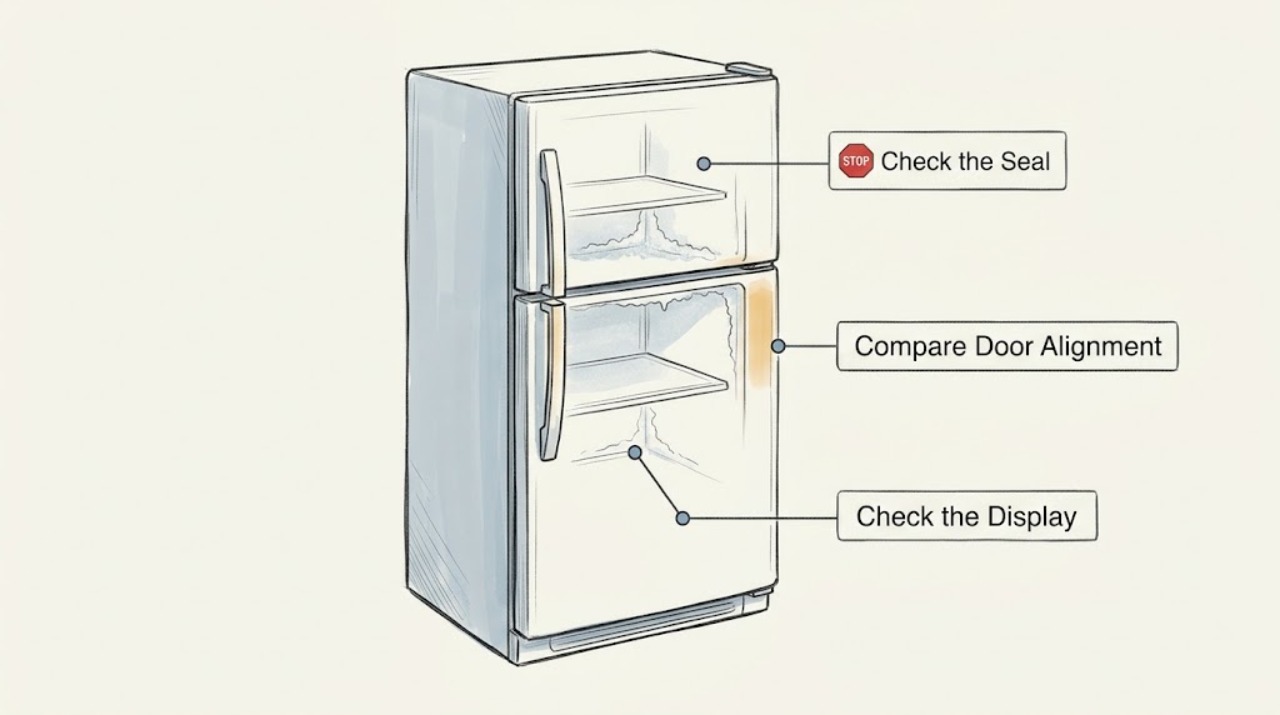
For Profile refrigerator frost buildup, first check that the freezer door or drawer closes fully and that no package, shelf, or bin blocks the seal. Inspect the gasket and alignment, clear only visible frost with a dry towel, and use the model instructions for temperature or leveling changes. Frost that returns after those checks, or frost that blocks airflow, needs service.
Before you begin
Safety first
- Do not use a knife, sharp tool, heat gun, or panel removal to clear ice; do not access defrost or sealed-system parts.
Work through in order
Diagnostic checks
Use only checks that match the exact appliance or system and its official guide.
-
Check 1
Move packages, shelves, baskets, and bins away from the freezer door or drawer opening, then close it and check for a complete perimeter seal.
Expected result: The door closes flush and frost is concentrated near the opening, or the seal still has a gap.
Next step: Keep the closing path clear and continue with the gasket check if the gap remains.
Why this matters
Why: Localized frost with an obstruction suggests warm air entered through the closure; a persistent gap points to gasket, alignment, or leveling.
-
Check 2
Inspect the gasket for dirt, folds, cuts, or tears and inspect the door or drawer for uneven alignment.
Expected result: The gasket is continuous and contacts the cabinet, or it is damaged or lifted at one section.
Next step: Use model-specific installation instructions for alignment; replace a gasket only after confirming model fit, and arrange service for a torn seal.
Why this matters
Why: A damaged or displaced gasket can admit humid air; a sound gasket makes loading, leveling, or an internal frost cause more likely.
-
Check 3
Remove loose surface frost with a dry towel and check the temperature control against the Owner's Manual; do not chip or melt ice with an improvised tool.
Expected result: Frost clears and stays away after the door/seal issue is corrected, or it returns in the same area.
Next step: If frost returns or covers vents, stop repeated clearing and arrange service.
Why this matters
Why: A temporary layer can follow a door-ajar event; repeated accumulation indicates the underlying air, defrost, or airflow problem remains.
-
Check 4
Note whether frost is only on food packages, around the door opening, or across the freezer walls and vents.
Expected result: Only packages have crystals, the opening has a band of frost, or heavy frost covers walls/airflow areas.
Next step: Correct the matching external cause; arrange service when heavy frost persists or airflow is restricted.
Why this matters
Why: Crystals on packages can follow normal humid-air exposure; a door-opening band suggests a seal issue; heavy wall frost can impair airflow and needs deeper diagnosis.
Use your observations
Decision map
Find the observation that best matches what you see, then follow the next safe action.
-
PATH 01Next step
What you see
Frost is confined to the door edge and disappears after an obstruction is removed.
Do this next
Keep shelves and packages clear and monitor the seal.
Why this path and its safety boundary
Why it matters: Warm humid air was entering at the closure rather than proving a failed cooling component.
-
PATH 02Next step
What you see
The gasket is torn, folded, or fails to contact the cabinet at one corner.
Do this next
Confirm the model-specific gasket requirement and arrange service or a properly matched replacement.
Why this path and its safety boundary
Why it matters: The freezer cannot maintain a consistent air seal, so frost is likely to recur.
-
PATH 03Next step
What you see
Heavy frost returns across walls or vents after closure, gasket, alignment, and temperature checks.
Do this next
Stop scraping and arrange service; keep the model and frost location available for the technician.
Why this path and its safety boundary
Why it matters: An internal defrost or airflow problem is more likely than a simple loading issue.
Helpful context
Understand the symptom
Frost is an air-leak clue
A door left open or slightly ajar lets warm, humid air condense and freeze. Frost near the opening points toward closure and gasket checks; frost that returns everywhere after those checks points toward an internal defrost or airflow fault.
Only after diagnosis
Potential parts
- freezer door gasket
Only relevant when inspection finds a torn or non-contacting gasket after the door is aligned.
Verify the exact model and manufacturer's fit information before ordering.
When checks do not resolve it
Need a professional?
Arrange service for frost that returns after external checks, frost blocking vents, a damaged gasket, or an inaccessible defrost problem.
Safety scope: Do not use a knife, sharp tool, heat gun, or panel removal to clear ice; do not access defrost or sealed-system parts.
Have this ready
- Provide the model, frost location, door/gasket condition, whether packages blocked closure, and whether cooling is also affected.
Common questions
FAQ
Is frost on a Profile freezer wall always a failed part?
No. GE Appliances notes that frequent openings or a slightly ajar door can cause frost; persistent frost after closure and gasket checks needs service.
Why are there ice crystals on frozen packages?
Warm moist air entering during door openings can form crystals on packages. Check closure and load placement before assuming an internal failure.
Read the exact guide
Official sources
- Refrigerator - Frost or Ice Crystals on Food in FreezerGE Appliances (GE Profile) · GE Profile refrigerator frost crystals, package loading, and door seal guidance
- Refrigerator - Frost in FreezerGE Appliances (GE Profile) · GE Profile refrigerator freezer frost, gasket, alignment, and leveling guidance
Community feedback
Share a repair observation
Share a plain-text repair observation. Accepted observations are published automatically; this page may take a moment to update.