
On this page
Start here
Quick answer
Protect the floor and identify where the water starts: under the fresh-food drawers, at the dispenser, inside the freezer, or behind the refrigerator. For a floor puddle, turn off the ice maker and water supply if it is safe to reach, and unplug before cleaning or maintenance. A leaking valve, tank, tubing, or inaccessible drain needs service; a leak in the home's plumbing line needs a plumber.
Before you begin
Safety first
- Unplug before maintenance or cleaning; do not work around water and live power, pierce tubing, or remove internal panels.
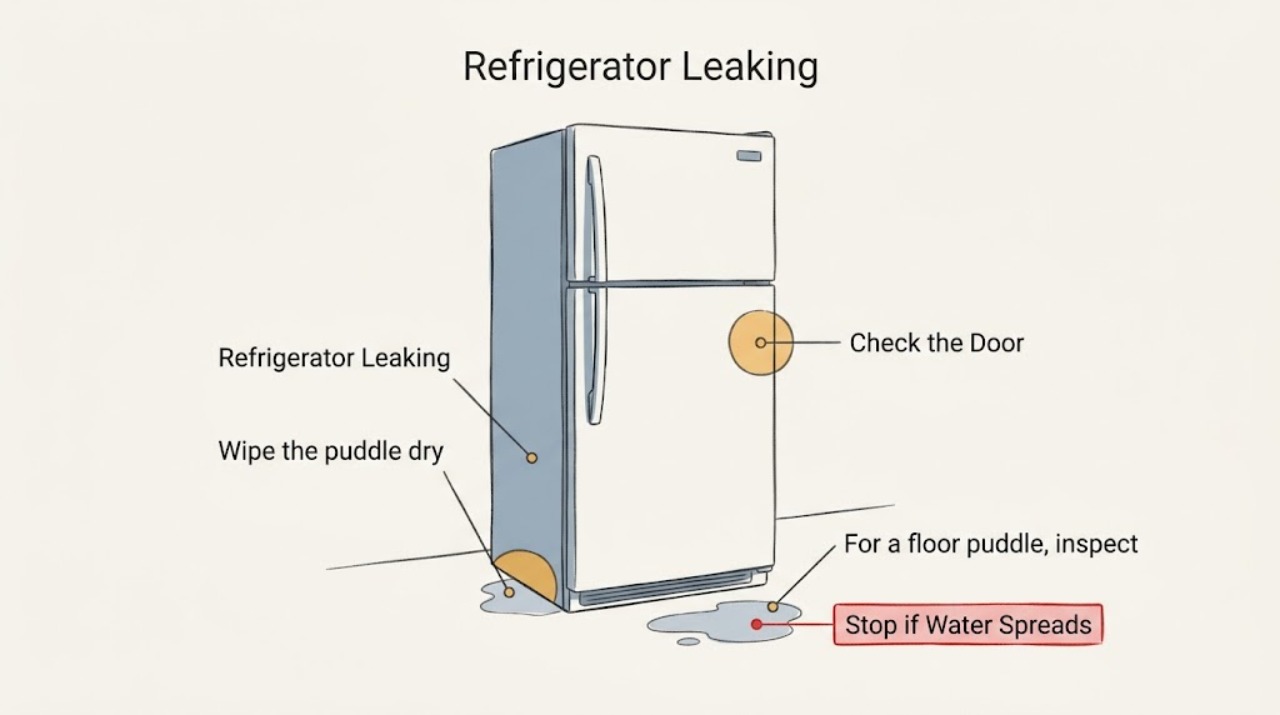
Work through in order
Diagnostic checks
Use only checks that match the exact appliance or system and its official guide.
-
Check 1
Wipe the puddle dry and note whether water reappears under the fresh-food drawers, on the freezer floor, at the dispenser tray, or behind the cabinet.
Expected result: The source location is visible, or water keeps spreading before its source can be seen.
Next step: If the source is not clear, stop using the water and ice functions and arrange service rather than moving the appliance repeatedly.
Why this matters
Why: Under-drawer water suggests tank/tubing or defrost drainage; freezer-floor ice suggests a drain; dispenser drips can be normal briefly; an unseen source needs isolation.
-
Check 2
If water is under the fresh-food drawers and the dispenser is present, pull the drawers out, leave the door open, and watch the tank while dispensing a small glass of water.
Expected result: The tank or tubing visibly leaks during dispensing, or it stays dry.
Next step: Do not dismantle the liner; arrange service for a visible tank or tubing leak.
Why this matters
Why: A visible tank/tubing leak identifies an internal water-path fault; no leak during this check makes a defrost drain, valve, or other location more likely.
-
Check 3
For a floor puddle, inspect the accessible supply line and plastic fill line for a loose or split section, and check for ice under the freezer or drawers.
Expected result: A line is wet/split, or ice accompanies the puddle under the freezer or drawers.
Next step: Turn off the refrigerator water supply if safe. Use a plumber for the home's copper line and appliance service for an appliance line or drain.
Why this matters
Why: A supply or fill-line leak needs water shutoff; ice with a puddle can indicate a clogged defrost drain, often requiring service.
-
Check 4
If the leak is at the dispenser, observe whether only a few drops fall immediately after dispensing or whether dripping continues long after the glass is removed.
Expected result: Only a few immediate drops occur, or the drip continues.
Next step: Wipe the drip tray for the normal case; arrange service for persistent dripping.
Why this matters
Why: A few drops can result from water-line pressure and condensation; continued dripping indicates a service issue.
Use your observations
Decision map
Find the observation that best matches what you see, then follow the next safe action.
-
PATH 01Next step
What you see
Water appears under the drawers while the dispenser is used and the tank/tubing visibly wets.
Do this next
Stop dispensing and arrange appliance service; keep the water supply off if the leak continues.
Why this path and its safety boundary
Why it matters: The leak is in the refrigerator's internal water path.
-
PATH 02Next step
What you see
A puddle is paired with freezer-floor ice or ice under the fresh-food pans.
Do this next
Use only model-specific drain guidance; arrange service when the drain is inaccessible or the leak returns.
Why this path and its safety boundary
Why it matters: A defrost drain may be clogged, with the exact repair depending on the refrigerator style.
-
PATH 03Next step
What you see
Water is from the home supply line or the dispenser continues dripping after use.
Do this next
Shut off water safely and call a plumber for the home line or refrigerator service for the dispenser.
Why this path and its safety boundary
Why it matters: The source is plumbing or a dispenser water-path fault rather than normal brief condensation.
Helpful context
Understand the symptom
Location narrows the cause
Water that travels across a cabinet can make the puddle appear far from the source. Dry the area, observe during a controlled dispenser use only when safe, and avoid pulling a heavy refrigerator over a wet floor.
When checks do not resolve it
Need a professional?
Arrange service for a leaking tank, tubing, valve, recurring drain overflow, or an unidentified leak inside the cabinet.
Safety scope: Unplug before maintenance or cleaning; do not work around water and live power, pierce tubing, or remove internal panels.
Have this ready
- Provide the leak location, whether dispensing or ice making triggers it, any freezer-floor ice, and whether the house line or appliance line is wet.
Common questions
FAQ
Are a few drops from a Profile dispenser normal?
GE Appliances says a few drops immediately after dispensing can result from line pressure and condensation; dripping long after the glass is removed needs service.
What does water under the fresh-food drawers suggest?
It may be a leak in the water storage tank or tubing; GE's check is to watch the tank during a controlled dispenser use, then arrange service if it leaks.
Read the exact guide
Official sources
- Refrigerator - Water Under the Fresh Food DrawersGE Appliances (GE Profile) · GE Profile refrigerator tank and tubing leak guidance
- Refrigerator - Dripping or Leaking Water from DispenserGE Appliances (GE Profile) · GE Profile refrigerator dispenser dripping and service guidance
- Refrigerator - Water on FloorGE Appliances (GE Profile) · GE Profile refrigerator floor-water, drain, valve, and supply-line guidance
Community feedback
Share a repair observation
Share a plain-text repair observation. Accepted observations are published automatically; this page may take a moment to update.