
On this page
Start here
Quick answer
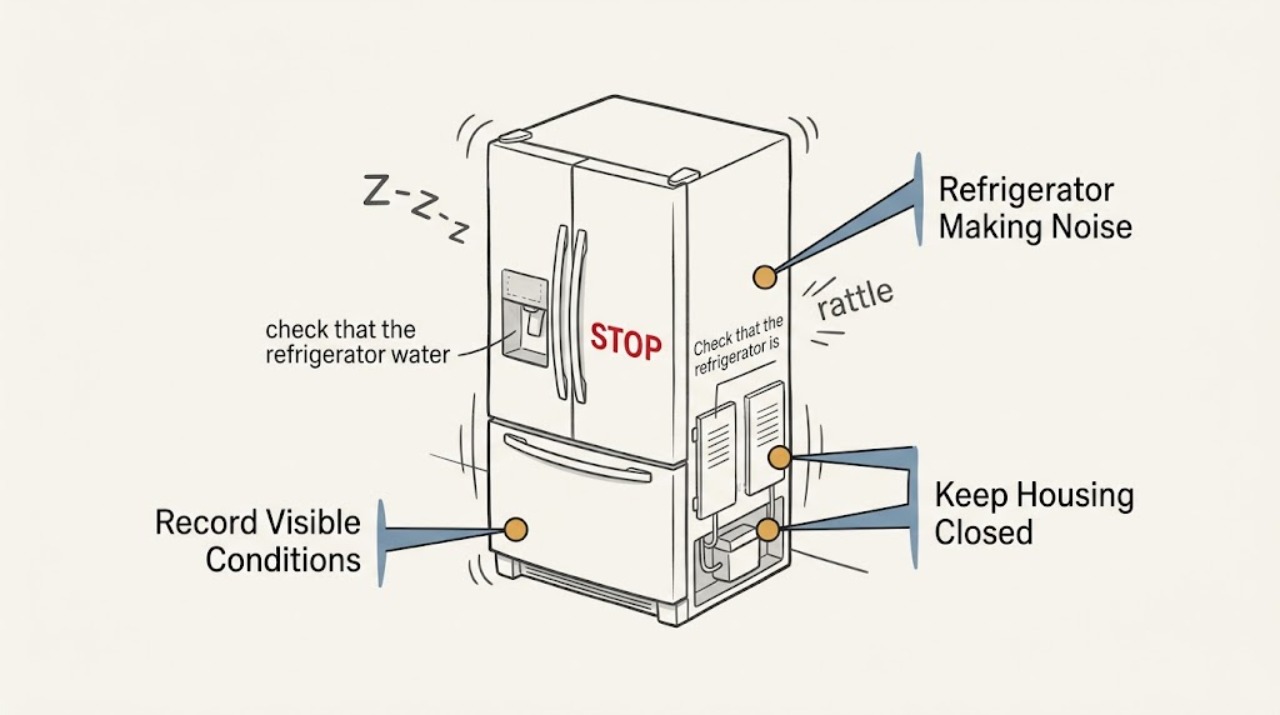
Record when the sound occurs and whether it is a brief buzz, a repeated buzz, vibration, clicking, scraping, or a loud new noise. GE Profile refrigerators can buzz briefly while an ice maker or water valve operates. If the ice maker is on with no water supply, turn the ice maker off using the model controls; stop and arrange service for scraping, burning odor, vibration that moves the appliance, or a sound that persists after external checks.
Before you begin
Safety first
- Do not open electrical covers, reach into fans, disconnect sealed-system parts, or continue operating with smoke, burning odor, or a wet electrical area.
Work through in order
Diagnostic checks
Use only checks that match the exact appliance or system and its official guide.
-
Check 1
Stand beside the refrigerator and record the sound's location and pattern: brief buzz during water or ice use, repeated buzz at idle, vibration, clicking, or scraping.
Expected result: The sound is brief and tied to a function, repeats with no water supply, or is a new mechanical sound.
Next step: Continue with the water-supply check for a buzz; arrange service for scraping or an unexplained new sound.
Why this matters
Why: A function-linked buzz commonly comes from a valve; a repeated idle buzz can mean the ice maker is trying to fill without water; scraping or new mechanical sounds need diagnosis.
-
Check 2
If the buzz occurs while dispensing or making ice, check that the refrigerator water supply is turned on and the line is not visibly kinked, without disconnecting tubing.
Expected result: Water supply is on, or the ice maker is on while the supply is off.
Next step: Turn the ice maker off using the model's control when water is not connected; arrange service if buzzing continues with proper supply.
Why this matters
Why: The valve can buzz during normal filling; an ice maker repeatedly attempting to fill without water can create a recurring buzz.
-
Check 3
Check that the refrigerator is stable and not touching a wall, cabinet, or loose item, and that the sound is not caused by an external object vibrating against it.
Expected result: The noise changes when an external contact is removed, or vibration persists from inside the appliance.
Next step: Restore clearance without forcing the appliance. Do not remove covers to inspect internal fans or compressors.
Why this matters
Why: External contact can amplify a harmless motor or valve sound; persistent internal vibration needs a technician's diagnosis.
-
Check 4
Note whether cooling, ice making, dispensing, or the display also changes when the noise occurs, and look only for visible water or scorching at the exterior.
Expected result: Noise is paired with loss of cooling, failed dispensing, a leak, scorching, or no other change.
Next step: Disconnect power or water only when safe and arrange service for paired failures, leaks, scorching, or abnormal heat.
Why this matters
Why: A sound with another failing function is more significant than an isolated brief valve buzz; visible water or scorching raises the safety priority.
Use your observations
Decision map
Find the observation that best matches what you see, then follow the next safe action.
-
PATH 01Next step
What you see
A brief buzz occurs during ice-maker filling or water dispensing, with stable cooling and no leak.
Do this next
Monitor it; keep the water supply connected if the ice maker is enabled.
Why this path and its safety boundary
Why it matters: The sound is consistent with normal water-valve operation.
-
PATH 02Next step
What you see
A buzz repeats while the ice maker is on but the refrigerator water supply is off.
Do this next
Turn the ice maker off using the model controls, then arrange service if the sound persists after normal supply is restored.
Why this path and its safety boundary
Why it matters: The ice maker may be attempting repeated fills without water.
-
PATH 03Next step
What you see
The sound is scraping, loud and new, paired with cooling loss, scorching, leaking, or strong vibration.
Do this next
Stop and arrange appliance service; do not remove internal covers.
Why this path and its safety boundary
Why it matters: The pattern is not explained by a routine valve buzz and may involve a mechanical or electrical fault.
Helpful context
Understand the symptom
Timing is more useful than loudness
A short sound tied to dispensing or ice-maker filling is different from a constant mechanical noise. Note the compartment and trigger before moving the refrigerator or touching any panel.
When checks do not resolve it
Need a professional?
Arrange service for persistent or worsening noise, scraping, cooling or dispensing changes, abnormal vibration, scorching, or a noise that remains after the water-supply check.
Safety scope: Do not open electrical covers, reach into fans, disconnect sealed-system parts, or continue operating with smoke, burning odor, or a wet electrical area.
Have this ready
- Provide the sound type, location, timing, trigger, water-supply state, and any concurrent cooling, dispensing, leak, or display symptom.
Common questions
FAQ
Is a buzzing Profile refrigerator always failing?
No. GE Appliances says buzzing or humming commonly comes from the ice maker or dispenser water valve during normal operation.
Why does the refrigerator buzz every time the ice maker tries to fill?
If the ice maker is on but its water supply is off, GE Appliances says the valve may buzz on repeated fill attempts; turn the ice maker off until water is available.
Read the exact guide
Official sources
- Refrigerator - Buzzing NoiseGE Appliances (GE Profile) · GE Profile refrigerator buzzing, humming, water-valve, and ice-maker noise guidance
Community feedback
Share a repair observation
Share a plain-text repair observation. Accepted observations are published automatically; this page may take a moment to update.