
On this page
Start here
Quick answer
Check the temperature setting, door closure, food blocking the vents, and the installation clearance before assuming a sealed-system failure. A newly installed refrigerator may need time to stabilize. If your model has accessible condenser coils, clean them only with power disconnected and according to its manual. Persistent warmth, heavy frost, or a refrigerator that will not run needs service.
Before you begin
Safety first
- Unplug before any permitted coil cleaning; do not remove panels, access refrigerant, probe live circuits, or bypass door switches.
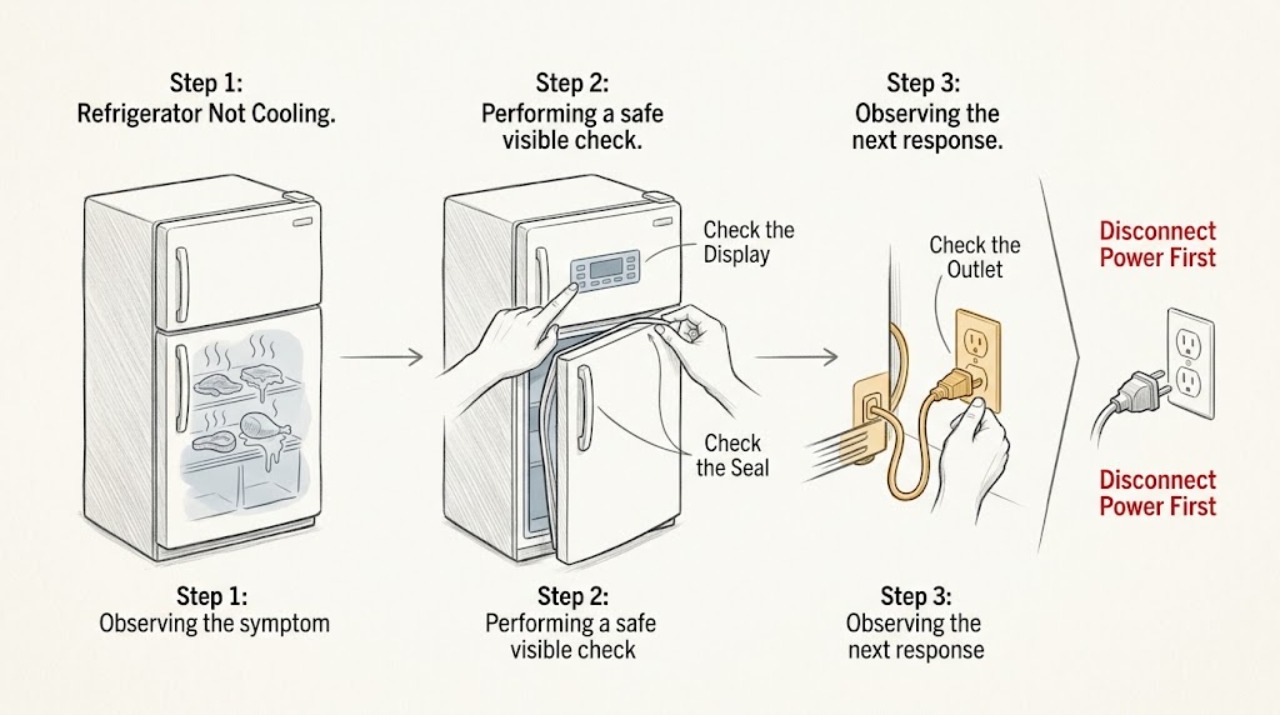
Work through in order
Diagnostic checks
Use only checks that match the exact appliance or system and its official guide.
-
Check 1
Check the refrigerator and freezer controls and confirm that the appliance has had adequate time to stabilize after installation or a long power interruption.
Expected result: The setting was warm/off, or the refrigerator remains warm after the controls are correct and stabilization time.
Next step: Correct the setting per the model manual and monitor; arrange service if cooling does not recover.
Why this matters
Why: A setting or recent start can explain temporary warmth; persistent warmth after stabilization requires deeper diagnosis.
-
Check 2
Inspect the refrigerator and freezer doors for packages, trays, ice, open bins, or a gasket gap that prevents full closure.
Expected result: A door closes after rearranging, or it remains misaligned or unsealed.
Next step: Clear the closing path and use model-specific leveling guidance; arrange service for a damaged gasket or hinge.
Why this matters
Why: A closure gap admits warm air and can make the unit run warm; a sound seal shifts attention to airflow or cooling components.
-
Check 3
Move tall containers away from rear air outlets and confirm that the refrigerator has the model-specified clearance around the cabinet.
Expected result: An outlet was blocked or clearance was restricted, or airflow appears clear.
Next step: Restore airflow and clearance without covering vents; continue to the coil check only if the model permits it.
Why this matters
Why: Blocked circulation or restricted heat release can reduce cooling; clear space rules vary by model.
-
Check 4
If the Owner's Manual says the condenser is owner-cleanable, unplug the refrigerator before inspecting accessible coils for dust or pet hair; do not clean a sealed or inaccessible assembly.
Expected result: Accessible coils are visibly dirty, or the model has a NeverClean/inaccessible condenser.
Next step: Clean only as the manual directs and restore power; arrange service if the unit remains warm.
Why this matters
Why: Dirt can reduce efficiency on models that require cleaning; many newer models do not expose coils for owner cleaning.
-
Check 5
Close the refrigerator door slowly and check whether the interior light goes out near the closed position; note heavy frost or a fan blocked by ice without removing panels.
Expected result: The light stays on, heavy frost covers vents, or neither symptom is present.
Next step: Correct the external door issue; arrange service for persistent frost, an internal fan problem, or continued cooling loss.
Why this matters
Why: A misaligned door can leave the light on and add heat; heavy frost can restrict airflow and points to a defrost or seal issue.
Use your observations
Decision map
Find the observation that best matches what you see, then follow the next safe action.
-
PATH 01Next step
What you see
Cooling improves after correcting the setting, allowing stabilization, or clearing a blocked door/vent.
Do this next
Keep the doors sealed and airflow clear, then monitor temperature.
Why this path and its safety boundary
Why it matters: The symptom was likely caused by operating conditions rather than an immediate sealed-system failure.
-
PATH 02Next step
What you see
The appliance runs but remains warm after closure, airflow, clearance, and model-approved coil checks.
Do this next
Arrange appliance service and provide the model, temperature trend, frost pattern, and checks already completed.
Why this path and its safety boundary
Why it matters: A fan, control, defrost, compressor, or sealed-system fault is more likely.
-
PATH 03Next step
What you see
The light stays on, heavy frost blocks vents, or the refrigerator will not run at all.
Do this next
Stop dismantling the unit and arrange service; protect perishable food separately.
Why this path and its safety boundary
Why it matters: Door alignment/light heat, airflow restriction, or an electrical/control problem may be driving the temperature complaint.
Helpful context
Understand the symptom
Start with external causes
Cooling complaints can come from airflow or closure as well as a refrigeration fault. Keep food safe, limit door opening, and use the model manual for settings rather than guessing an exact temperature.
When checks do not resolve it
Need a professional?
Arrange service for persistent warmth, heavy frost, no operation, damaged door hardware, or cooling loss after the external checks.
Safety scope: Unplug before any permitted coil cleaning; do not remove panels, access refrigerant, probe live circuits, or bypass door switches.
Have this ready
- Provide the model, control settings, installation age, door/gasket state, airflow/clearance findings, frost pattern, and whether the compressor or fan runs.
Common questions
FAQ
How long should a newly installed Profile refrigerator take to cool?
GE Appliances advises allowing about 24 hours for a newly installed refrigerator to cool and stabilize; persistent warmth afterward needs service.
Should I clean the condenser coils on every Profile refrigerator?
No. GE Appliances says many models have a NeverClean condenser or inaccessible coils; follow the specific Owner's Manual and disconnect power before permitted cleaning.
Read the exact guide
Official sources
- Refrigerator - Not Cooling EnoughGE Appliances (GE Profile) · GE Profile refrigerator temperature settings, closure, airflow, clearance, lights, and cooling guidance
- Refrigerator - Cleaning Condenser CoilsGE Appliances (GE Profile) · GE Profile refrigerator condenser accessibility and power-disconnected cleaning guidance
Community feedback
Share a repair observation
Share a plain-text repair observation. Accepted observations are published automatically; this page may take a moment to update.