
On this page
Start here
Quick answer
Remove food packages, bins, or shelves that project into the door path, then inspect and clean the gasket and any French-door hinged seal. Confirm the refrigerator is level and the door is aligned; model-specific hinge adjustment may be needed. A door that still will not close or seal can warm the cabinet and overwork the compressor, so arrange service for a torn gasket, bent hinge, damaged stop, or unresolved alignment.
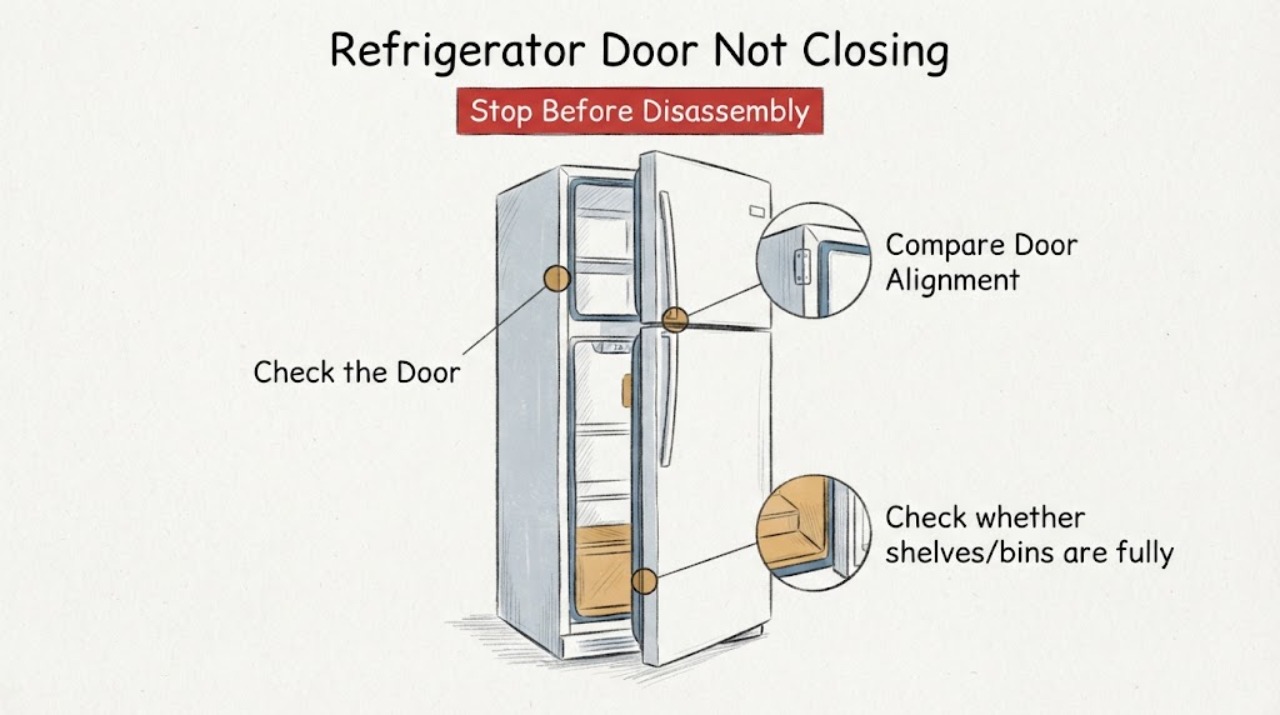
Work through in order
Diagnostic checks
Use only checks that match the exact appliance or system and its official guide.
-
Check 1
Open the door and remove or reposition food packages, bottles, shelves, and door bins that project into the closing path; push shelves fully into their rails.
Expected result: The door closes after rearranging contents, or still stops at the same location.
Next step: Keep contents clear and continue only if the door still will not close.
Why this matters
Why: A changed result confirms an obstruction or out-of-position storage component.
-
Check 2
Inspect the gasket around the full door perimeter and, on French-door models, the vertical hinged seal/mullion for debris, folds, gaps, tears, or a section staying outward.
Expected result: Gasket is dirty/folded/damaged, hinged seal is outward, or the seals appear intact.
Next step: Clean with warm water/soap and a soft cloth; fold the hinged seal inward as designed. Replace/service damaged sealing parts.
Why this matters
Why: A dirty gasket or outward hinged seal can prevent both closing and sealing.
-
Check 3
Check whether shelves/bins are fully seated and whether the cabinet stands level side-to-side and front-to-back.
Expected result: A bin/rail is mis-seated, the cabinet rocks/leans, or level appears correct.
Next step: Reseat accessible bins/shelves. Use the installation instructions for leveling; do not remove hinge hardware without model guidance.
Why this matters
Why: A mis-seated component can block the door; an unlevel cabinet can prevent proper self-closing and alignment.
-
Check 4
With the door empty and the gasket clean, close it slowly and observe hinge movement, door height, contact points, and whether it springs open or leaves a visible gap.
Expected result: Door rubs at a hinge, sits unevenly, contacts a stop, or leaves a gap despite a clear path.
Next step: Use the exact model alignment procedure or arrange service; do not force, bend, or fully remove hinge bolts.
Why this matters
Why: These observations point to alignment, hinge, stop, or gasket damage rather than contents.
-
Check 5
Verify the door remains closed and sealed through a supervised check, then monitor cabinet temperature and any door alarm.
Expected result: The door closes flush and stays closed, or it reopens/leaves a gap and temperature rises.
Next step: Arrange service for a persistent gap, torn gasket, damaged hinge/stop, or temperature rise.
Why this matters
Why: A stable seal supports a resolved obstruction/seal issue; a recurring gap threatens cooling performance.
Use your observations
Decision map
Find the observation that best matches what you see, then follow the next safe action.
-
PATH 01Next step
What you see
Door closes after packages, bins, or shelves are repositioned.
Do this next
Keep the closing path clear and confirm the door seals.
Why this path and its safety boundary
Why it matters: An obstruction or mis-seated storage part caused the symptom.
-
PATH 02Next step
What you see
The gasket is dirty or the French-door hinged seal is folded outward.
Do this next
Clean the gasket and fold the hinged seal inward before closing.
Why this path and its safety boundary
Why it matters: The seal itself was preventing closure.
-
PATH 03Next step
What you see
The cabinet is unlevel or the door is visibly uneven/rubbing.
Do this next
Follow the exact model installation/alignment instructions or arrange service.
Why this path and its safety boundary
Why it matters: Leveling or alignment is needed.
-
PATH 04Next step
What you see
A clear, level door still leaves a gap, has a torn gasket, damaged hinge/stop, or causes a temperature alarm.
Do this next
Keep the door closed manually only as a temporary measure and arrange service promptly.
Why this path and its safety boundary
Why it matters: A component or installation fault remains.
Helpful context
Understand the symptom
A door can fail to close because something is physically in the way, a gasket or hinged seal is folded/dirty, the cabinet is out of level, or a hinge/door component is damaged. Start with the reversible external checks.
Check the closing path and seal
Do not force the door against a package or shelf. A partially open refrigerator door leaks cold air and can create a separate cooling complaint.
When checks do not resolve it
Need a professional?
Arrange prompt service for a door that cannot seal, a torn gasket, damaged hinge/stop, exposed sharp hardware, rising temperature, or a door alarm that persists. Keep perishables safe while the door remains unresolved.
Common questions
FAQ
What is the first check for a refrigerator door that will not close?
Remove packages, bottles, shelves, and bins that project into the path, and confirm bins/shelves are pushed fully into position.
How do I handle a French-door center seal that sticks out?
Whirlpool says the vertical hinged seal should fold inward before closing; if it remains outward, the doors may not close or seal.
Should I adjust hinges without the model manual?
No. Alignment hardware and safety steps vary by model. Confirm leveling and use the exact installation/manual procedure, or arrange service.
Read the exact guide
Official sources
- Refrigerators - How to align doorsFrigidaire · refrigerator door alignment and movement
- Door Not Closing - RefrigeratorWhirlpool · refrigerator door obstruction, seal, and leveling
- Refrigerator Clean and Care GuideFrigidaire · refrigerator gasket cleaning
Community feedback
Share a repair observation
Share a plain-text repair observation. Accepted observations are published automatically; this page may take a moment to update.