
On this page
Start here
Quick answer
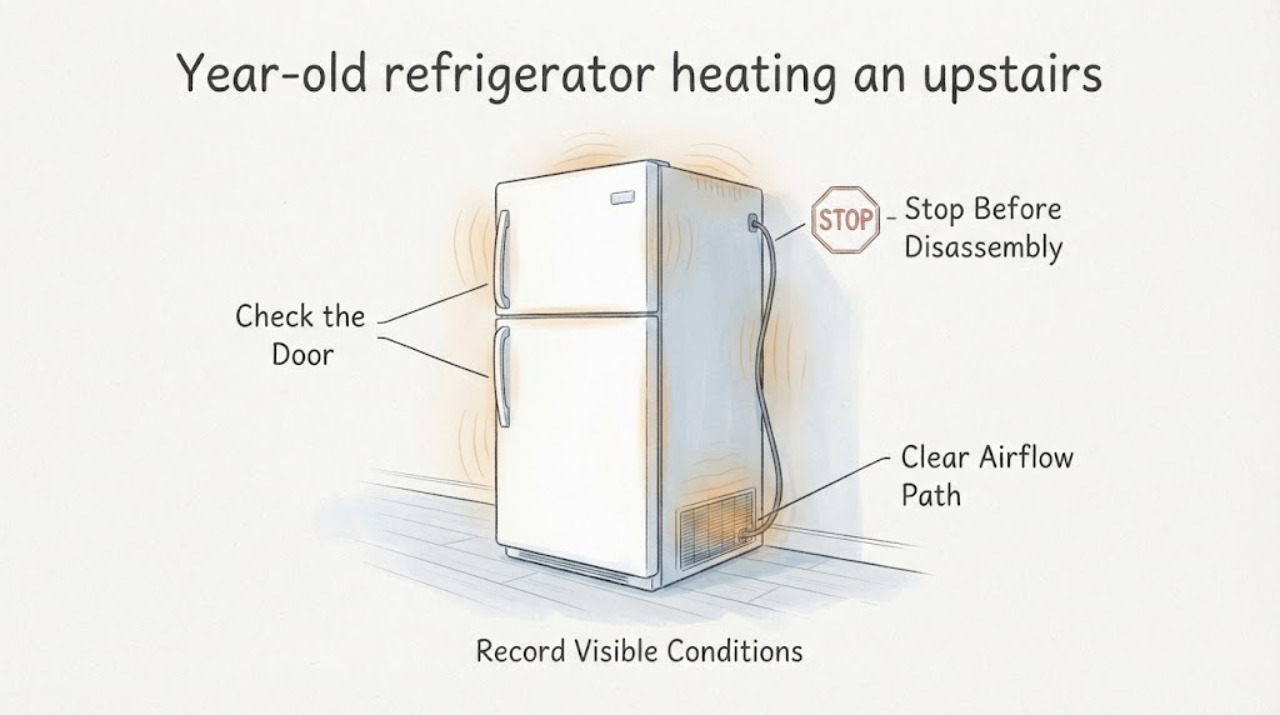
A refrigerator has to reject heat into the room, so warm cabinet sides, a warm door frame, or warm air near the base or rear can be normal. A 30-plus-year-old refrigerator that seems to heat an upstairs room severely still needs a measured check: confirm that the food compartments hold their intended temperatures, identify where the heat is coming from, and look for blocked airflow, visibly dirty accessible coils, a leaking door gasket, frequent door openings, or an interior light that stays on. These conditions can make the compressor run longer and add more room heat, but they do not prove that the compressor or sealed system has failed. If there is smoke, a burning smell, a hot or damaged cord or outlet, sparking, or a repeated breaker trip, stop using the refrigerator and arrange qualified service; do not use an extension cord.
Work through in order
Diagnostic checks
Use only checks that match the exact appliance or system and its official guide.
-
Check 1
Measure the fresh-food and freezer compartments with an appliance thermometer after the refrigerator has had time to operate normally, and record whether food is staying properly chilled. Also note whether the compressor seems to run almost continuously.
Expected result: The compartments hold their intended temperatures and the compressor cycles, or the compartments are warming while the compressor runs for very long periods.
Next step: If temperatures are rising or the compressor runs nearly continuously, move to the external airflow, gasket, vent, and light checks and arrange service if the condition persists. Do not infer a failed compressor or refrigerant circuit from runtime alone.
Why this matters
Why: Normal internal temperatures with expected cycling make room heat more consistent with normal heat rejection. Warming compartments combined with extended runtime indicates a cooling or heat-load problem that needs more than a surface-temperature judgment.
-
Check 2
Identify the hottest location without opening panels: the door mullion or frame, cabinet sides, rear, bottom, or a stream of warm air near the base. Compare the heat with the compressor running and after a normal off cycle.
Expected result: Heat is concentrated at the door frame or cabinet surfaces and changes with operation, or one area remains unusually hot while the refrigerator is not cooling normally.
Next step: Record the location and timing for the technician. Keep the refrigerator clear of walls or heat sources as the exact manual requires, and do not touch exposed coils or electrical parts to diagnose them.
Why this matters
Why: A warm mullion can be a moisture-control heat loop or heater, and warm air near the base or rear can be condenser discharge. Heat that stays excessive together with poor cooling, abnormal noise, or continuous operation should be treated as a service symptom rather than normal cabinet warmth.
-
Check 3
With the refrigerator stable and power disconnected only from a dry, safe location, inspect the visible rear, bottom, or under-unit airflow area for heavy dust, lint, pet hair, or an object blocking the clearance. Clean only an accessible condenser area if the exact manual permits it; do not pull a heavy upstairs appliance alone.
Expected result: Visible airflow is blocked or the accessible condenser area is heavily dirty, or the area is clear and the unit still runs hot and long.
Next step: Restore the required clearance and remove only loose, accessible debris. If the heat or long runtime continues after the external obstruction is addressed, leave internal diagnosis to qualified appliance service.
Why this matters
Why: Whirlpool and ENERGY STAR identify blocked or dirty condenser airflow as a reason for excess heat and longer operation, especially on older models. A clear exterior does not rule out a hidden airflow, control, or sealed-system problem.
-
Check 4
Check the door gasket and closing path from the outside, make sure food is not blocking freezer vents, and verify that the interior light turns off when the door is closed without defeating the door switch. Note frequent door openings or unusually warm loads.
Expected result: The gasket is torn or not sealing, vents are blocked, the light remains on, or the door and load checks look normal.
Next step: Correct only an obvious loading or closing issue and monitor the compartment temperature. If the gasket, light, or cooling behavior remains abnormal, provide the model and observations to a qualified technician instead of adjusting or bypassing a switch.
Why this matters
Why: GE lists damaged or dirty gaskets, blocked freezer vents, frequent openings, warm loads, and an interior light that stays on as factors that can extend compressor runtime. A normal visual check does not prove the gasket, switch, or control is electrically sound.
-
Check 5
Inspect the power connection from a safe position for a damaged, loose, or hot cord or outlet, and note any smoke, burning odor, sparking, or repeated breaker trip. Do not use an extension cord or power strip for the refrigerator.
Expected result: The cord and outlet are cool and undamaged with no electrical warning signs, or any hot, damaged, smoking, sparking, or repeatedly tripping condition is present.
Next step: For any electrical warning sign, stop using the refrigerator and obtain qualified appliance or electrical service; leave it de-energized only in a way that is safe and accessible. Do not repeatedly reset a breaker or continue running the unit to collect more heat observations.
Why this matters
Why: USFA says major appliances such as refrigerators should plug directly into a wall outlet, that an extension cord can overheat and start a fire, and that a cracked, damaged, or loose cord is a replacement concern. These signs are an electrical safety issue, not a refrigerator cooling diagnosis.
Use your observations
Decision map
Find the observation that best matches what you see, then follow the next safe action.
-
PATH 01Next step
What you see
The cabinet or door frame is warm, internal temperatures are stable, and the heat changes as the compressor cycles.
Do this next
Keep the required clearance, avoid direct heat sources, monitor internal temperatures, and use the model documentation if the surface heat changes or becomes continuous.
Why this path and its safety boundary
Why it matters: This pattern is consistent with normal heat rejection or a moisture-control heat loop, although clearance and placement can affect how noticeable it is.
-
PATH 02Next step
What you see
The room feels much hotter while the refrigerator runs nearly continuously, and the compartments are warming or the visible condenser airflow is blocked or dirty.
Do this next
Correct only visible clearance or accessible debris permitted by the exact manual, then arrange qualified service if temperatures or runtime do not return to normal. Protect perishable food if the compartments are warming.
Why this path and its safety boundary
Why it matters: The refrigerator may be rejecting heat inefficiently or carrying a cooling load that is not being resolved; the observations do not identify a compressor, refrigerant, or control failure.
-
PATH 03Next step
What you see
Internal temperatures are stable, but a small upstairs room remains uncomfortably warm even after clearance and loading checks.
Do this next
Compare energy use and repair cost with the unit's age and condition, confirm the model-specific service history, and discuss repair or replacement with a qualified professional without assuming a part is bad.
Why this path and its safety boundary
Why it matters: The appliance may be operating normally while adding heat to a warm or poorly ventilated room. The reported age can also make energy use higher, but age alone does not prove a repairable failure.
-
PATH 04Next step
What you see
There is smoke, a burning smell, sparking, a hot or damaged cord or outlet, or a repeated breaker trip.
Do this next
Stop using the refrigerator and arrange qualified appliance or electrical service. Do not use an extension cord, repeatedly reset the breaker, open the electrical compartment, or continue testing it.
Why this path and its safety boundary
Why it matters: This is an electrical or fire-safety warning, separate from ordinary condenser warmth.
Helpful context
Understand the symptom
Why an upstairs refrigerator can feel hot
A refrigerator moves heat from its compartments into the surrounding room. Whirlpool describes a heat loop in some cabinet walls near the door gasket, and GE notes that warm air may leave around a fan-cooled condenser. A warm side or door frame by itself is therefore not a diagnosis. An upstairs room may make the heat more noticeable, but the useful distinction is whether the refrigerator is maintaining its intended internal temperatures and whether its compressor is running unusually long.
What age does and does not establish
The reported age matters for efficiency and service decisions, not as proof of a particular failed part. ENERGY STAR says refrigerators over 15 years old can cost more to run and that an average old refrigerator uses about 20 percent more energy than an ENERGY STAR model. That supports comparing energy use, cooling performance, placement, and repair cost; it does not establish a refrigerant leak, compressor failure, or unsafe temperature from age alone.
Keep the check external and safety-led
Use the model information from the rating plate or owner's documentation when arranging service. Unplug only from a dry, safe location, and limit cleaning to the accessible exterior or condenser area described by the exact manual. Do not remove sealed-system covers, open the electrical compartment, handle refrigerant, or keep testing an appliance with a hot or damaged cord.
When checks do not resolve it
Need a professional?
Stop using the refrigerator and obtain qualified service for smoke, a burning odor, sparking, a hot or damaged cord or outlet, repeated breaker trips, rising food temperatures, or continuous operation that does not improve after safe external airflow and door-seal checks. Do not open sealed-system or electrical panels, handle refrigerant, bypass a door switch, or keep testing a hazardous appliance.
Have this ready
- Provide the full model and serial information, the refrigerator's approximate age, measured compartment temperatures, where the heat is located, compressor runtime observations, visible airflow or gasket findings, and any electrical warning signs. Tell the technician that the unit is upstairs and whether moving it requires assistance.
Common questions
FAQ
Are hot refrigerator sides or a warm door frame normal?
They can be. Whirlpool describes heat loops near some door gaskets, and GE explains that warm air can leave around fan-cooled condensers. The heat becomes a service concern when it is accompanied by rising compartment temperatures, nearly continuous operation, abnormal noise, or an electrical warning sign.
Does being more than 30 years old prove the refrigerator is overheating?
No. ENERGY STAR reports higher average energy use for older refrigerators, which can make their operation more costly and their room heat more noticeable, but age does not identify a failed compressor, refrigerant circuit, or control. Use measured compartment temperatures and runtime observations to decide whether service is needed.
Can I clean the refrigerator coils?
If the exact manual allows it, you can clean loose dust from an accessible exterior or condenser area with power safely controlled. Do not remove panels, move a heavy upstairs appliance alone, or use coil cleaning as a reason to handle refrigerant or electrical parts. Persistent heat or long runtime needs service.
When should I unplug a refrigerator that feels hot?
Warm cabinet surfaces alone do not require an emergency shutdown. Stop using it and arrange qualified service for smoke, burning odor, sparking, a hot or damaged cord or outlet, repeated breaker trips, or unsafe water or electrical conditions. Do not use an extension cord or repeatedly reset a tripped breaker.
Read the exact guide
Official sources
- Refrigerators | ENERGY STARENERGY STAR · Opened ENERGY STAR product guidance used for older-unit energy context and safe external placement, clearance, coil and door-seal checks. It does not establish a failure or require replacement of this unbranded refrigerator.
- Refrigerator - Warm or Hot AreasGE Appliances · Opened GE support guidance used as a manufacturer example of normal warm door areas and older-model condenser or Energy Saver factors. It is not used to claim the unbranded refrigerator is a GE model.
- Refrigerator - How Long Should a Refrigerator Run?GE Appliances · Opened GE support guidance used for symptom-level runtime factors, including gaskets, vents, warm loads, door openings, condenser coils and interior light. It does not diagnose the unbranded refrigerator's internal components.
- Refrigerator - Hot Air from the Bottom or SidesGE Appliances · Opened GE support explanation used only for the general distinction between condenser discharge and a fault; exact unbranded model applicability remains to be checked by its own manual.
- Appliance and Electrical Fire SafetyU.S. Fire Administration · Opened U.S. government fire-safety guidance used only for electrical warning signs and cord/outlet boundaries, not for refrigerator cooling diagnosis.
- Mullion is Warm//Hot - Side by Side RefrigeratorWhirlpool · Opened Whirlpool owner support guidance for side-by-side refrigerator exterior warmth. Used for general heat-rejection and accessible airflow observations, not to assign a component failure to an unbranded 30-year-old refrigerator.
Community feedback
Share a repair observation
Share a plain-text repair observation. Accepted observations are published automatically; this page may take a moment to update.