
On this page
Start here
Quick answer
First separate three different symptoms: the ice maker is not making ice, frozen cubes are present but the ice maker is not releasing them into the bin, or ice is in the bin but the dispenser will not deliver it. Manufacturer guidance treats those as different checks. Look at the mold or ice-making compartment without forcing the ejector, confirm the ice maker is enabled, check the freezer temperature against the refrigerator's own manual, and inspect the visible water supply and filter for restriction. If there is ice in the mold but no harvest, use only the exact model manual's user test or reset; a reset sequence from another brand is not universal. If the bin is full of clumped ice, the bin is not seated, or the dispenser chute is blocked, clear that external condition. If a model-specific test still will not cycle, stop and arrange appliance service rather than replacing a motor or valve by guesswork.
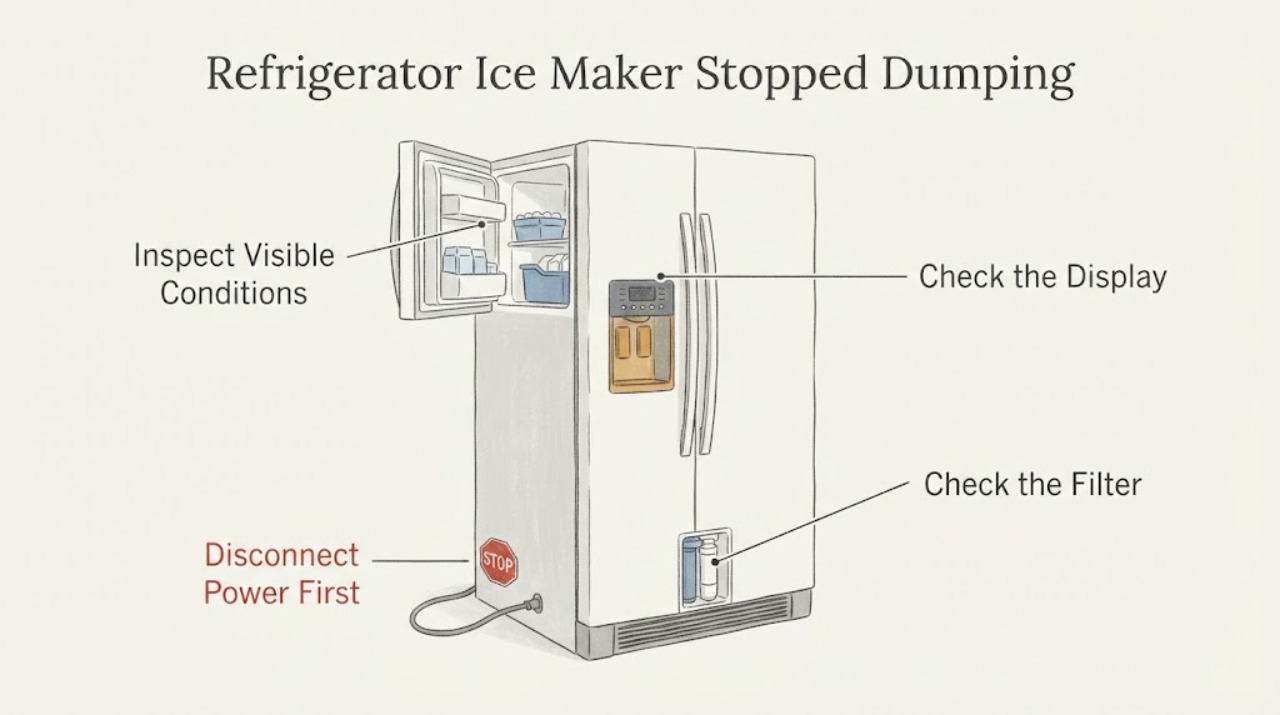
Work through in order
Diagnostic checks
Use only checks that match the exact appliance or system and its official guide.
-
Check 1
Open the freezer or ice-making compartment and observe the ice mold, the ice bin, and the dispenser separately. Do not pry the ejector fingers, twist the tray, or insert a tool into the mechanism.
Expected result: The mold is empty, the mold contains frozen cubes that remain in place, the bin contains loose ice, or the bin contains no ice at all.
Next step: Use the matching branch rather than resetting the appliance immediately. Record the appliance brand and model from its rating label before using any model-specific test or manual.
Why this matters
Why: An empty mold points toward an ice-production, temperature, power, or water-supply branch. Frozen cubes that remain in the mold are a harvest/dumping symptom. Ice in the bin means the ice maker may be working and a dispenser, chute, lock, or clumping issue may be the actual fault.
-
Check 2
Check the visible ice-maker setting, control lock, and feeler arm or paddle if the refrigerator has one. Confirm that the ice maker is enabled and that the arm or paddle is not blocked by stored food or ice. Use the exact owner's manual for the location and meaning of the control.
Expected result: The ice maker is off, a lock is active, the arm or paddle is blocked/out of place, or all controls appear enabled and unobstructed.
Next step: Restore the setting only through the documented user control and clear only the visible obstruction. Allow the time specified by the exact manual for production, then reassess whether cubes are forming and harvesting.
Why this matters
Why: Manufacturer support pages identify an off ice maker, an active lock, or a blocked feeler arm/paddle as conditions that can stop ice production or operation. The control names and locations vary by model, so a lit icon alone does not prove a component failure.
-
Check 3
Check the freezer temperature display or thermometer against the range specified in the refrigerator's own manual, then inspect the external water valve, tubing, and filter for a closed valve, kink, leak, or overdue/clogged filter. Do not disconnect a pressurized line or remove a valve cover.
Expected result: The compartment is warmer than the manual's ice-making range, the water supply is off or restricted, the filter is due or clogged, or temperature and visible supply checks are normal.
Next step: Correct only an accessible setting or clearly visible kink/valve condition permitted by the manual, and replace a filter only with the exact model-compatible item specified by the manufacturer. If the supply is leaking or the condition is not visible, stop and arrange service.
Why this matters
Why: GE and LG identify temperature, water supply, and filter restriction as common reasons for no ice; GE also identifies a blocked ice mold as a separate issue. These checks do not prove that a water inlet valve or internal ice-maker motor has failed.
-
Check 4
If the mold contains frozen cubes but they do not dump, locate the exact model manual and follow its documented user-level ice-maker test or reset, if one exists. Keep the bin and nearby surfaces clear so a harvest can be observed without reaching into moving parts.
Expected result: The documented test cycles the mechanism and releases ice, the test does not cycle, or the refrigerator has no user test/reset described for this model.
Next step: If the test succeeds, monitor the next production cycle. If it fails or no safe user test exists, stop forcing the tray or ejector and request service with the model number and the mold/bin observation.
Why this matters
Why: A successful model-specific cycle points to a temporary control or obstruction condition; a failed cycle after temperature and water checks leaves an internal harvest mechanism or control fault possible, but does not identify which part. A procedure from another brand cannot fill the evidence gap.
-
Check 5
If there is ice in the bin but it will not come out, remove the bin only as the manual permits and inspect for fused cubes, a blocked chute, or a bin that is not fully seated. Use a plastic utensil for loose clumps and a warm damp cloth for the accessible chute; never use a sharp object or pour water into an installed dispenser mechanism.
Expected result: Ice is clumped, the chute is blocked, the bin is not latched/seated, or the bin and chute are clear but the dispenser still does not move ice.
Next step: Clear only the accessible ice condition, dry the bin completely, reinstall it as the manual shows, and test once. If the bin is clear and correctly seated but the dispenser still fails, request service rather than opening the auger or wiring.
Why this matters
Why: Whirlpool and Samsung identify clumping, a blocked opening, and an incorrectly seated bin as dispenser-side causes. This branch does not explain frozen cubes remaining in the mold, which is a harvest problem rather than an auger/chute problem.
Use your observations
Decision map
Find the observation that best matches what you see, then follow the next safe action.
-
PATH 01Next step
What you see
The mold is empty and the bin is empty after the appliance has had the manual's normal time to make ice.
Do this next
Check those visible conditions using the exact manual. If they are normal and no model-specific test succeeds, arrange service.
Why this path and its safety boundary
Why it matters: This is a no-production symptom, not proof that the harvest motor is stuck. Manufacturer guidance points first to the ice-maker setting, temperature, water supply, filter, and a blocked mold.
-
PATH 02Next step
What you see
Frozen cubes are visibly present in the mold but remain there after the documented user test or harvest attempt.
Do this next
Stop pressing or forcing the mechanism. Provide the model number, mold condition, temperature, water-supply result, and test result to an appliance technician.
Why this path and its safety boundary
Why it matters: The symptom is consistent with a harvest/dumping failure, but the brand, ice-maker design, and model are unknown, so the failed observation cannot identify a motor, thermostat, heater, control, or gear.
-
PATH 03Next step
What you see
The ice maker has produced ice and the bin contains it, but the dispenser does not deliver any.
Do this next
Inspect and clear the bin/chute only as described above. If ice remains fused or the mechanism still will not move after correct seating, request service.
Why this path and its safety boundary
Why it matters: This is a dispenser-path problem such as clumping, a blocked chute, a control lock, or an improperly seated bin, rather than evidence that the ice maker stopped dumping into the bin.
-
PATH 04Next step
What you see
Temperature, water supply, filter, ice-maker setting, bin, and chute checks are normal, but the model-specific harvest test fails or no safe test is provided.
Do this next
Stop user troubleshooting and schedule appliance service. Do not bypass the feeler arm, remove a valve or motor, or order a part without the model-specific fit information.
Why this path and its safety boundary
Why it matters: The remaining fault is inside the model-specific ice-maker or control path and cannot be safely narrowed from an unidentified refrigerator.
Helpful context
Understand the symptom
Confirm that the problem is harvesting, not dispensing
The phrase “stopped dumping ice” can describe an ice maker that has frozen cubes but does not release them, while a separate dispenser problem occurs when ice is already in the bin but will not travel through the chute. Whirlpool's refrigerator guidance explicitly starts by asking whether the appliance is making ice and separates that from the dispenser path. Use the ice mold and bin as the deciding observations before changing any setting.
Model instructions control any test or reset
There is no safe universal harvest-button sequence for an unidentified refrigerator. LG documents a test procedure for its own refrigerator ice-maker styles, while Whirlpool directs the reader to the owner's manual for model-specific dispensing information. Treat those pages as examples of the decision path, not as permission to press a hidden button, bend an ejector arm, or apply a reset time to another brand.
Common questions
FAQ
Is an ice maker that stopped dumping the same as a dispenser that will not dispense?
No. If frozen cubes remain in the mold, the ice maker has a harvest/dumping symptom. If cubes are already in the bin but do not reach the glass, inspect the dispenser lock, clumping, chute, and bin seating instead. Manufacturer guidance treats these as separate paths.
Can I use another refrigerator brand's ice-maker reset sequence?
No. Reset and test controls vary by ice-maker design. LG documents tests for its own refrigerator styles, while Whirlpool directs users to the owner's manual for model-specific information. Use the exact model manual or have a technician test it.
What should I check if there are no new ice cubes at all?
Check that the ice maker is enabled, the freezer is within the manual's ice-making temperature range, the water valve and tubing are accessible and normal, and the filter is not overdue or restricting flow. If those checks are normal, service is safer than guessing at an inlet valve or motor.
What if the ice bin is full but ice will not come out?
Look for fused cubes, a blocked chute, an active lock, or a bin that is not fully seated. Clear accessible clumps without sharp tools, dry the bin if the manual permits rinsing the removable bin, reinstall it correctly, and request service if the dispenser still does not move ice.
Read the exact guide
Official sources
- Not Dispensing Ice - Refrigerator - Product HelpWhirlpool Corporation · Used for the documented distinction between an ice maker making ice but not dumping it and a dispenser-side failure, plus clumped ice, chute, lock, and bin-seating checks. It is not a universal reset instruction for unidentified brands.
- LG Refrigerator – Why is My Refrigerator Not Making Ice?LG Electronics USA · Used for the documented distinction between power/temperature/water conditions and a model-specific ice-maker test, and for service escalation after a failed test. LG's test and temperature values are not transferred as universal instructions.
- Issues with Samsung refrigerator ice dispensersSamsung Electronics America · Used only for the dispenser-side observations of fused ice, blocked opening, control lock, and correctly seated removable bin; it is not evidence for an unidentified refrigerator's internal harvest mechanism.
- Refrigerator and Freezer Troubleshooting and SupportGE Appliances · Used for the manufacturer-listed checks of temperature, filter condition, ice release from the mold, feeler arm/paddle, plug, and water line. It does not establish an exact unidentified model's component or test sequence.
Community feedback
Share a repair observation
Share a plain-text repair observation. Accepted observations are published automatically; this page may take a moment to update.