
On this page
Start here
Quick answer
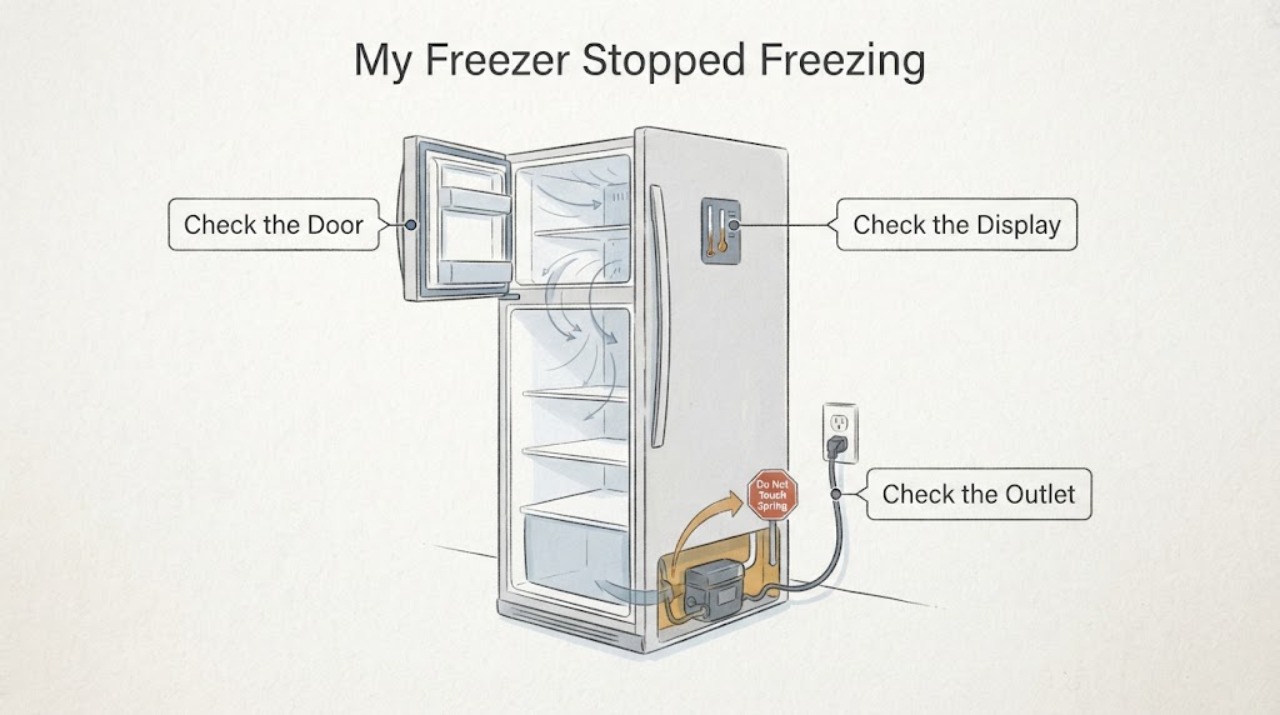
Keep the freezer door closed and protect the food first. Check the actual temperature with an appliance thermometer between frozen packages; 0°F or below is the normal long-term target, while food that has thawed above 40°F for more than 2 hours should be discarded under FoodSafety.gov guidance. From a dry, safe position, check the breaker, outlet, plug and visible cord, then check the temperature setting, door seal, clearance and visible frost or blocked vents. Do not guess a compressor, fan, thermostat or refrigerant fault, use a sharp tool to remove ice, or open the sealed system. If power and external checks are sound but the freezer remains above target or food is spoiling, keep the door closed as much as possible and arrange qualified appliance service.
Work through in order
Diagnostic checks
Use only checks that match the exact appliance or system and its official guide.
-
Check 1
Keep the freezer door closed except for a quick inspection, and move high-risk perishables to a working freezer or cooler with ice if the compartment is warming. Do not taste thawed food to decide whether it is safe.
Expected result: Food still has ice crystals, is 40°F or colder, is soft or thawed, or has been above 40°F for more than 2 hours; the door has been left open or the outage duration is unknown.
Next step: Use the FoodSafety.gov chart for each item; discard food that exceeded the chart's time/temperature limits, and keep the remaining food cold while arranging appliance service.
Stop if: Stop relying on the freezer for food storage when food is warming, leaking, or the temperature history is unknown and outside the safe chart limits.
Why this matters
Why: FoodSafety.gov uses ice crystals/temperature and time as the decision points. A full closed freezer may hold safe temperature for about 48 hours and a half-full freezer about 24 hours, but the exact food decision is item-specific.
-
Check 2
Place an appliance thermometer between frozen packages, close the door, and allow the compartment to stabilize before reading it. Check the control setting without changing it repeatedly, and note whether the freezer is near 0°F, above target, or not cold enough to freeze items.
Expected result: The measured temperature is at or below 0°F, above 0°F but below 40°F, above 40°F, or the display and thermometer disagree.
Next step: Keep the door closed and protect food while monitoring a warm compartment. If the temperature does not return toward the appliance's documented target after safe external checks, request service rather than selecting a component.
Why this matters
Why: The measured compartment temperature is more useful than touching air or relying on a display alone. USDA guidance uses about 0°F for long-term frozen storage; a warm reading changes the food-safety and service urgency.
-
Check 3
From a dry position, check whether the breaker or GFCI has tripped, whether the outlet is live using a normal low-risk appliance only if safe, and whether the plug and visible cord are loose, hot, melted, cracked or damaged. Do not remove an outlet cover or perform live appliance measurements.
Expected result: The freezer is completely silent and dark, the circuit has tripped, the outlet is dead, the plug/cord is damaged or hot, or external power appears normal.
Next step: For a dry, undamaged circuit, reset a tripped breaker once if safe. If it trips again, the outlet is hot/loose, or the cord is damaged, keep the freezer disconnected and call a qualified electrician or appliance service.
Stop if: Stop immediately for smoke, sparks, exposed conductors, melted plastic, a hot outlet or a breaker that trips again.
Why this matters
Why: A supply problem can stop cooling, but a damaged cord, hot receptacle or repeated trip is an electrical hazard rather than a freezer diagnosis.
-
Check 4
Inspect the closed freezer door, gasket and nearby storage without removing panels. Make sure packages are not holding the door open, the gasket is clean and continuous, air vents are not blocked by food, and there is room around the appliance for heat to leave. Look for heavy frost that visibly blocks airflow; do not chip it with a knife, pick or other sharp object.
Expected result: The door does not seal, a paper test slips out with no resistance, vents are blocked, the appliance is pressed tightly against a wall, or frost covers the vents/liner.
Next step: Remove only the storage obstruction and clean the accessible gasket. Follow the appliance manual for any defrost process; do not use a sharp tool, heat gun, or electrical heater. Request service for a damaged seal, persistent frost or continued warm temperature.
Why this matters
Why: ENERGY STAR and DOE identify airtight seals, clearance and airflow as important external conditions; frost and a poor seal can let warm moist air enter and reduce cooling performance. The observation does not identify the defrost or refrigeration component responsible.
-
Check 5
Record the measured temperature, food condition, power observations, display or alarm status, frost location and door-seal result, then arrange qualified appliance service if the freezer remains above target after safe external checks.
Expected result: The temperature remains warm, food continues to thaw, the unit cycles abnormally, frost returns, or no safe external cause is found.
Next step: Keep the door closed, preserve the temperature/food record, and give the service provider the model and serial label if safely accessible. Do not open the sealed system or order a replacement part from the symptom alone.
Why this matters
Why: The available general evidence supports external triage and food protection but cannot determine a compressor, fan, thermostat, control, defrost or sealed-system fault without the appliance identity and professional testing.
Use your observations
Decision map
Find the observation that best matches what you see, then follow the next safe action.
-
PATH 01Next step
What you see
The cord or outlet is hot, loose, damaged, sparking, smoking, or the breaker trips again.
Do this next
Keep the appliance disconnected if safe and call a qualified electrician or appliance service. Do not remove covers or re-energize a damaged connection.
Why this path and its safety boundary
Why it matters: The condition may be an electrical fire or shock hazard and is not safe to narrow by repeated cooling tests.
-
PATH 02Next step
What you see
The freezer is at or below about 0°F and food remains solidly frozen, but the user only noticed a temporary change after opening the door.
Do this next
Keep the door closed as much as practical and continue monitoring with the appliance thermometer. Escalate if the temperature rises or food begins to thaw.
Why this path and its safety boundary
Why it matters: The measured temperature does not show a current loss of freezing performance; warm air entering during a door opening is not proof of a failed component.
-
PATH 03Next step
What you see
Power is present, the door seals and clears are acceptable, but the measured freezer temperature remains above target and food is thawing.
Do this next
Keep the door closed, protect the food under the FoodSafety.gov chart, and request qualified appliance service. Do not guess a compressor, fan, thermostat, defrost or refrigerant repair.
Why this path and its safety boundary
Why it matters: The problem remains a genuine cooling fault or an unidentified model-specific setting; the external checks do not identify which internal system is responsible.
-
PATH 04Next step
What you see
Heavy frost blocks vents or the door gasket fails to seal.
Do this next
Remove only harmless storage obstructions, follow the exact appliance manual for defrosting, and arrange service for a damaged gasket, recurring frost or a freezer that stays warm. Never chip ice with sharp objects.
Why this path and its safety boundary
Why it matters: Warm moist air or blocked internal airflow can account for poor freezing, but the root cause of the frost or seal failure is not established.
Helpful context
Understand the symptom
The assigned topic contains no brand, model, exact appliance type or source post. This page therefore stays at the common freezer level: measure the temperature, preserve the food, inspect accessible power and sealing conditions, and stop before internal electrical, sealed-system or refrigerant work. A freezer that is not freezing can have many causes, and the symptom alone does not identify a part.
Do not repeatedly open the door while the freezer is warming. FoodSafety.gov says a closed full freezer retains safe temperature longer, and its chart distinguishes food that still has ice crystals from food that stayed above 40°F too long. When in doubt, use the chart and discard rather than tasting food to decide whether it is safe.
An external check can show whether the problem may be power, temperature setting, door sealing, airflow or frost. It cannot safely prove a failed compressor, evaporator fan, thermostat, control board, heater or refrigerant circuit. Those diagnoses belong to model-specific service.
When checks do not resolve it
Need a professional?
Request qualified appliance service when the freezer remains above its documented target after safe external power, setting, seal, clearance and frost checks, when food is thawing or spoiling, or when the model-specific manual is unavailable.
Common questions
FAQ
What temperature should a freezer reach?
USDA guidance uses about 0°F for long-term frozen storage. Use an appliance thermometer between frozen packages and do not rely only on the air feeling cold or on a display setting.
Can I keep food that started to thaw?
FoodSafety.gov says frozen food may be refrozen if it still contains ice crystals or is 40°F or below, but food exposed above 40°F for more than 2 hours should be discarded according to its chart. Never taste food to test safety.
Should I replace the compressor or thermostat first?
No. A freezer that stops freezing can involve power, settings, seals, airflow, frost, defrost or sealed-system conditions. Record the temperature and external observations, then have the exact appliance diagnosed before selecting a part.
Read the exact guide
Official sources
- Freezing and Food SafetyUSDA Food Safety and Inspection Service · Supports food-safety and thermometer decisions; it does not establish an appliance fault or repair path.
- RefrigeratorsENERGY STAR · General external refrigerator guidance; it does not identify the cause of a particular freezer failure.
- Food Safety During Power OutageFoodSafety.gov · Applies to food held in a home freezer during a cooling failure or outage; it does not diagnose the appliance.
- CPSC Guide to Home Wiring HazardsU.S. Consumer Product Safety Commission · Supports the electrical stop boundary for any unidentified freezer; it does not diagnose refrigerator cooling components.
- EnergySavers: Tips on Saving Money and Energy at HomeU.S. Department of Energy · General household refrigerator/freezer guidance; it does not diagnose an internal component.
Community feedback
Share a repair observation
Share a plain-text repair observation. Accepted observations are published automatically; this page may take a moment to update.