
On this page
Start here
Quick answer
If neither the refrigerator compartment nor the freezer is cold, protect the food first and verify the condition with appliance thermometers. FDA guidance uses 40°F or below for the refrigerator and 0°F for the freezer, and says not to rely on appearance when the time above a safe temperature is unknown. After noting the readings, check only external conditions: a working power connection and cooling setting, the exact model's temperature instructions, unobstructed interior vents and base ventilation, normal room placement, and doors that close and seal. Whirlpool's opened official all-refrigerator support page documents these user checks and directs owners to service when they do not restore cooling. They do not identify a compressor, refrigerant leak, fan, relay, or sealed-system fault on an unbranded refrigerator; do not open the sealed system or test live parts.
Before you begin
Safety first
- Do not open panels, probe live wiring, bypass a control, force a fan, access refrigerant, open the sealed system, or order a compressor, relay, fan, or thermostat part from a no-cooling symptom alone.
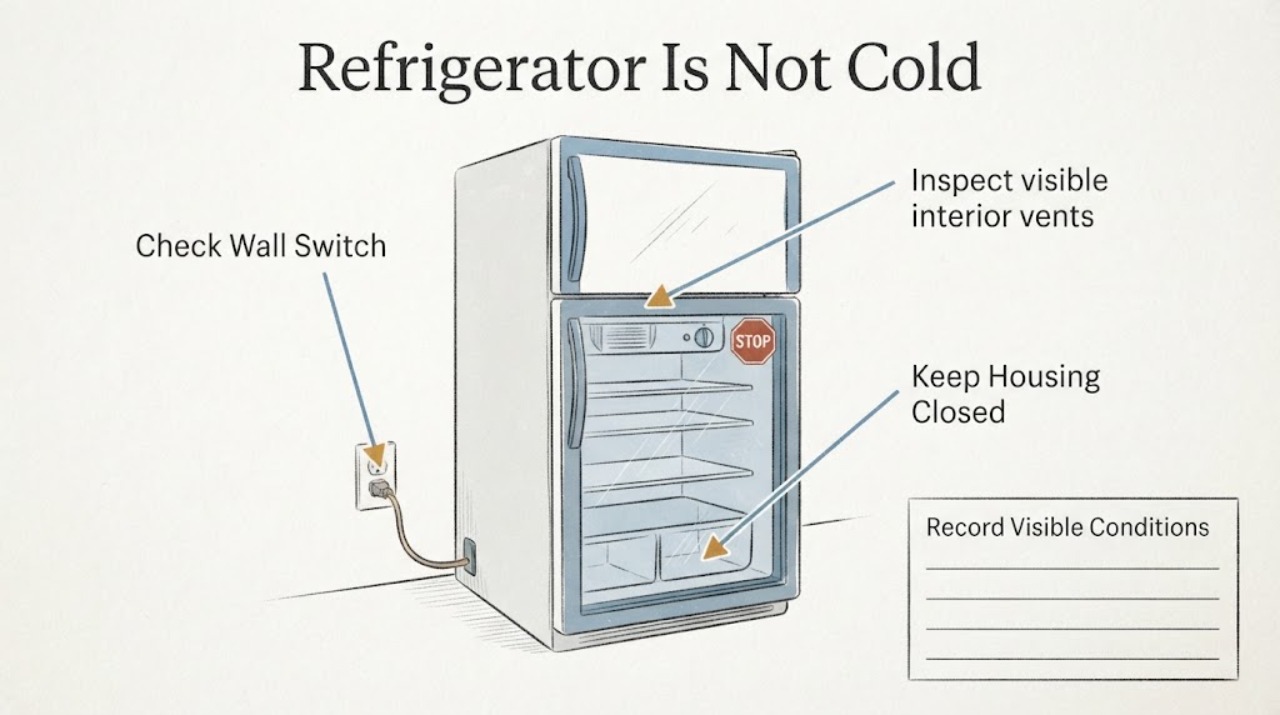
Work through in order
Diagnostic checks
Use only checks that match the exact appliance or system and its official guide.
-
Check 1
Place an appliance thermometer in the middle of the refrigerator and another in the freezer, then record the readings, interior-light/display state, and whether the appliance has recently lost power, been installed, moved, or loaded with warm food.
Expected result: The refrigerator is at or below 40°F and the freezer near 0°F, both compartments are above those targets, or the temperature history is unknown.
Next step: Move perishables to known-safe cold storage when readings are unsafe or uncertain. Keep the refrigerator and freezer doors closed as much as possible while deciding what food can be kept.
Why this matters
Why: FDA uses the measured temperatures, not the control display or food appearance, to assess cold storage. Both compartments above target indicates a cooling concern; unknown time-temperature history is a food-safety concern even if the unit later restarts.
-
Check 2
Check the external power connection and cooling control without opening the appliance: confirm the plug is fully seated in a working outlet, check the normal breaker or switch, and verify that cooling is enabled rather than a model-specific demo or cooling-off mode.
Expected result: The outlet or breaker is not supplying power, the refrigerator is powered but cooling is disabled or set incorrectly, or power and cooling controls appear normal.
Next step: Correct only a normal household outlet, breaker, or documented control setting. If power and cooling are normal but both compartments remain warm, continue only with the external checks below and prepare for service.
Why this matters
Why: A disconnected supply or disabled cooling setting can leave both compartments warm without proving a compressor fault. Control panels and modes vary by model, so a generic button sequence is not safe to invent.
-
Check 3
Inspect visible interior vents and the base grille/ventilation space without removing panels. Move packages away from air openings, do not overpack the cabinet, and confirm the refrigerator is not enclosed against a heat source or installed outside the exact manual's ambient limits.
Expected result: Food blocks a vent, the base grille or surrounding clearance is obstructed, the unit is beside a heat source or in an unsuitable room, or the external airflow paths are clear.
Next step: Rearrange food and restore only the manual-specified clearance; do not remove an evaporator cover or reach into a fan. If the airflow and placement are normal, allow the model's documented recovery period and remeasure.
Why this matters
Why: Whirlpool says blocked vents restrict cold-air circulation, poor installation or heat sources can impair cooling, and large recent loads can temporarily warm both compartments. Clearing an external obstruction does not prove a fan, damper, condenser, or sealed system is healthy.
-
Check 4
Check that every refrigerator and freezer door closes fully and that the visible gasket contacts the cabinet evenly. Remove packaging or bins that hold a door open, wipe away visible debris, and keep door openings brief while temperatures recover.
Expected result: A door or drawer is obstructed, a gasket is visibly dirty/damaged or does not contact evenly, or closure and gasket contact appear normal.
Next step: Correct only an obvious external obstruction or clean the gasket as the exact manual permits. If the doors seal and both compartments remain warm, stop changing settings randomly and arrange qualified refrigerator service.
Why this matters
Why: A poor seal admits warm air and can prevent the appliance from maintaining temperature. Normal closure rules out only this external condition and does not identify an internal component.
Use your observations
Decision map
Find the observation that best matches what you see, then follow the next safe action.
-
PATH 01Next step
What you see
A refrigerator thermometer reads above 40°F, the freezer is not near 0°F, or the time-temperature history is unknown for perishables.
Do this next
Move perishables to a known-safe refrigerator or cooler, keep the doors closed, and follow FDA time-temperature discard guidance. Continue repair checks only after food is protected.
Why this path and its safety boundary
Why it matters: The appliance is not established as safe cold storage, even if some food still feels cool or partially frozen.
-
PATH 02Next step
What you see
The outlet is dead, the breaker/switch is off, or cooling is disabled or in a model-specific demo mode.
Do this next
Correct the normal household or documented control condition safely. If the breaker trips again or the appliance remains warm with power restored, stop resetting it and arrange service.
Why this path and its safety boundary
Why it matters: The observed cause is an external supply or documented control state, not proof of a compressor or refrigerant failure.
-
PATH 03Next step
What you see
A package blocks a vent, the base ventilation is obstructed, a large warm load was recently added, or a door/gasket does not close normally.
Do this next
Clear only the visible obstruction, restore model-specified clearance, close the doors, and remeasure after the exact manual's recovery period. Use service if both compartments remain warm.
Why this path and its safety boundary
Why it matters: The external airflow, installation, load, or seal can explain temporary or sustained warming without identifying a failed internal part.
-
PATH 04Next step
What you see
Power, cooling control, vents, placement, load, and door seals are normal, but measured refrigerator and freezer temperatures remain unsafe.
Do this next
Keep food in known-safe cold storage and contact the manufacturer or a qualified refrigerator technician with the model, readings, control state, and observations. Do not open the sealed system or test live components.
Why this path and its safety boundary
Why it matters: The published external checks did not resolve the symptom. The cause may require model-specific diagnosis, but the evidence does not establish a compressor, relay, fan, defrost, refrigerant, or sealed-system fault.
Helpful context
Understand the symptom
Confirm that both compartments are actually warm
A display setting or a hand on a package cannot establish the air temperature. Put appliance thermometers in the middle of the refrigerator and freezer, record the readings and whether the interior light or display works, and note any recent power loss, installation, move, or large food load. A refrigerator that is warm in both compartments needs a safe power and control check before anyone guesses at an internal part.
Protect perishables before troubleshooting
FDA says to keep the refrigerator at or below 40°F and the freezer at 0°F, keep doors closed during a power interruption, and discard food when the time-temperature history is unsafe or unknown. Move meat, dairy, eggs, leftovers, and other perishables to known-safe cold storage if the appliance has been warm. Do not treat a cold package surface or normal smell as proof of safety.
Keep the diagnosis at the external-check boundary
The exact model is missing, so controls, vents, base grille, condenser access, room-temperature limits, and recovery time must come from the matching owner manual. Whirlpool's official support page is used here for the common external decision sequence only: power and placement, control setting, airflow, recent loading, door use, and service. It does not authorize opening panels or declaring a sealed-system or compressor failure on another brand.
When checks do not resolve it
Need a professional?
Provide the exact model or rating-label details, thermometer readings, recent power or installation history, control state, visible airflow/seal observations, and food-safety concerns to service.
Safety scope: Do not open panels, probe live wiring, bypass a control, force a fan, access refrigerant, open the sealed system, or order a compressor, relay, fan, or thermostat part from a no-cooling symptom alone.
Common questions
FAQ
What should I check first when both the fridge and freezer are warm?
Protect food and measure both compartments with appliance thermometers. Then check a working outlet, normal breaker/switch, enabled cooling, visible vents, room placement, recent warm loading, and door closure. These external checks do not identify an internal part.
Can I tell food is safe because it smells normal?
No. FDA says food can be unsafe without looking, smelling, or tasting spoiled. Use the thermometer and time-temperature history; when that history is unsafe or unknown, discard the affected perishables.
Should I replace the compressor or add refrigerant?
No. Neither the missing model nor the symptom establishes a compressor fault or refrigerant leak. Those are professional service boundaries requiring model-specific diagnosis and sealed-system equipment.
How long should I wait after clearing a vent or changing the setting?
Use the exact owner manual. Whirlpool's official guidance says to wait at least 24 hours between control adjustments and recheck; a different refrigerator may have different recovery instructions. Keep food protected during the wait.
Read the exact guide
Official sources
- Refrigerator Thermometers - Cold Facts about Food SafetyU.S. Food and Drug Administration · Opened the FDA page. It supports using appliance thermometers, keeping the refrigerator at or below 40°F and freezer at 0°F, avoiding overpacking, keeping doors closed during power loss, and discarding food when time-temperature history is unsafe or unknown. It supports food safety, not a refrigerator component diagnosis.
- Are You Storing Food Safely?U.S. Food and Drug Administration · Opened the FDA consumer update. It supports keeping the refrigerator at or below 40°F, freezer at 0°F, avoiding crowding, monitoring with thermometers, and not relying on appearance or odor for food safety. It is included only for food protection while the appliance symptom is investigated.
- Not Cooling - Product HelpWhirlpool · Opened the official Whirlpool Product Help article. It supports external checks for placement/ambient conditions, base ventilation, controls, recent installation or load, blocked air vents, door opening, and service. It is used as general manufacturer support for the symptom class, not to transfer Whirlpool internal parts or model-specific procedures to an unbranded refrigerator.
- Why Is My Refrigerator Not Cooling? 7 Possible Causes and FixesWhirlpool · Opened the official Whirlpool consumer article. It supports checking installation clearance, food organization, vents, door gaskets, temperature controls, and professional service when external checks do not resolve cooling. It does not support a diagnosis of an unbranded refrigerator's compressor or sealed system.
Community feedback
Share a repair observation
Share a plain-text repair observation. Accepted observations are published automatically; this page may take a moment to update.