
On this page
Start here
Quick answer
When a GE refrigerator still cools but both the water dispenser and interior lights stop working, first separate a refrigerator-wide power or control symptom from two unrelated user-facing symptoms. Check the outlet and refrigerator controls without opening the cabinet, then use the exact model manual for any lock, Sabbath-mode or dispenser-panel setting. GE's general guidance supports a 30-second power disconnect for a dispenser panel with no power, external water-supply and filter checks for no water, and model-specific service for LED lighting. The combination does not prove a shared door switch, harness or control board, so do not live-test or replace one.
Work through in order
Diagnostic checks
Use only checks that match the exact appliance or system and its official guide.
-
Check 1
Check whether the refrigerator is still cooling and whether the dispenser display or other controls respond. Confirm the plug is seated and check the household breaker or GFCI without opening the refrigerator or using a live meter.
Expected result: The refrigerator is completely dead, the dispenser panel is dark, or cooling and other controls remain normal.
Next step: If the appliance has no power, restore only a stable household supply and stop if the breaker trips again. If the dispenser panel alone has no power, continue with the model-appropriate power-reset and lock/settings checks below.
Why this matters
Why: A completely dead unit points first to the appliance supply path; a working refrigerator with a dark dispenser panel is a narrower dispenser-control symptom and does not by itself establish a shared light circuit.
-
Check 2
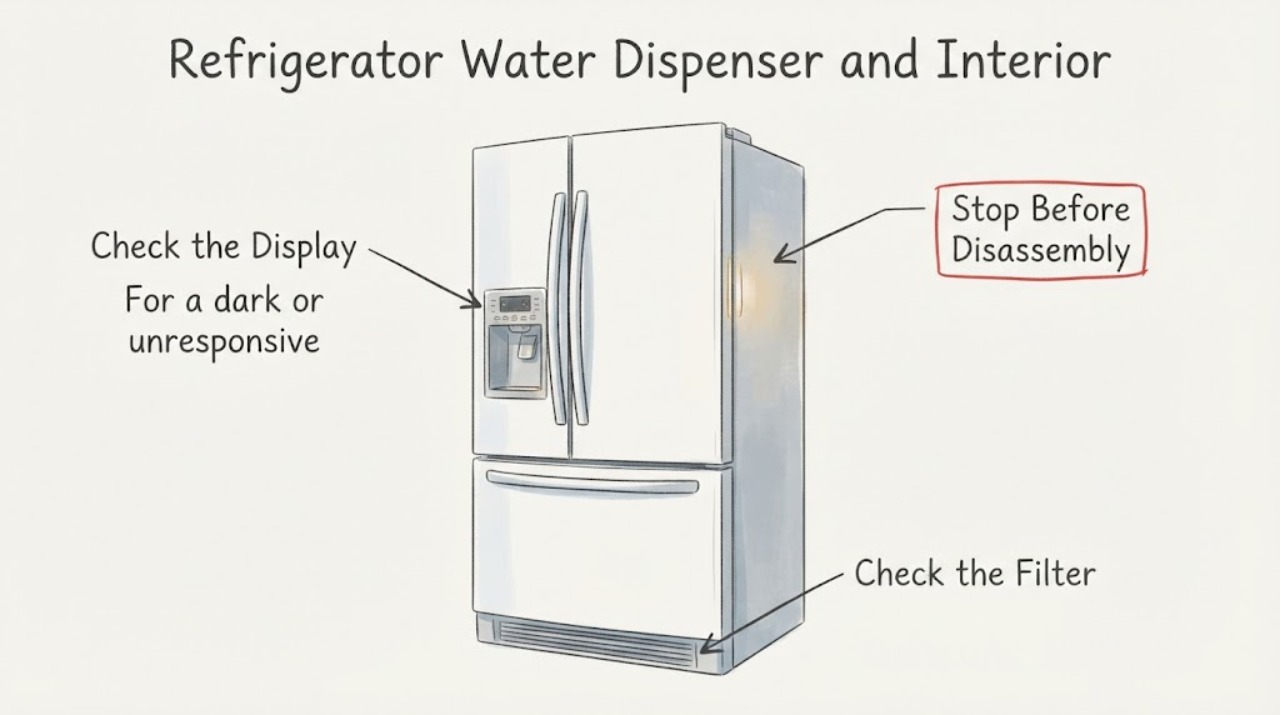
For a dark or unresponsive dispenser panel, turn the refrigerator off at its normal disconnect or unplug it for 30 seconds, then restore power once. If the model manual shows a dispenser lock, Sabbath mode or similar feature, check that setting using the manual rather than a button sequence from another GE model.
Expected result: The dispenser panel returns after the single power cycle or settings correction, or it remains dark while the refrigerator continues cooling.
Next step: Use the refrigerator normally only if the panel and lights remain stable. If the panel remains inactive, record the full model number and arrange GE service; do not open the panel or test its wiring.
Why this matters
Why: A temporary panel lock or control-state issue is possible when the panel recovers; persistence means GE's general reset did not resolve the dispenser-power symptom and does not identify a board or door switch.
-
Check 3
With the refrigerator powered normally, check the water side externally: confirm the household shutoff is open, the supply line is not kinked, the filter is seated and not overdue, and the dispenser has not simply retained air after installation or filter replacement. Do not disconnect a pressurized line.
Expected result: Water flow returns after the external supply/filter condition is corrected, remains absent, or the fresh-food floor shows water from a suspected frozen or cracked reservoir.
Next step: Purge air only as described by the exact GE manual after installation or filter work. If a reservoir is leaking, water is near electrical parts, or flow remains absent, stop using the dispenser and arrange service.
Why this matters
Why: GE identifies the shutoff, air in a new system, a clogged filter and a frozen or cracked reservoir as different water-delivery possibilities; none proves a dispenser valve or shared electrical component.
-
Check 4
Identify the light technology from the exact GE manual or model/serial record. If the refrigerator uses an owner-replaceable bulb, inspect only the bulb with power disconnected and use the manual's specified type; if it uses an LED assembly or light column, do not remove the assembly.
Expected result: A specified bulb is visibly failed and the manual permits owner replacement, or the refrigerator uses an LED assembly / the manual does not identify a safe owner replacement.
Next step: Replace only a clearly identified owner-replaceable bulb with power disconnected. For LED lighting, uncertain model fit, multiple failed lights or persistent darkness, leave the light circuit closed and use authorized service.
Why this matters
Why: GE says bulb type varies by model and many newer refrigerators use LED assemblies that require service. A failed light alone does not prove why the dispenser is also inactive.
-
Check 5
Record the complete GE model and serial information, whether the refrigerator cools, whether ice production works, whether the dispenser panel responds, whether any lights work in either compartment, and whether the condition began after installation, cleaning, a filter change or a power event.
Expected result: The model is missing, the two symptoms persist after the external checks, or a breaker, cord, plug, water leak or wiring concern is present.
Next step: Keep the refrigerator safe and arrange model-specific qualified service. Do not splice a door harness, bypass a switch, replace a control board or perform live electrical measurements from the symptom combination alone.
Why this matters
Why: Without the model and a separated symptom pattern, GE's family guidance cannot establish a common circuit, door-switch diagnosis, control-board failure or compatible part.
Use your observations
Decision map
Find the observation that best matches what you see, then follow the next safe action.
-
PATH 01Next step
What you see
The refrigerator is completely dead or the breaker/GFCI trips again when power is restored.
Do this next
Leave the refrigerator disconnected if safe, keep food-safety needs in mind, and arrange qualified electrical/appliance service. Do not repeatedly reset the protection device.
Why this path and its safety boundary
Why it matters: This is an appliance-supply or electrical safety condition rather than a water-dispenser-only symptom.
-
PATH 02Next step
What you see
Cooling continues, the dispenser panel is dark, and one 30-second power disconnect restores it.
Do this next
Monitor the panel and lights without repeated reset cycles. If the condition returns, use the exact model manual and schedule service rather than assuming a board or door switch.
Why this path and its safety boundary
Why it matters: GE documents a temporary no-power or control-state condition as one possible explanation for a dark dispenser panel.
-
PATH 03Next step
What you see
The dispenser panel responds but no water comes out, while external supply, filter and air-purge checks identify a change.
Do this next
Follow the exact model's water-system instructions; stop for a leak or frozen/cracked reservoir and arrange service.
Why this path and its safety boundary
Why it matters: The water path is more consistent with a shutoff, filter, air or reservoir issue than with a proven shared light/electrical failure.
-
PATH 04Next step
What you see
The refrigerator cools but both functions remain failed, several lights are out, water is near wiring, the cord is damaged, or the issue persists after the safe external checks.
Do this next
Stop internal troubleshooting, provide the complete model/serial information and symptom timeline to qualified GE service, and do not open panels or perform live tests.
Why this path and its safety boundary
Why it matters: The available GE family guidance does not identify a common internal circuit or a compatible component for a model-unspecified refrigerator.
Helpful context
Understand the symptom
No water and no interior light is a symptom combination, not proof that one component failed. GE's public guidance separates dispenser-panel power, water delivery, and light technology. With no GE model number in the topic, use the checks below to identify which user-facing function is absent; do not infer a common door switch, wiring harness or control board from the coincidence.
If the refrigerator has a burning odor, heat at the plug, water near electrical parts, a damaged cord, or a breaker that trips again, leave it disconnected and arrange qualified service. Do not remove door panels, splice wiring or perform live voltage tests. The exact model and serial information should accompany any service request because GE says refrigerator support and installation details are model-specific.
When checks do not resolve it
Need a professional?
Arrange qualified service when the dispenser panel remains dead after one 30-second power disconnect, water remains absent after the external supply/filter checks, an LED assembly is out, a reservoir leaks, the model-specific manual does not authorize an owner light replacement, or any breaker, cord, wiring, odor, heat or water-near-electricity concern occurs.
Common questions
FAQ
Do no water and no interior light prove that the same GE refrigerator part failed?
No. GE publishes separate guidance for dispenser-panel power, water delivery and light technology. The combination can justify service, but without the exact model and inspection it does not prove a door switch, harness or control board.
Should I reset the GE refrigerator?
If the dispenser panel has no power, GE's general support article says to disconnect refrigerator power for 30 seconds and recommends service if the panel remains inactive. Use this once as a diagnostic step; repeated resets are not a repair and do not establish a failed part.
Can I replace the refrigerator interior light myself?
Only if the exact GE manual identifies an owner-replaceable bulb and specifies its type. GE says newer refrigerators may use LED assemblies that require authorized service, and power must be disconnected before bulb work.
What model information should I find before calling service?
Record the complete model and serial information from the refrigerator's tag or QR support label, plus whether cooling, ice production, the dispenser panel and each compartment light still work. GE uses model-specific support and installation information for refrigerator troubleshooting.
Read the exact guide
Official sources
- Refrigerator - No Power to the DispenserGE Appliances · Opened GE guidance for a dark or unresponsive dispenser panel; it supports one 30-second power disconnect and model-specific harness verification after door removal, not live electrical testing or a shared light-circuit diagnosis.
- Refrigerator - Not Getting Water from the DispenserGE Appliances · Opened GE no-water guidance used for external shutoff, air purge, filter and reservoir observations. It does not prove a door switch, valve, harness or control-board fault for an unidentified model.
- Refrigerator - Interior LED LightingGE Appliances · Opened GE lighting guidance used to distinguish LED assemblies from owner-replaceable bulbs; it does not identify the task refrigerator's lighting design without a model number.
- Refrigerator - Does Not Run or CoolGE Appliances · Opened GE guidance used for the safe first distinction between a completely unpowered refrigerator and a refrigerator that still cools. It does not diagnose the dispenser/light combination.
- Refrigerator and Freezer Troubleshooting and SupportGE Appliances · Opened GE Appliances refrigerator support page used for model/serial identification, water-dispenser symptom categories, external water checks and service routing. It does not establish a shared circuit or model-specific component diagnosis.
- Refrigerator - Selecting Appropriate Light BulbsGE Appliances · Opened GE bulb guidance used only for the model-dependent bulb/LED distinction and unplug-before-replacement boundary; no bulb wattage is assigned to this model-unspecified topic.
Community feedback
Share a repair observation
Share a plain-text repair observation. Accepted observations are published automatically; this page may take a moment to update.