
On this page
Start here
Quick answer
First classify the odor before cleaning: a musty or sour smell usually follows retained moisture, detergent residue, or wet laundry; a sewage-like smell points to the drain path or house plumbing; a hot-plastic, burning, or electrical smell is a stop condition. Record the Roper model and whether the odor comes from the basket, lid or door, detergent area, drain, floor, plug, or outlet, and when it appears. For ordinary moisture odor, remove wet clothes promptly, wipe accessible surfaces dry, leave the lid or door open between loads, and use only the exact manual's detergent and cleaning procedure. Whirlpool's official washer guidance recommends a model-supported Clean Washer cycle and warns not to add detergent or other chemicals during that procedure. Do not mix cleaning products. Stop using the washer for smoke, sparks, a hot or discolored outlet, a damaged cord, leakage near electrics, repeated breaker trips, or a burning odor; isolate it only if safe and use qualified service.
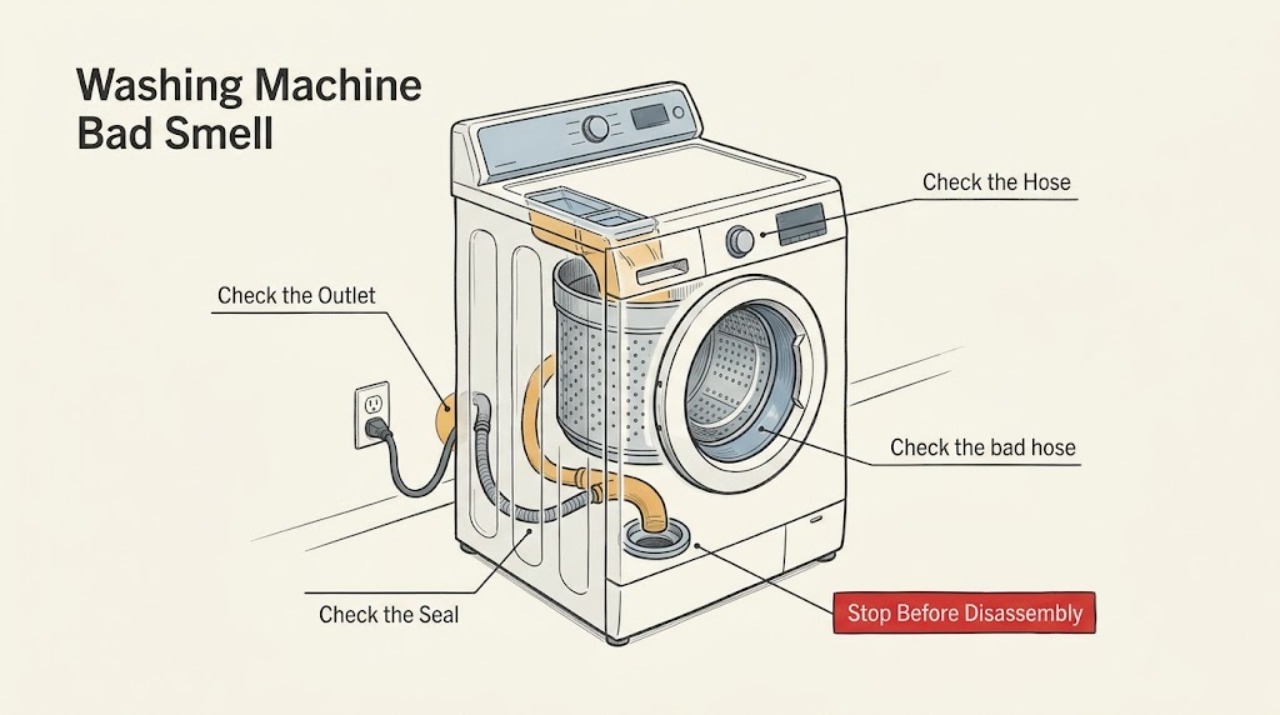
Work through in order
Diagnostic checks
Use only checks that match the exact appliance or system and its official guide.
-
Check 1
Stop the washer and classify the odor from a safe position. If it smells like hot plastic, burning insulation, or an electrical connection, or if there is smoke, a spark, a hot or discolored outlet, water near electrics, or a repeated breaker trip, stop using the washer immediately. Isolate power only if the plug or disconnect is dry and safely reachable; do not reset or retest it.
Expected result: The odor is musty or sour, sewage-like, detergent-like, or hot and electrical; the washer may also be leaking or the outlet may be warm.
Next step: Leave the washer out of service for any electrical warning, smoke, spark, leak near electrics, or damaged cord or outlet, and obtain qualified electrical or appliance help.
Why this matters
Why: CPSC identifies arcing, overheating, odors, and repeated outages as electrical warning signs. A hot or electrical smell must not be treated as ordinary washer residue.
-
Check 2
Record the exact Roper model, whether it is a top-load or another configuration, and where and when the smell is strongest: inside the basket, under the lid, at a dispenser, at the drain hose or standpipe, beneath the cabinet, or at the plug or outlet. Note whether it appears after a cold wash, hot wash, drain, spin, or while the washer is idle.
Expected result: The odor is confined to the wet basket or detergent area, follows draining, comes from the floor or house drain, or appears only when the washer is energized or moving.
Next step: Use the matching branch below and the exact Roper manual. Do not pull the appliance out or tilt it to locate an underside smell.
Why this matters
Why: Location and timing separate retained moisture or residue from a drain or plumbing odor and from an electrical or mechanical warning. A model is needed before applying any cleaning-cycle or dispenser instruction.
-
Check 3
For a musty, sour, or detergent-residue odor with no electrical warning, remove clothes as soon as the cycle ends. With the washer off, wipe the accessible lid or door, basket rim, gasket if present, and detergent area according to the Roper manual; leave the lid or door open between loads so the interior can dry. Do not pour an unapproved cleaner into the machine.
Expected result: The smell is strongest after wet laundry was left inside, around damp surfaces, or at a visibly soiled dispenser; the odor decreases as the basket dries, or it persists despite dry storage and a clean dispenser.
Next step: Continue with the exact model's approved cleaning cycle only if the odor is ordinary moisture or residue. If it persists, smells like a drain, or appears with leakage, arrange service rather than adding stronger chemicals.
Why this matters
Why: Roper's manual warns not to leave wet laundry in the washer and says to leave the lid open until the basket is dry. Whirlpool also links retained moisture and residue with mildew and odor.
-
Check 4
If the smell follows draining or is strongest at the standpipe, drain hose, or floor drain, inspect only the visible hose routing and the area around the house drain for standing water, backup, a loose connection, or a dry trap. Do not remove the washer cabinet or run repeated cycles to flush a suspected plumbing problem.
Expected result: The odor is localized to the drain, the standpipe backs up, the hose connection is loose, or the washer area is dry but the basket itself smells musty.
Next step: Have a qualified plumber correct a blocked or defective site drain. If the site drain is normal but the odor persists inside the washer, follow the model-specific cleaning path or contact appliance service.
Why this matters
Why: A drain or trap odor is a plumbing path, not a reason to clean the basket with chemicals. A loose or incorrectly routed drain can also leave residue or dirty water near the appliance.
-
Check 5
Check the detergent and load routine against the Roper manual. Use only the required detergent type and amount, do not leave soaked or wet loads sitting, and do not combine fabric softener, bleach, detergent, vinegar, ammonia, or other products in one cleaning attempt. If your Roper model has a dispenser, clean it only as the manual describes.
Expected result: Non-recommended detergent, excess product, a damp load left in the basket, or residue in a dispenser coincides with the odor; or the routine and dispenser are correct but the smell returns.
Next step: Correct the product and storage routine. If the smell returns without those triggers, stop adding chemicals and use the model-specific Clean Washer or service path.
Why this matters
Why: Whirlpool states that non-HE or excessive detergent can leave film and excess suds that contribute to odor and drainage concerns. The Roper manual's product and model instructions control for an older or different configuration.
-
Check 6
If the exact Roper manual supports an empty-tub cleaning cycle, follow that manual's single-product procedure. Whirlpool's official general guidance uses a Clean Washer cycle with an approved washer cleaner or the manual-approved alternative, says not to add detergent or other chemicals, and says to leave the lid or door open afterward. Do not start this cycle if the washer leaks, trips protection, or has a burning odor.
Expected result: The odor clears after the permitted cycle and dry ventilation, or it remains, returns quickly, or is joined by leakage, unusual pump or motor noise, smoke, heat, or an electrical symptom.
Next step: Stop using the washer for a returning or high-risk odor and contact qualified appliance service. Do not run stronger products or repeat cleaning cycles indefinitely.
Why this matters
Why: A supported cleaning cycle can address accessible residue, but it cannot repair a drain, seal, bearing, motor, pump, wiring, or plumbing fault. A persistent or high-risk odor needs diagnosis.
Use your observations
Decision map
Find the observation that best matches what you see, then follow the next safe action.
-
PATH 01Next step
What you see
The odor is hot, burning, electrical, or accompanied by smoke, sparks, a hot or discolored outlet, a damaged cord, water near electrics, or a repeated breaker trip.
Do this next
Stop using the washer, do not reset or retest it, and obtain qualified electrical or appliance help. Use emergency assistance for fire or immediate danger.
-
PATH 02Next step
What you see
The odor is musty or sour and follows wet clothing, damp surfaces, excess detergent, or a dirty dispenser.
Do this next
Remove wet laundry promptly, dry the accessible interior, leave the lid or door open between loads, and follow only the exact Roper model's cleaning and detergent instructions.
-
PATH 03Next step
What you see
The odor is strongest at the drain hose, standpipe, or floor drain, or the site drain backs up.
Do this next
Stop repeated wash tests and have the visible connection or house drain assessed by a qualified plumber. Do not mask a drain odor with chemicals.
-
PATH 04Next step
What you see
The exact Roper manual supports an empty-tub cleaning cycle and no leak or electrical warning is present.
Do this next
Run the one manual-approved cleaning procedure with one approved product only, then ventilate the washer. Do not mix products or add detergent during the cleaning cycle.
-
PATH 05Next step
What you see
The smell persists or returns after the model-approved routine, or it comes from beneath the cabinet, during spin, or when a pump or motor runs.
Do this next
Leave the washer out of service and request appliance service. Do not tilt the machine, remove panels, or diagnose internal parts from odor alone.
Helpful context
Understand the symptom
A bad smell is a clue about where to look, not proof that the basket itself is dirty. Musty odors, drain odors, and electrical odors have different risk levels and different next steps. Start with the first place the smell is strongest and the point in the cycle when it appears.
The Roper manual and Whirlpool Product Help cover different model families. Use Whirlpool's cleaning guidance only when the Roper model's own manual offers the same cycle or product path. Never combine bleach, vinegar, ammonia, detergent, or other chemicals, and do not run a cleaning cycle if the washer has a burning or electrical odor.
Common questions
FAQ
How do I tell whether a Roper washer smell is mildew or an electrical problem?
Mildew or sour smells are usually strongest at damp laundry or residue. A hot-plastic, burning, or electrical smell, especially with smoke, sparks, heat, water near electrics, or a trip, is a stop condition. Do not clean or retest an electrically suspect washer.
Can I use bleach and vinegar together to clean a Roper washer?
No. Use only the single product and cleaning procedure approved by the exact Roper manual. Whirlpool's official procedure says not to add detergent or other chemicals during the cleaning cycle.
Why does my Roper washer smell like a drain?
If the smell is strongest at the drain hose, standpipe, or floor drain, inspect only the visible connection and look for backup. A persistent or blocked site drain needs qualified plumbing help; repeated wash cycles will not fix the house drain.
Read the exact guide
Official sources
- Removing Odors from the Interior of a Washer - Product HelpWhirlpool Corporation · Whirlpool washer interior-cleaning and product-separation guidance
- Removing Odor or Smell - Washer - Product HelpWhirlpool Corporation · Whirlpool washer odor, wet-load, detergent, and Clean Washer guidance
- CPSC Guide to Home Wiring HazardsU.S. Consumer Product Safety Commission · Household electrical hazard recognition and qualified-service boundaries
- Removing Odors or Smells - Front Load Washer - Product HelpWhirlpool Corporation · Whirlpool front-load washer odor, ventilation, detergent, and steam-cycle applicability guidance
- Owner's ManualWhirlpool Corporation / Roper Appliances · Roper AL4132V, AL5143V, AL6245V, AX5133V, and AX6245V washer operation, maintenance, and safety
Community feedback
Share a repair observation
Share a plain-text repair observation. Accepted observations are published automatically; this page may take a moment to update.