
On this page
Start here
Quick answer
Start with the dishwasher's drain area, filter housing, spray nozzles, door seal, and connected sink drain. Samsung links odor to moisture and food residue and warns against bleach in stainless-steel interiors. Clean accessible parts with the model manual, run an appropriate empty cleaning cycle, and escalate if the odor is burning, sewage-like after plumbing checks, or persists.
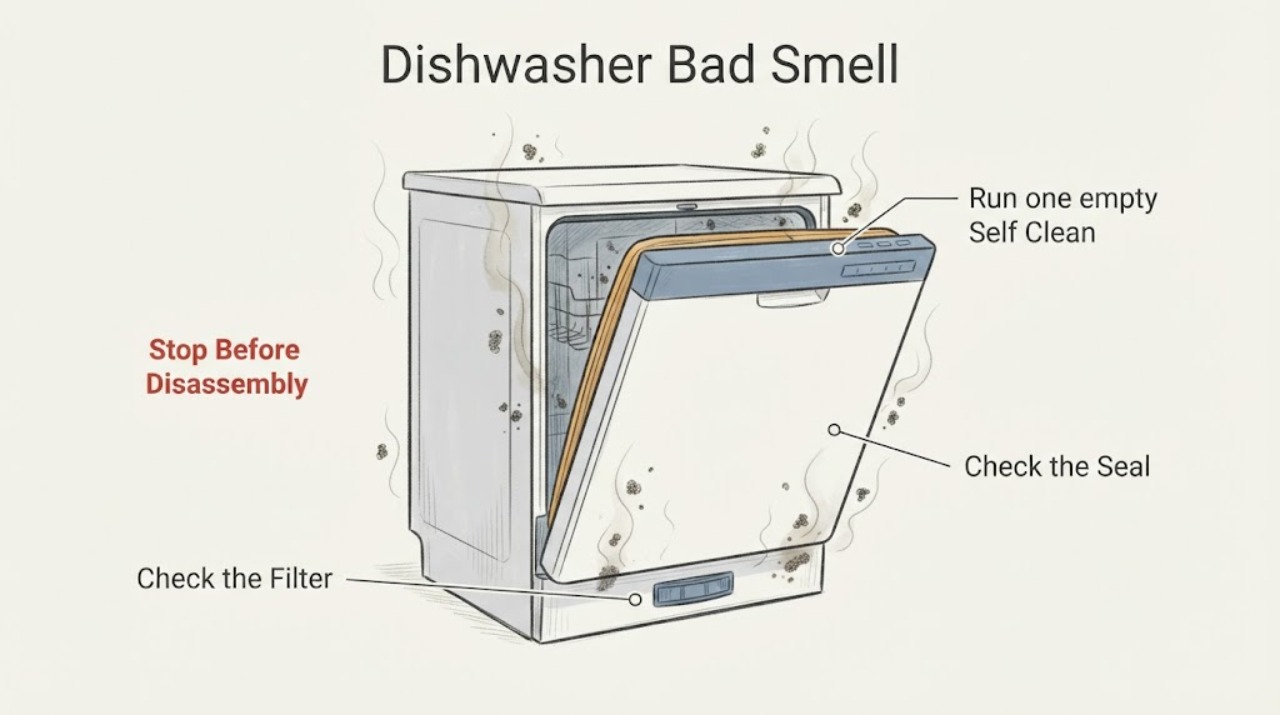
Work through in order
Diagnostic checks
Use only checks that match the exact appliance or system and its official guide.
-
Check 1
With the dishwasher empty, remove only model-approved racks, filter, and accessible nozzles and inspect the drain area and filter housing.
Expected result: Food residue, sludge, or standing water is present, or the area is clean and dry.
Next step: Wash accessible parts with warm soapy water and refit the filter exactly as the manual shows.
Why this matters
Why: Residue and moisture are a supported odor source; a clean area makes the sink drain or another issue more likely.
-
Check 2
Check the spray nozzles and door seal for debris, then run hot water at the sink before the next cycle.
Expected result: Nozzle holes or seal edges are dirty, or the sink water remains slow to become hot.
Next step: Clear accessible nozzle debris, wipe the seal, and have a plumber assess persistently inadequate hot water or a sink problem.
Why this matters
Why: Blocked nozzles can leave food behind, and insufficient hot water can reduce cleaning and odor removal.
-
Check 3
Run one empty Self Clean or Normal cleaning cycle using one compatible cleaning agent; never combine vinegar and detergent and do not use bleach in a stainless-steel tub.
Expected result: The odor clears, improves but returns, or does not change.
Next step: Check the sink drain/garbage disposal next and request service if odor remains after both paths are clean.
Why this matters
Why: Improvement supports residue/mineral buildup; persistence points to plumbing backflow, hidden contamination, or service need.
Use your observations
Decision map
Find the observation that best matches what you see, then follow the next safe action.
-
PATH 01Next step
What you see
The smell is strongest inside the tub and improves after filter, drain-area, seal, and empty-cycle cleaning.
Do this next
Leave the door slightly open between loads and remove large food debris so moisture and residue do not accumulate.
Why this path and its safety boundary
Why it matters: Residual food, mineral grime, and moisture were the likely contributors.
-
PATH 02Next step
What you see
The smell is strongest at the sink connection or remains after the dishwasher is clean.
Do this next
Have the sink plumbing cleaned or assessed; do not disassemble the dishwasher to chase a plumbing odor.
Why this path and its safety boundary
Why it matters: The connected drain or garbage disposal is more likely than a dishwasher part.
-
PATH 03Next step
What you see
The odor is burning/electrical, accompanied by smoke, or appears with a leak.
Do this next
Stop the cycle, disconnect power only if safe, and arrange qualified appliance service.
Why this path and its safety boundary
Why it matters: This is outside routine odor maintenance and may be a safety issue.
Helpful context
Understand the symptom
Find where the smell starts
A smell inside the tub often follows trapped residue or standing moisture. A smell strongest at the sink or drain connection may be plumbing-related, so the two paths should be separated before buying a part.
When checks do not resolve it
Need a professional?
Stop using the dishwasher for a burning or electrical odor, smoke, active leak, or odor that persists after accessible cleaning and sink-drain checks. Do not use bleach in a stainless-steel interior.
Common questions
FAQ
Can I use bleach to remove a Samsung dishwasher smell?
Samsung cautions against bleach in a stainless-steel interior, which most of its dishwashers have. Use the model-approved cleaning method instead.
Why does the dishwasher smell clean but the kitchen drain still smells?
Samsung advises checking the connected sink drain or garbage disposal when odor remains after dishwasher cleaning; plumbing may need attention.
Read the exact guide
Official sources
- Routine and deep clean your Samsung dishwasherSamsung Support US · Samsung dishwasher filter, nozzle, and drain-pump maintenance
- Samsung Dishwasher stinks or has a musty smellSamsung Support US · Samsung dishwasher odor, hot-water, cleaning, and sink-drain troubleshooting
Community feedback
Share a repair observation
Share a plain-text repair observation. Accepted observations are published automatically; this page may take a moment to update.