
On this page
Start here
Quick answer
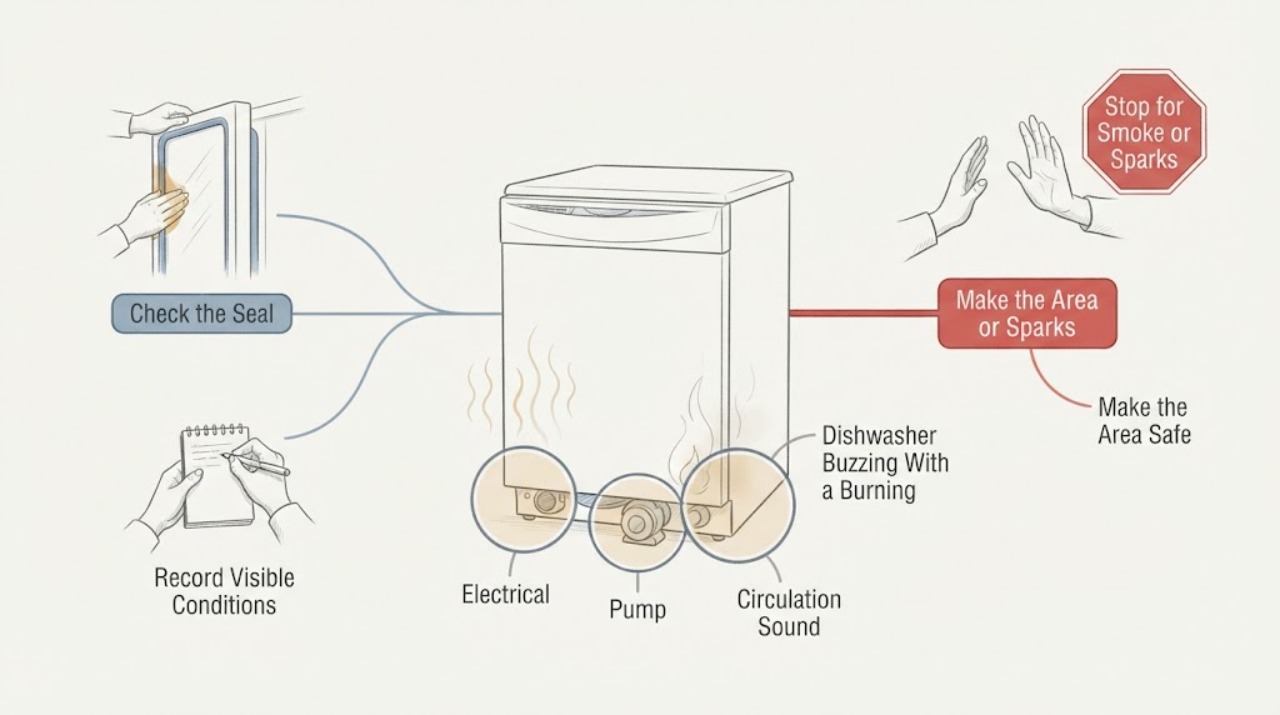
Stop the Samsung DW80M3021US immediately when a buzzing sound is accompanied by a burning smell. Samsung's appliance safety guidance says to stop use, unplug if it can be done safely and contact a Samsung service center when an appliance produces a strange noise, burning smell or smoke. Do not run an empty cycle, reset it to see whether the smell returns, open the cabinet or test a pump, motor, heater or wiring. Once the appliance is disconnected and cool, record when the buzz occurred and check only for visible scorching, melted plastic, water around the base, a damaged cord or a loose/overheated outlet. Samsung says a low hum or buzz can be normal, while a loud recurring buzz can indicate debris at the drain-pump impeller on applicable models; that general noise guidance does not make a burning smell safe to test or identify the failed part.
Work through in order
Diagnostic checks
Use only checks that match the exact appliance or system and its official guide.
-
Check 1
Press Power if the controls respond, stop the cycle, and disconnect the DW80M3021US from power only if the plug or breaker can be reached without touching smoke, water or a hot/damaged cord. Keep the door closed if there is smoke or an active electrical smell and move people away from the appliance.
Expected result: The smell is strong or recurring, smoke or heat is visible, the plug/outlet is hot or scorched, water is near electrical parts, or the appliance has stopped without those signs.
Next step: Keep the dishwasher disconnected and contact Samsung service. If there is active smoke or fire, leave the area and use local emergency procedures; do not open panels or pour water on an electrical appliance.
Stop if: Do not touch the plug, breaker, door or appliance if doing so exposes you to smoke, flame, standing water or a hot/damaged electrical connection.
Why this matters
Why: Samsung's safety guidance says a strange noise, burning smell or smoke requires immediate stop of use, safe disconnection and Samsung service. A hot, wet or damaged electrical connection adds shock/fire risk.
-
Check 2
With power disconnected and the dishwasher cool, record the exact model suffix, cycle stage, whether the sound was a low hum or loud buzz, whether it repeated every cycle, and where the smell was strongest. Do not reconnect the appliance to reproduce the sound.
Expected result: The buzz was brief and isolated, repeated during drain/fill/wash/dry, or the timing and odor location cannot be determined without running the appliance again.
Next step: Give the timing and odor location to Samsung service and keep the appliance off. Do not use an empty-cycle test or reset to collect another observation.
Why this matters
Why: Samsung says a low hum or buzz can be normal, while loud recurring buzzing can indicate a drain-pump impeller issue on applicable models. Those sound distinctions are only descriptive once a burning smell has already occurred; they do not prove a normal condition or a failed part.
-
Check 3
Inspect only the exterior: the accessible power cord and plug, wall outlet, lower cabinet edge, floor, door seal area and visible insulation or kickplate. Look without removing the kickplate or inserting tools for scorch marks, melted plastic, water, a displaced panel or a foreign object touching the exterior.
Expected result: There is visible scorching, melting, water, a damaged cord/outlet, loose exterior material or no visible abnormality.
Next step: Keep power off and photograph the finding for service. If the exterior is clear, still do not restart the dishwasher; provide the negative finding and symptom timing to Samsung.
Stop if: Stop the inspection if the cord, outlet, cabinet or floor is hot, wet, smoking or damaged.
Why this matters
Why: Visible heat, water or electrical damage supports a service/installation safety problem but does not identify whether the source was the pump, heater, motor, wiring or outlet. No visible mark does not clear an appliance that produced a burning smell.
-
Check 4
Do not open the pump, motor, heater, wiring, control cabinet or cabinet panels. If the DW80M3021US manual specifically identifies a user-accessible filter, tell service whether it was already clean or obstructed; do not remove a pump cover or reach into an energized or recently hot appliance to investigate the buzz.
Expected result: The accessible filter condition is known without disassembly, or determining it would require a panel, pump opening, electrical test or powered run.
Next step: If inspection requires disassembly or a powered test, stop and request Samsung service. Do not use WD-40, probe wiring, test a capacitor/motor/heater, or substitute a drain pump from the symptom alone.
Why this matters
Why: Samsung's noise guide allows filter/pump inspection only on applicable models and says inaccessible or persistent loud buzzing should go to service. The safety guidance separately requires service after a burning smell, so a filter finding cannot authorize a restart or internal repair.
-
Check 5
Give Samsung service the complete DW80M3021US suffix, purchase/installation context, cycle stage, sound recording made only from the original event if available, odor location, any error code, and photos of exterior findings. State that a burning smell occurred with buzzing and that the unit has remained disconnected.
Expected result: The burning smell returns, the buzz was loud or recurrent, there is smoke/heat/water damage, the dishwasher will not start, or the source cannot be identified externally.
Next step: Leave the dishwasher disconnected until Samsung or a qualified appliance/electrical professional clears it. Do not order an internal part or authorize a repair based only on the buzz description.
Why this matters
Why: The remaining possibilities include electrical, pump, motor, heater, installation or outlet conditions that cannot be safely distinguished from user-level checks. Samsung directs abnormal noise and burning-smell conditions to service.
Use your observations
Decision map
Find the observation that best matches what you see, then follow the next safe action.
-
PATH 01Next step
What you see
The appliance produced any burning smell with the buzz, even if there is no visible smoke or scorch mark after it cools.
Do this next
Keep the DW80M3021US disconnected and request Samsung service. Do not reset or run an empty cycle.
Why this path and its safety boundary
Why it matters: Samsung's published safety boundary is met; absence of visible damage does not turn the event into a normal operating sound.
-
PATH 02Next step
What you see
The buzz is loud or recurs on every cycle, and the drain filter/pump opening is not safely accessible for this model.
Do this next
Report the sound and the burning-smell event to Samsung service with the exact model suffix; keep the unit off.
Why this path and its safety boundary
Why it matters: Samsung's noise guidance says inaccessible persistent buzzing should be handled through the Support Center; it does not establish a pump failure for this exact model.
-
PATH 03Next step
What you see
The exterior shows a hot/scorched plug or outlet, melted insulation, water near the base, smoke or another visible hazard.
Do this next
Do not touch the damaged connection or operate the appliance. Keep people away and arrange appropriate Samsung service plus qualified electrical/plumbing help as the visible hazard requires.
Why this path and its safety boundary
Why it matters: The condition may involve electrical, water or installation safety and cannot be narrowed to a dishwasher internal component by visual inspection.
-
PATH 04Next step
What you see
There is no visible exterior damage and the original sound was only a low hum, but the burning smell was reported.
Do this next
Keep the dishwasher off and let Samsung service determine whether the odor came from the appliance, installation or nearby outlet. Do not resume use merely because the exterior looks normal.
Why this path and its safety boundary
Why it matters: Samsung describes low hum/buzz as potentially normal in isolation, but the accompanying burning smell remains a stop-use event and is not explained by the noise category alone.
Helpful context
Understand the symptom
The burning smell changes the decision
A dishwasher can make a low hum or buzz during normal operation, but the DW80M3021US topic includes a burning smell. Samsung's safety guidance treats a strange noise together with a burning smell or smoke as a stop-use condition. That means the noise guide can help describe the sound for service, but it cannot justify restarting the dishwasher to separate a normal pump hum from a fault.
Keep the diagnosis outside the energized appliance
After disconnecting power safely and allowing the dishwasher to cool, document the cycle stage, whether the odor came from the cabinet, cord or nearby outlet, and whether any smoke, water or error display appeared. Keep the lower kickplate, pump, wiring, heater and control area closed. A visible scorch mark, melted insulation, wet outlet or recurring smell needs professional service rather than a filter or part substitution.
Common questions
FAQ
Can a Samsung dishwasher buzzing sound be normal?
Samsung says a low hum or buzz can be normal, but this page concerns the DW80M3021US with a burning smell as well. Samsung's safety guidance says to stop use and disconnect the appliance safely when a strange noise is accompanied by burning smell or smoke, so do not run a test cycle.
Should I clean the drain pump to stop the buzzing?
Samsung's noise guide allows filter/pump inspection only on applicable models and directs persistent loud buzzing with inaccessible areas to service. Because a burning smell was also reported, keep the DW80M3021US disconnected and do not open the pump or cabinet as a DIY test.
Can I reset the DW80M3021US and see whether the smell disappears?
No. A reset is not a safe diagnostic for a burning smell. Samsung says to stop usage, unplug if safe and contact a service center when an appliance produces strange noise, burning smell or smoke.
Read the exact guide
Official sources
- Samsung dishwasher is too noisySamsung US Support · Opened Samsung's official dishwasher noise guide. It is family-level troubleshooting, used for describing the sound only; its low-buzz and drain-pump statements do not override the separate burning-smell safety boundary or prove a DW80M3021US component failure.
- Hidden Touch Control 50 dBA DishwasherSamsung Canada Support · Opened the exact Samsung support page. It identifies DW80M3021US/AC as the Hidden Touch Control 50 dBA Dishwasher and exposes the user manual, installation guide and support topics; it does not identify the cause of a burning smell.
- Home Appliance Terms and ConditionsSamsung US Support · Opened Samsung's official safety page. It states that warnings may vary by device and directs users to the exact user manual, but its explicit stop-use/disconnect/service rule is directly applicable to the reported burning-smell hazard.
Community feedback
Share a repair observation
Share a plain-text repair observation. Accepted observations are published automatically; this page may take a moment to update.