
On this page
Start here
Quick answer
A Samsung dishwasher's musty or food smell usually comes from moisture and trapped food or grease in the filter, drain area, spray nozzles, door seal, racks, or inner door. Turn the dishwasher off, remove debris carefully, and clean only the model-accessible parts described in the manual. Do not use bleach in a stainless-steel interior, and never combine vinegar with detergent or another cleaner. Check whether a large amount of water remains after a cycle or whether the odor is actually coming from the connected sink or disposal; those clues point to a drain or plumbing problem. Run the model's empty cleaning cycle with an approved agent, wipe the interior dry, and leave the door slightly open. Stop and arrange service for a burning or chemical odor, a leak, a recurring drain error, or persistent odor after the documented cleaning and drain checks.
Before you begin
Safety first
- This article covers cool, powered-off cleaning of model-accessible parts, visible drain and sink observations, and one documented empty cleaning cycle. It does not authorize opening cabinet or pump areas, handling unsafe water or sharp debris, disconnecting pressurized lines, bypassing sensors, or replacing internal components.
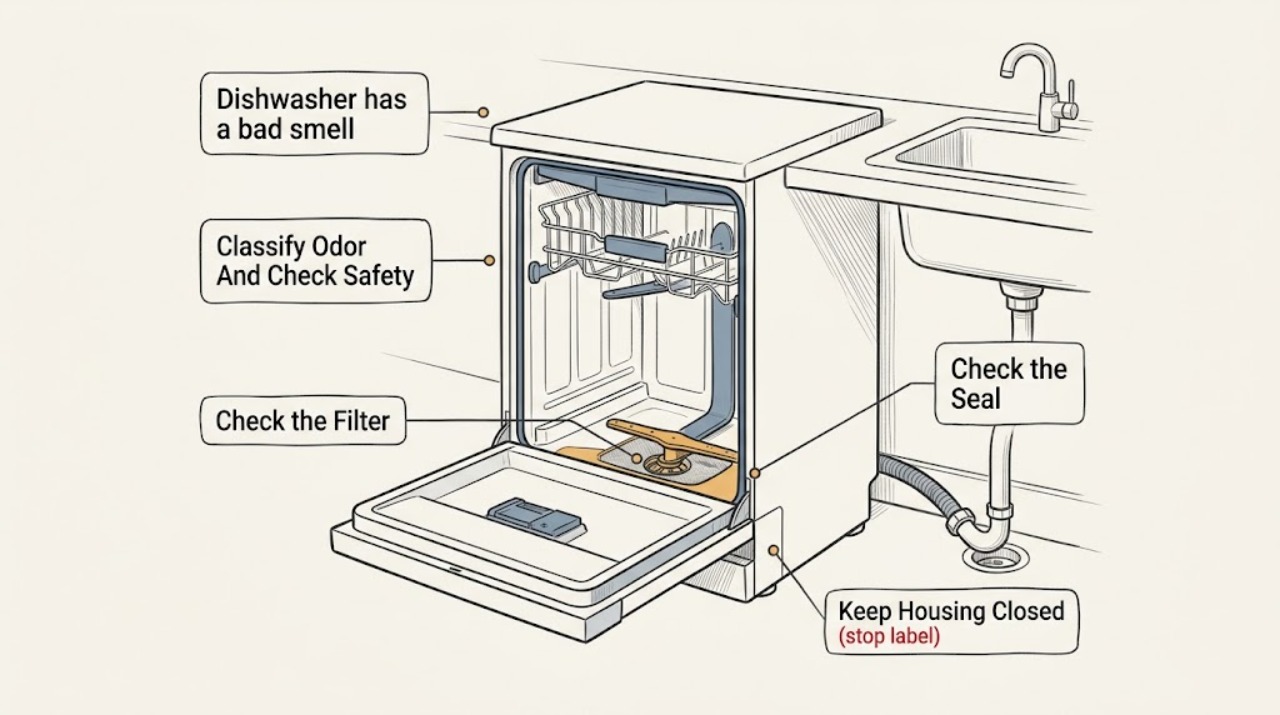
Work through in order
Diagnostic checks
Use only checks that match the exact appliance or system and its official guide.
-
Check 1
Turn the dishwasher off and identify the odor without putting your face inside: note whether it is musty or food-like, sewage-like near the sink, burning or electrical, chemical, or accompanied by smoke, a leak, or unusual heat.
Expected result: The smell is musty or food-like, strongest at the sink connection, burning or electrical, chemical or gas-like, or paired with smoke, heat, or water.
Next step: For a routine odor, continue with the cool, off cleaning checks. For a hazardous or uncertain odor, keep the dishwasher off, ventilate only if safe, and arrange qualified service or appropriate emergency help.
Stop if: Stop immediately for smoke, sparks, burning odor, gas-like odor, uncontrolled water, or water near electrical parts.
Why this matters
Why: Musty or food odor usually points to moisture and debris. Sink-side sewage odor points toward household plumbing. Burning, chemical, gas-like odor, smoke, heat, or a leak is a safety boundary and not a cleaning diagnosis.
-
Check 2
With the dishwasher off, remove the lower rack and inspect the model-accessible filter, filter housing, drain area, and spray-nozzle holes; remove visible food or grease and clean removable parts only as the manual describes.
Expected result: The filter or drain area contains food or grease, nozzle holes are blocked, the model has no removable filter, or the accessible areas are clean.
Next step: Rinse and refit removable parts in the exact order shown in the manual. If no filter is removable, wipe the reachable drain area and do not open a pump or cabinet panel.
Stop if: Use caution around sharp debris; do not reach into a hidden pump, remove sealed panels, or force a filter or nozzle.
Why this matters
Why: Debris in the filter, drain area, or nozzles can retain moisture and create odor while also reducing cleaning and drainage. A clean accessible path makes the door seal, inner door, connected drain, or an internal drain problem more likely.
-
Check 3
Wipe the door seal, bottom edge of the door, inner door, tub surfaces, racks, and removable accessories with the model-approved mild cleaning method; remove trapped residue and dry the areas afterward.
Expected result: Residue or slime is present at the seal or door edge, plastic racks or accessories smell, the inner tub has film, or all reachable surfaces are clean.
Next step: Refit all parts correctly and leave the door slightly open after use. Do not use bleach in a stainless-steel interior, and do not combine vinegar with detergent or another cleaning agent.
Stop if: Do not use harsh or abrasive chemicals, spray liquid into controls, or clean while the dishwasher is hot or energized.
Why this matters
Why: Food residue and retained moisture at the seal, door edge, racks, and tub can produce a musty smell even when the filter looks clean. A clean interior with recurring odor shifts attention to drain backflow, standing water, or a service issue.
-
Check 4
After a prior cycle has ended and the unit is safe to inspect, look for a large amount of water in the tub and check whether the odor is strongest at the sink, air gap, garbage disposal, or drain-hose connection; run water in the connected sink and see whether it drains freely.
Expected result: A large amount of water remains, the dishwasher shows a drain error or blinking lights, the sink or disposal backs up, the drain hose is kinked or lacks the required high loop or air gap, or the sink drains normally.
Next step: Correct only a visible hose kink or model-documented connection issue. Arrange plumbing help when the sink or disposal backs up, and appliance service when the dishwasher remains full after the external path is clear.
Stop if: Do not detach a water-filled hose without safe containment, pour chemical drain cleaner into the dishwasher, or open the pump or cabinet.
Why this matters
Why: Standing water or a drain error can sustain odor and points to the dishwasher drain path. Sink backup or a poor connection points to household plumbing or installation. A normal sink and clear visible connection make a filter, pump, internal hose, or seal issue more likely.
-
Check 5
When the filter and drain area are correctly reassembled and the dishwasher can drain, run the model's empty Self Clean, Normal, or other documented cleaning cycle with one approved cleaning agent; do not combine agents.
Expected result: The cycle drains and the odor clears, debris or agent remains afterward, the cycle cannot drain, an error appears, or the odor is unchanged.
Next step: Wipe away any residue, dry the interior, and leave the door slightly open. If the cycle cannot drain or the odor persists, stop repeating cleaning cycles and arrange the appropriate appliance or plumbing service.
Stop if: Do not use bleach in a stainless-steel interior, mix vinegar with detergent or another agent, run a cleaning cycle with dishes, or continue if smoke, burning odor, leak, or fault appears.
Why this matters
Why: A clear cycle with a resolved odor supports an interior maintenance cause. Residue, a failed drain, an error, or unchanged odor indicates that cleaning did not address the source and may point to drain, backflow, seal, or internal service trouble.
-
Check 6
After cleaning, remove dishes promptly, wipe the inner door and accessible damp areas, leave the door slightly open when idle, and observe the next normal cycle for odor, standing water, a leak, or an error.
Expected result: The odor stays gone, returns only after dirty dishes sit, returns with standing water or sink backup, or returns with a leak, fault, or abnormal smell.
Next step: Continue the documented drying and filter routine for a resolved maintenance odor. Arrange plumbing or appliance service for recurring drainage or leakage, and stop using the unit for hazardous smells or faults.
Stop if: Do not keep running cycles to mask an odor, leave a leaking or faulted dishwasher unattended, or replace a pump, hose, or seal without diagnosis.
Why this matters
Why: An odor that follows stored dirty dishes or retained moisture supports a maintenance cause. Odor with standing water or sink backup indicates drainage or plumbing. A leak, fault, burning, chemical, or gas-like smell requires service rather than more cleaning.
Use your observations
Decision map
Find the observation that best matches what you see, then follow the next safe action.
-
PATH 01Safety boundary
What you see
The odor is musty or food-like, visible residue is present in the filter, drain area, nozzles, seal, racks, or inner door, and the dishwasher drains normally.
Do this next
Clean the model-accessible parts, run one empty documented cleaning cycle with an approved agent, wipe the interior dry, and leave the door slightly open.
Why this path and its safety boundary
Why it matters: Moisture and trapped food or grease are more likely than a failed component.
Safety stop: Do not use bleach in a stainless-steel interior or mix cleaning agents.
-
PATH 02Safety boundary
What you see
The smell is strongest below the sink, the sink or disposal backs up, the drain hose connection is kinked or incorrectly routed, or odor returns with water flowing back into the tub.
Do this next
Correct only a visible model-documented hose connection issue. Arrange plumbing help for sink or disposal backup and appliance service for an unresolved dishwasher-side drain fault.
Why this path and its safety boundary
Why it matters: Household plumbing, drain-hose routing, or backflow is more likely than an interior cleaning issue.
Safety stop: Do not detach a water-filled hose without containment or pour drain chemicals into the dishwasher.
-
PATH 03Safety boundary
What you see
A large amount of water remains, a drain or leakage code appears, the filter and drain area are clean, or the dishwasher leaks while the odor persists.
Do this next
Keep the dishwasher off if water is uncontrolled or near electrical parts, and arrange qualified appliance service. Use plumbing help when the household drain is the source of backup.
Why this path and its safety boundary
Why it matters: A drain restriction, pump, internal hose, seal, leak sensor, or installation problem may be retaining moisture and needs diagnosis.
Safety stop: Do not open the pump or cabinet, bypass a leak sensor, or run repeated cycles with standing water or a leak.
-
PATH 04Safety boundary
What you see
The smell is burning, electrical, chemical, or gas-like, or it occurs with smoke, sparks, unusual heat, a damaged cord, or an active leak.
Do this next
Stop using the dishwasher and keep clear. From a dry, safely accessible point disconnect power and water only if doing so does not require touching damaged equipment, then arrange urgent qualified help.
Why this path and its safety boundary
Why it matters: This is a safety boundary, not a dishwasher-cleaning problem. Electrical, heating, detergent, gas, or leak damage may be involved.
Safety stop: Do not run a cleaning cycle, touch wet electrical parts, investigate under the cabinet while energized, or attempt a repair.
Helpful context
Understand the symptom
Classify the smell before cleaning
Musty, sour, or food-like odor with residue usually points to moisture and organic debris inside the dishwasher. A sewage-like smell that is strongest under the sink can come from the connected drain or disposal. A burning, electrical, solvent, or gas-like odor is not a cleaning problem: stop using the appliance and arrange prompt service or appropriate emergency help.
A small amount of water can be normal, a large amount is not
Samsung notes that a small amount of water can remain after a cycle, while a large amount of standing water can indicate that the dishwasher is not draining. A blocked filter, drain area, hose, sink connection, or pump can retain moisture and feed an odor, so pair odor cleaning with a drain observation.
Drying prevents the odor from returning
After cleaning, remove debris and moisture from the inner door, seal, tub, and accessible filter area. Leave the door slightly open when the dishwasher is not in use, and remove dirty dishes promptly. These steps reduce the warm, damp conditions that let odor return.
Safety boundary
Stop conditions
- Stop using the dishwasher for burning, electrical, chemical, or gas-like odor, smoke, sparks, unusual heat, uncontrolled water, or water near electrical parts.
- Do not use bleach in a stainless-steel interior, mix vinegar with detergent or another cleaning agent, or pour chemical drain cleaner into the dishwasher.
- Do not reach into a hidden pump, handle sharp debris with bare hands, open cabinet panels, bypass a leak sensor, or detach a water-filled hose without safe containment.
- Do not leave a leaking or faulted dishwasher unattended or keep running cycles to hide a recurring odor, standing-water condition, or drain error.
- Do not order a filter, drain pump, hose, seal, sensor, or control until the exact model and qualified diagnosis identify the failed component and fit.
Only after diagnosis
Potential parts
- dishwasher filter or filter assembly
Consider this category only when the exact model identifies a damaged, missing, or non-sealing filter after cleaning and correct reassembly do not resolve the odor or drain symptom.
Confirm the exact Samsung model, filter variant, housing, locking interface, and manufacturer fit information before ordering. - door seal or tub seal
Consider this category only when qualified inspection finds a damaged, displaced, or odor-retaining seal associated with a leak or moisture path after cleaning.
Confirm the exact Samsung model, seal profile, door or tub location, installation method, and technician diagnosis before ordering. - drain pump, drain hose, leak sensor, or control
Consider this category only when standing water, drain or leakage errors, backflow, or a persistent odor remains after external drain and filter checks and qualified diagnosis identifies the failed assembly.
Confirm the exact Samsung model, pump and hose routing, sensor or control revision, electrical connectors, and repair diagnosis before ordering.
When checks do not resolve it
Need a professional?
Arrange appliance service when odor persists after the model-accessible filter, drain-area, seal, interior, and empty cleaning-cycle checks; when a large amount of water remains, a drain or leakage code returns, the dishwasher leaks, or an internal pump, hose, sensor, seal, or control may be involved. Arrange plumbing help when the connected sink, disposal, or household drain backs up. Seek urgent help for burning, electrical, chemical, or gas-like odor, smoke, sparks, unusual heat, or water near electrical parts.
Safety scope: This article covers cool, powered-off cleaning of model-accessible parts, visible drain and sink observations, and one documented empty cleaning cycle. It does not authorize opening cabinet or pump areas, handling unsafe water or sharp debris, disconnecting pressurized lines, bypassing sensors, or replacing internal components.
Common questions
FAQ
Why does my Samsung dishwasher smell bad?
Samsung links odor to moisture, warmth, and trapped food particles. Check the filter, drain area, spray nozzles, door seal, racks, and inner door. If a large amount of water remains or the smell is strongest at the sink, investigate drainage or plumbing as well.
Can I use bleach to remove a Samsung dishwasher smell?
Do not use bleach in a dishwasher with a stainless-steel interior; Samsung warns it can damage or discolor the interior. Use only the cleaning method and agent approved for the exact model, and never combine vinegar with detergent or another agent.
How do I clean a Samsung dishwasher filter for odor?
Turn the dishwasher off, remove the lower rack, and follow the exact manual for the filter variant. Rinse removable filter parts, clear food from the drain area, and reassemble the filter correctly. Some models have no removable filter, so do not force one or open a pump panel.
Why does the smell come from under my Samsung dishwasher or sink?
A sink, disposal, drain hose, or backflow issue can smell like a dishwasher problem. Check whether the sink drains freely and whether the hose is kinked or incorrectly connected. Arrange plumbing help for sink backup and appliance service for a dishwasher-side leak or drain fault.
When should I stop using a Samsung dishwasher that smells bad?
Stop for burning, electrical, chemical, or gas-like odor, smoke, sparks, unusual heat, uncontrolled water, a leak, water near electrical parts, or a recurring drain or leakage code. Keep the dishwasher off and arrange qualified service instead of running more cleaning cycles.
Read the exact guide
Official sources
- Samsung dishwasher is not drainingSamsung Electronics America · Official Samsung drain troubleshooting used to connect standing water and odor with external drain or plumbing conditions; exact installation requirements vary by model and local regulation.
- Samsung Dishwasher stinks or has a musty smellSamsung Electronics America · Official Samsung support article used for the primary odor-cleaning and prevention path; the exact dishwasher manual controls removable parts and cleaning-agent compatibility.
- Samsung dishwasher is leaking or has a leakage error codeSamsung Electronics America · Official Samsung leak guide used for odor branches involving leaks, moisture detection, or water near electrical parts; it does not replace the exact model manual.
- Routine and deep clean your Samsung dishwasherSamsung Electronics America · Official Samsung cleaning guide used for model-dependent filter and drain-area care; the owner's manual controls variants without matching access.
Community feedback
Share a repair observation
Share a plain-text repair observation. Accepted observations are published automatically; this page may take a moment to update.