
On this page
Start here
Quick answer
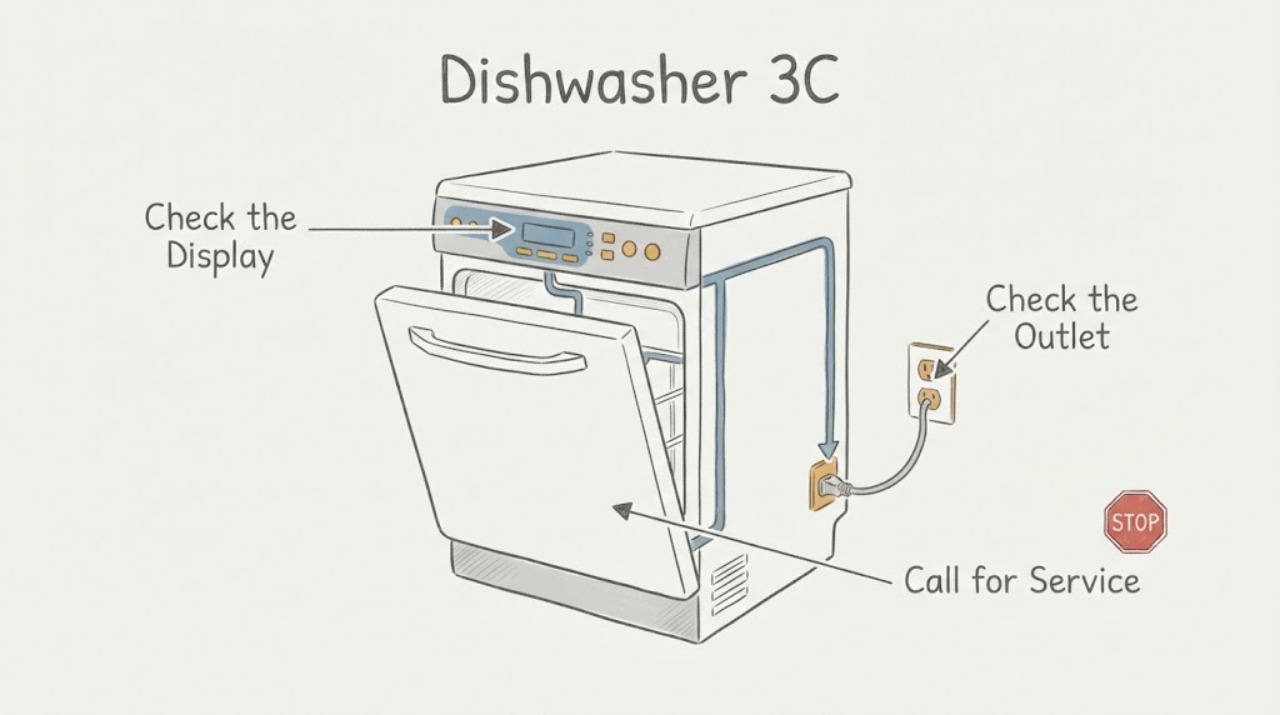
Samsung's US dishwasher code guide labels 3C as a pump operation error, but that does not tell a homeowner which pump, control or other part to replace. First photograph the complete model label and verify that the display is actually 3C, not 3E, PC, 4C/4E, 5C/5E, OC/0C/oE or LC/LE; the meanings and troubleshooting can vary by model and market. If the code is 3C, check only for visible water, leaks, an incorrectly assembled or obstructed accessible filter, and spray-arm or dish obstructions with power off. Follow the exact manual's troubleshooting before a single normal power reset; if 3C returns or the dishwasher remains stopped, request Samsung service. Do not remove the pump, tilt the unit, open electrical covers, test live wiring, or assume a pump or main-board replacement is required.
Work through in order
Diagnostic checks
Use only checks that match the exact appliance or system and its official guide.
-
Check 1
With the dishwasher idle and dry, photograph the complete model label, serial information and display or light pattern; copy every character exactly and record the market or country, selected cycle and whether the tub has water.
Expected result: The display clearly reads 3C, resembles 3E or PC, shows a drain/supply/leak code, uses blinking lights instead of a display, or the model label is missing or unreadable.
Next step: Use Samsung's support search and the manual for the exact model and market. If the display or model remains uncertain, stop at safe observations and give the photo to Samsung or a qualified appliance technician; do not apply a different model's reset or service sequence.
Why this matters
Why: Samsung states that some models communicate codes through blinking lights and that the model guide controls the interpretation. The same-looking characters can represent different functions, so a guessed 3C is not enough to start a circulation diagnosis.
-
Check 2
Compare the captured characters and the machine's behavior with Samsung's code categories: 3C pump operation, 3E high-temperature water supply, PC Zone Wash, 4C/4E water supply, 5C/5E/SC/SE drain, OC/0C/oE over-level, or LC/LE leakage.
Expected result: The code and symptom match 3C, the characters match another category, or the display cannot be read reliably.
Next step: Follow only the matching exact-model guide. For a confirmed 3C, continue with safe visual checks and the guide's single retry instruction; for another code, use that code's supply, drain, over-level or leakage path instead of this 3C article.
Why this matters
Why: 3C points to pump operation in Samsung's US list; 3E concerns water temperature, PC concerns Zone Wash, 4C/4E concerns incoming water, drain codes concern drainage or over-level conditions, and LC/LE concerns moisture detection. These are different decision paths, not interchangeable names for a circulation pump.
-
Check 3
Before any reset, check from ordinary access for water on the floor or under the door, standing water across the tub, an active leak, detergent foam, or moisture near the outlet or cord; keep the dishwasher off if any of these are present.
Expected result: The dishwasher is dry with no leak, the filter area contains only ordinary residue, the tub is holding substantial water, foam or moisture is visible, or water is near electrical parts.
Next step: For a leak or water near electricity, stop use, close the water supply and isolate power at the normal disconnect only if safe, then arrange qualified appliance or emergency help. Do not tilt the dishwasher, reach into the pump, or run it to reproduce 3C.
Why this matters
Why: A leak, over-level or drain condition can prevent normal operation and takes priority over a presumed pump fault. Water or foam can also create a separate safety or cleaning problem. A dry safe machine is the only condition in which a normal power reset can be considered after the code-specific checks.
-
Check 4
With power off and the door open, inspect only the user-accessible filter and spray-arm area for food debris, a loose filter, blocked nozzles, or dishes/utensils preventing spray-arm movement; clean or reseat parts only when the verified manual describes them as removable.
Expected result: A visible filter or nozzle obstruction is present, spray arms cannot rotate because of a load item, the accessible parts are clear, or the model has a different filter or spray assembly.
Next step: Clear only an obvious dish or utensil obstruction and follow the exact model's filter/nozzle care instructions. Do not remove a pump, unscrew hidden covers, poke into a motor opening, or use the cleaning check as a live circulation test.
Why this matters
Why: Samsung says clogged nozzles and blocked moving parts can reduce cleaning performance, and filter variants differ by model. These observations can explain dirty dishes without proving that the 3C pump has failed, while a model mismatch makes a generic removal step unsafe.
-
Check 5
If there is no confirmed 3C behavior and the complaint is mainly poor cleaning, observe whether dishes are wet, detergent has dispensed, the spray arms are unobstructed, and the hot-water supply is available; do not infer circulation failure from one dirty load.
Expected result: Dishes are wet but dirty, dishes remain dry, detergent remains in the dispenser, the load blocks spray, or the supply temperature/pressure is outside the published requirements.
Next step: Correct only an obvious loading, dispenser or visible obstruction issue using the verified manual. Use plumbing help for a household supply problem; if the code is confirmed 3C or the cycle remains stopped, use the service branch rather than testing internal parts.
Why this matters
Why: Wet but dirty dishes can result from loading, spray/nozzle, filter, detergent or temperature conditions. Dry dishes or a stopped cycle fit a broader operating or fill problem. Samsung publishes water-supply temperature and pressure requirements, but those values do not identify a failed pump or authorize home pressure testing.
-
Check 6
Only after the matching code-specific checks and only when the dishwasher is dry and electrically safe, perform the Samsung consumer reset once by unplugging it or switching off its circuit breaker for the documented short interval, then restore power and record the result.
Expected result: The code clears and a normal cycle operates, 3C returns, a different code appears, or the dishwasher remains stopped.
Next step: Do not repeat resets or enter a diagnostic/service mode. Preserve the model, code, cycle stage, photos and reset result and request Samsung service when 3C returns or the machine remains stopped.
Why this matters
Why: Samsung warns that resetting before troubleshooting can leave the cause unresolved. A one-time clear can remove a transient control state, but a returning 3C is evidence for service, not proof of which internal part failed.
Use your observations
Decision map
Find the observation that best matches what you see, then follow the next safe action.
-
PATH 01Next step
What you see
The model is missing, the market is unknown, the display is dim or the code could be 3E, PC, 4C/4E, 5C/5E, OC/0C/oE or LC/LE rather than 3C.
Do this next
Hold at identity verification, photograph the display and label, and use the exact Samsung manual. Do not apply a pump diagnosis or another model's reset.
Why this path and its safety boundary
Why it matters: The exact code and model path are not established; Samsung assigns different meanings and checks to these categories.
-
PATH 02Next step
What you see
The display clearly reads 3C, there is no leak or standing water near electricity, and the visible filter/spray area has no model-permitted obstruction.
Do this next
Follow the exact manual's code-specific instruction and make at most one normal retry/reset when safe. If 3C returns or the cycle remains stopped, request Samsung service without ordering a pump or board.
Why this path and its safety boundary
Why it matters: Samsung defines 3C as a pump operation error, but the safe user evidence still cannot distinguish a pump, wiring, sensing or control cause.
-
PATH 03Next step
What you see
The display is actually 3E, PC or another non-3C category.
Do this next
Leave the 3C path and follow the exact-model instructions for the captured code. Do not call a circulation pump the cause because the characters look similar.
Why this path and its safety boundary
Why it matters: 3E is a high-temperature water-supply error and PC is a Zone Wash error; supply, drain, over-level and leakage codes have their own branches.
-
PATH 04Next step
What you see
The dishwasher is not showing 3C and dishes are wet but dirty, detergent has dispensed, or visible spray/nozzle, filter, loading or hot-water conditions are abnormal.
Do this next
Correct only the visible, model-supported condition and reassess one suitable cycle. If an error appears or cleaning remains poor with those conditions normal, request service.
Why this path and its safety boundary
Why it matters: Cleaning performance can be reduced by circulation coverage, filtration, loading, detergent or temperature without a confirmed pump-operation error.
-
PATH 05Next step
What you see
3C returns after the documented troubleshooting and one safe normal reset, or the dishwasher remains stopped with no visible user-correctable condition.
Do this next
Keep the dishwasher off and request Samsung or qualified appliance service with the complete model, market, code photo, cycle stage, water/leak observations and reset result.
Why this path and its safety boundary
Why it matters: The fault needs model-specific professional diagnosis. The code does not establish a pump replacement, main-board replacement or a repair-versus-replace decision.
-
PATH 06Next step
What you see
There is a visible leak, standing water near the outlet or cord, smoke, burning odor, sparks, exposed wiring, uncontrolled filling, repeated breaker trips or water spreading into cabinets or flooring.
Do this next
Stop using the dishwasher. If safe, close the water supply and isolate power at the normal disconnect; keep away from wet electrical areas and obtain qualified or emergency help. Do not reset or restart it.
Why this path and its safety boundary
Why it matters: This is an immediate water, electrical or fire safety event, not a circulation-code troubleshooting opportunity.
Helpful context
Understand the symptom
3C is not the same as 3E or PC
Samsung's public US error-code guide separates 3C, 3E and PC: 3C is a pump operation error, 3E is a high-temperature water-supply error, and PC is a Zone Wash error. 4C/4E is a water-supply error, 5C/5E and related codes are drain errors, and LC/LE is a leakage indication. A character read from a dim display can send the diagnosis down the wrong path, so capture the display and the model before doing anything else.
A code does not name a replacement part
The 3C label is a service boundary, not a confirmation that a circulation pump alone has failed. Samsung says to turn off the dishwasher and try starting the cycle again, then request service if 3C persists. Safe external observations can separate a code mismatch, visible obstruction, supply or drain symptom, and a returning pump-operation indication without opening the machine.
When checks do not resolve it
Need a professional?
Request Samsung or qualified appliance service when 3C returns after the code-specific check and one safe reset, the dishwasher remains stopped, the model or market cannot be matched to a guide, or a pump, wiring, sensor or control diagnosis would be required. Use plumbing help for a household water-supply or drain problem.
Have this ready
- Provide the complete model and serial label, market, exact display or light pattern, selected cycle and stage, whether the tub is dry or holding water, visible filter/spray observations, supply or drain observations, leak/foam history, and the result of the single documented reset.
Common questions
FAQ
Does Samsung 3C prove the circulation pump must be replaced?
No. Samsung labels 3C a pump operation error and directs a turn-off/retry followed by service if it persists. The code does not identify a specific pump, wiring, sensor or control, so do not order a part from 3C alone.
How can I tell 3C from 3E or PC?
Photograph the complete display and compare it with the exact model guide. Samsung's US list describes 3C as pump operation, 3E as high-temperature water supply, and PC as Zone Wash; these are separate categories.
Can I reset a Samsung dishwasher showing 3C?
Only after the code-specific troubleshooting and only when the dishwasher is dry and electrically safe. Samsung's consumer reset guidance permits a normal power reset, but warns that resetting first can leave the cause unresolved. Make one reset, then request service if 3C returns.
Read the exact guide
Official sources
- Routine and deep clean your Samsung dishwasherSamsung · Samsung dishwasher model-dependent consumer checks for spray nozzles, moving-part obstructions, filters and correct reassembly; not a pump or electrical repair guide.
- Samsung dishwasher is displaying an error codeSamsung · Samsung US dishwasher error-code categories and consumer instructions for 3C, 3E, PC, 4C/4E, 5C/5E, OC/0C/oE and LC/LE; exact model and market still control applicability.
- Detergent does not dispense in Samsung dishwasherSamsung · Samsung dishwasher external cleaning-performance observations: detergent status, visible obstructions and spray-arm movement; use only as symptom differentiation, not as proof of a 3C part failure.
- Dishwashers | Samsung Support USSamsung · Samsung US dishwasher model and support routing; use the model-code search to obtain the applicable manual and service path for an unmodeled 3C report.
- How to reset your Samsung dishwasherSamsung · Samsung US dishwasher consumer power-reset guidance and warning to troubleshoot the code before resetting; use only when the appliance is safe and the exact model permits the normal procedure.
Community feedback
Share a repair observation
Share a plain-text repair observation. Accepted observations are published automatically; this page may take a moment to update.