
On this page
Start here
Quick answer
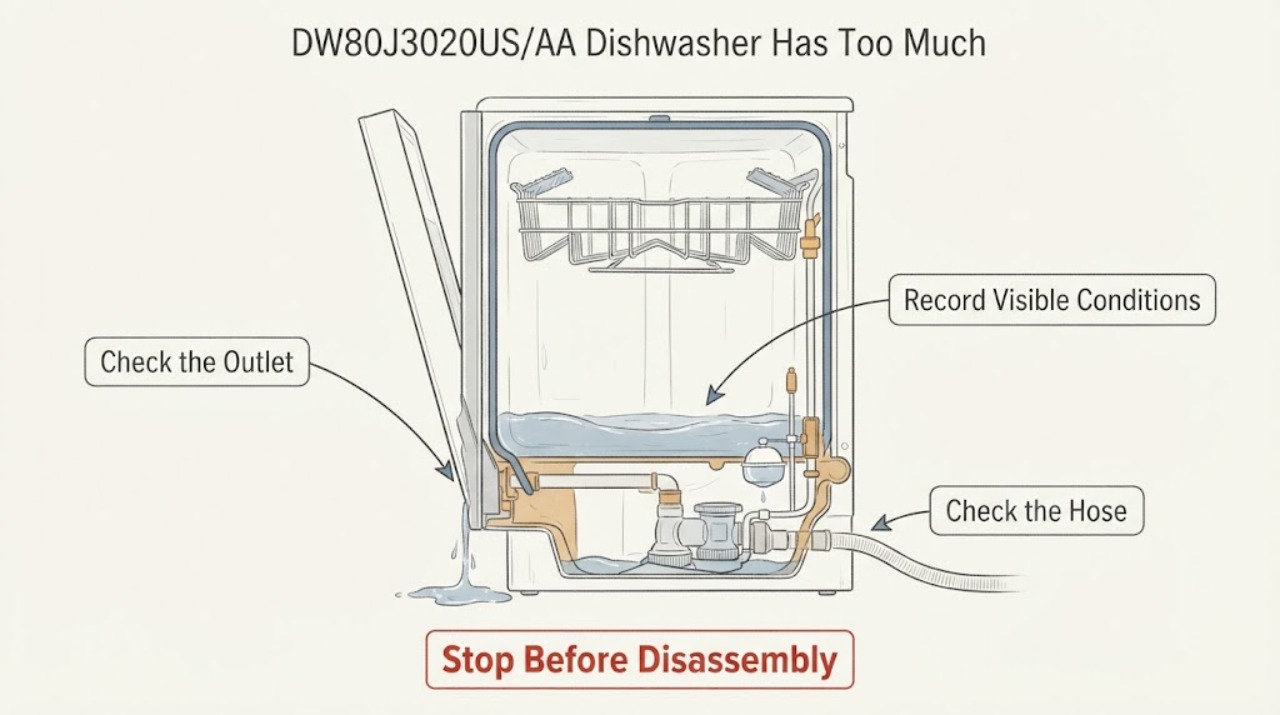
For the Samsung DW80J3020US/AA report, separate water that reaches the door or floor during a running cycle from water that remains in the tub after the cycle. Samsung says its over-level codes OC/0C/oE indicate excessive water and often a drainage problem, and directs an external check of the drain connections, hose, filter and sump; its dishwasher light guidance likewise says too much water usually calls for checking the drain hose for a kink or obstruction. The reported Reddit case says there was no overflow error and that the owner had already worked on pumps, hoses and sensors, so those facts do not prove an inlet valve, level sensor, pump or control fault. Stop a cycle that is leaking onto the floor, isolate water and power only from safe accessible controls, inspect only the visible drain hose and removable filter/sump area as the exact manual allows, record any display or blinking-light pattern, and arrange model-specific service if the leak or standing water persists.
Work through in order
Diagnostic checks
Use only checks that match the exact appliance or system and its official guide.
-
Check 1
Stop the dishwasher if water is reaching the door edge or floor. From a dry, stable position, turn the dishwasher off and close its accessible water shutoff; if water is near the outlet, cord or other electrical equipment, isolate power at the breaker only if it can be done without touching wet areas. Do not reach under the appliance, move it, or run another cycle to see whether the water level changes.
Expected result: Water is actively pooling on the floor, the cord or outlet is wet or damaged, or there is no active exterior leak and the water is confined to the tub.
Next step: Keep the dishwasher isolated and arrange qualified service for an active leak or wet electrical area. If the water is confined to the tub, continue only with safe external observations after power is off.
Stop if: Stop immediately if safe shutoff or power isolation would require moving the dishwasher or touching wet electrical parts.
Why this matters
Why: A floor leak or wet electrical area is an immediate stop-use condition. Water confined to the tub still needs a timing and drain-path check, but it does not prove an overfill component failure.
-
Check 2
With the dishwasher off and isolated, record whether the water first becomes excessive during the fill or wash period, appears at the door while the spray arms are operating, remains only after the drain portion, or returns while the appliance is idle. Measure the visible height by comparison with the filter or tub floor rather than reaching into the water.
Expected result: Water reaches the door during operation, remains after the cycle with no active leak, or returns while idle.
Next step: Use the corresponding branch below, photograph the water level and leak location, and record the exact display or blinking pattern before contacting service. Do not repeatedly run the dishwasher for comparison.
Why this matters
Why: Door or floor water is an active leak or over-level safety concern; post-cycle water is consistent with a drainage decision point but is not a diagnosis; idle return water is outside the exact Reddit report and needs model-specific service rather than an assumed valve diagnosis.
-
Check 3
After power is off, inspect only the visible drain hose and accessible sink or disposal connection for a kink, pinch, loose connection or obvious obstruction. Follow the exact DW80J3020US/AA manual for any approved hose position; do not disconnect a water-filled hose, probe it with a tool, or remove panels.
Expected result: The visible hose is sharply kinked, the connection is loose or visibly obstructed, or the visible drain path looks clear.
Next step: Correct only an obvious external positioning or connection issue without opening the machine. If the path is clear or the symptom persists, proceed to the filter/sump check and service boundary instead of guessing a pump or valve.
Stop if: Stop if the connection cannot be inspected without disconnecting plumbing, if water begins to escape, or if access requires moving the dishwasher.
Why this matters
Why: Samsung specifically directs users to check the drain hose for kinks or obstructions and lists drain connections among the external checks for excessive-water and drain indications. A clear visible hose does not exclude an internal blockage, a leak path or a failed component.
-
Check 4
With power isolated and the tub drained as far as is safely possible, inspect and clean only the removable filter and visible sump area if the exact manual shows that procedure. Remove loose debris without reaching into a pump opening or taking off a panel; do not use the reported prior pump, motor or sensor work as a reason to repeat a repair.
Expected result: Debris is visible in the removable filter or sump area, or those areas are visibly clear while standing water or a leak continues.
Next step: Reinstall only the parts the exact manual says are removable and stop if the symptom remains. Arrange model-specific service with the exact model, water timing, code/light pattern and prior user-reported work; do not open the cabinet.
Why this matters
Why: Samsung lists the filter and sump among checks for drain-related codes. Clearing visible debris may remove one external drain condition, but a clear area does not identify an inlet valve, level sensor, pump or control fault.
-
Check 5
Record the display and any repeating light pattern without treating an unreported code as present. If the display actually shows OC, 0C or oE, compare it with Samsung's over-level guidance; if the relevant model-family lights blink, compare the exact pattern with Samsung's light guide. Do not use a generic blinking pattern to name a failed part.
Expected result: An OC/0C/oE code or a Samsung light pattern is present, or there is no code despite persistent water.
Next step: After the safe external checks, keep the dishwasher out of service and contact qualified Samsung or appliance service if the code, leak or standing water persists. Provide the full DW80J3020US/AA identity and do not replace a sensor, valve or pump based only on the symptom.
Why this matters
Why: Samsung defines OC/0C/oE as excessive water and commonly points to drainage, while some blinking combinations also direct a drain-hose check. The original post reports no overflow error, so a no-code case remains symptom-led and unresolved by the code pages.
Use your observations
Decision map
Find the observation that best matches what you see, then follow the next safe action.
-
PATH 01Next step
What you see
Water reaches the door edge or floor during a cycle, or the floor or nearby electrical area is wet.
Do this next
Stop the cycle, isolate water and power only from safe accessible controls, keep the area clear, and arrange qualified service. Do not run another test cycle or remove panels.
Why this path and its safety boundary
Why it matters: This is an active leak or over-level safety concern, regardless of whether a Samsung code is displayed.
-
PATH 02Next step
What you see
No water reaches the floor, but a large amount remains in the tub after the cycle and the visible hose, connection, filter and sump checks have not found an obvious obstruction.
Do this next
Keep the dishwasher out of service and give the technician the water height, timing, code/light pattern and external-check results. Do not repeat pump or sensor replacement without a model-specific inspection.
Why this path and its safety boundary
Why it matters: The pattern is compatible with a drain-path problem, but the opened sources do not prove an internal pump, valve, sensor or control failure.
-
PATH 03Next step
What you see
The display shows OC, 0C or oE, or the exact Samsung light pattern is one that Samsung labels as too much water.
Do this next
Perform only the safe external checks allowed by the exact manual. If the indication or water problem persists, arrange model-specific service rather than replacing a guessed component.
Why this path and its safety boundary
Why it matters: Samsung associates those indications with excessive water and commonly directs attention to drainage, hose, filter and sump conditions; the indication does not identify a particular failed part.
-
PATH 04Next step
What you see
Water returns while the dishwasher is idle after the cycle, a situation not reported in the exact Reddit post.
Do this next
Close the accessible water shutoff, keep the dishwasher out of service, and have the exact DW80J3020US/AA inspected. Do not force a valve test or replace a part from this observation alone.
Why this path and its safety boundary
Why it matters: The opened evidence does not establish an idle-water cause for this model, so an inlet-valve or drain-back diagnosis would be speculation.
Helpful context
Understand the symptom
First identify when the water is excessive
The exact report combines two observations: water can come out at the door while the dishwasher is running, and a lot of water remains in the bottom after the cycle. Those observations do not by themselves distinguish an over-level condition, incomplete draining, a leak path, or water returning through a connection. Samsung's public code guidance is conditional: OC/0C/oE is an excessive-water indication that is often related to drainage, but the Reddit post does not report that code.
Keep checks external and model-scoped
Samsung identifies the DW80J3020US/AA on its support and product pages and lists a water leakage sensor and overflow sensor as product features. Those features establish the model context and safety design; they do not identify which sensor, valve, pump or control has failed. Do not order another part or open the appliance from this symptom alone.
When checks do not resolve it
Need a professional?
Call qualified Samsung or appliance service when water reaches the floor, the dishwasher leaks at the door, a Samsung over-level or drain indication persists after safe external checks, water returns while idle, or standing water remains without an obvious hose, filter or sump condition. Do not diagnose or order an inlet valve, level sensor, pump, motor or control board from this symptom alone.
Common questions
FAQ
Does standing water prove that the water-level sensor or inlet valve is bad?
No. Samsung's guidance connects its OC/0C/oE over-level indication with excessive water and often a drainage problem, but the opened sources do not diagnose a particular sensor or valve for this report. Check the safe visible drain path and arrange model-specific service if the problem persists.
What should I do if water leaks out of the dishwasher door?
Stop the cycle and keep the dishwasher out of service. Isolate water and power only from safe accessible controls, keep water away from electrical areas, and arrange qualified service. Do not continue testing or remove panels to look for a valve or sensor.
Can I replace the drain pump because the tub is full?
Not from this symptom alone. The exact report already mentions prior pump and related work without a verified resolution, and Samsung's public guidance starts with drain connections, hose, filter and sump checks. A technician should inspect the model before another part is selected.
Read the exact guide
Official sources
- Samsung Dishwasher too much waterReddit r/appliancerepair · Exact opened Reddit post. It supports the reported model and symptoms only; the commenters' unverified theories are not used as technical evidence and the post has no verified repair outcome.
- DW80J3020US/AA | Samsung Support BRSamsung · Exact model support page. It confirms the assigned model identity and the availability of the model's user and installation manuals; it is not used to infer an unlisted component failure.
- Blinking lights on your Samsung dishwasherSamsung · Generic Samsung dishwasher guidance, used only for the documented conditional meaning of the listed light combinations. It does not establish that the exact Reddit case had one of those patterns.
- The meaning of error codes on your Samsung dishwasherSamsung · Generic Samsung dishwasher code guidance. It is applied conditionally: OC/0C/oE supports an excessive-water and drainage branch only when that code is actually observed, while the report itself says no overflow error was present.
- DW80J3020US Samsung DishwasherSamsung · Exact product PDF for the DW80J3020US family. It confirms the model family and identifies the digital water-leakage and overflow sensors as design features; it does not determine which component failed in this report.
Community feedback
Share a repair observation
Share a plain-text repair observation. Accepted observations are published automatically; this page may take a moment to update.