
On this page
Start here
Quick answer
On Samsung dishwashers, LE/LC is a leakage indication: the leak sensor has detected moisture where it should not be, even when no ongoing leak is visible. After cleaning a reservoir and spilling water, residual moisture near the sensor is plausible, but it is not proof that the dishwasher is safe to run. If water is actively leaking, close the dishwasher's water-supply valve and switch off power from a safe, dry position; do not tilt the machine, blow hot air underneath, bypass the sensor, or remove the bottom panel. If there is no active leak, leave power off and allow the appliance to dry naturally, while checking only accessible hose ends, door area, floor, and cleaning spill evidence. After it is fully dry, restore power once and observe the code; if LE returns, the pump keeps draining, water reappears, or the model remains abnormal, stop resetting and arrange Samsung or qualified appliance service.
Before you begin
Safety first
- Do not tilt or slide the dishwasher, remove the kick plate or bottom panel, blow hot air underneath, open electrical covers, bypass the leak sensor or float, probe live parts, or repeatedly reset/run the appliance while LE is active. Do not restore water or power when an active leak or unsafe wet electrical area is present.
Work through in order
Diagnostic checks
Use only checks that match the exact appliance or system and its official guide.
-
Check 1
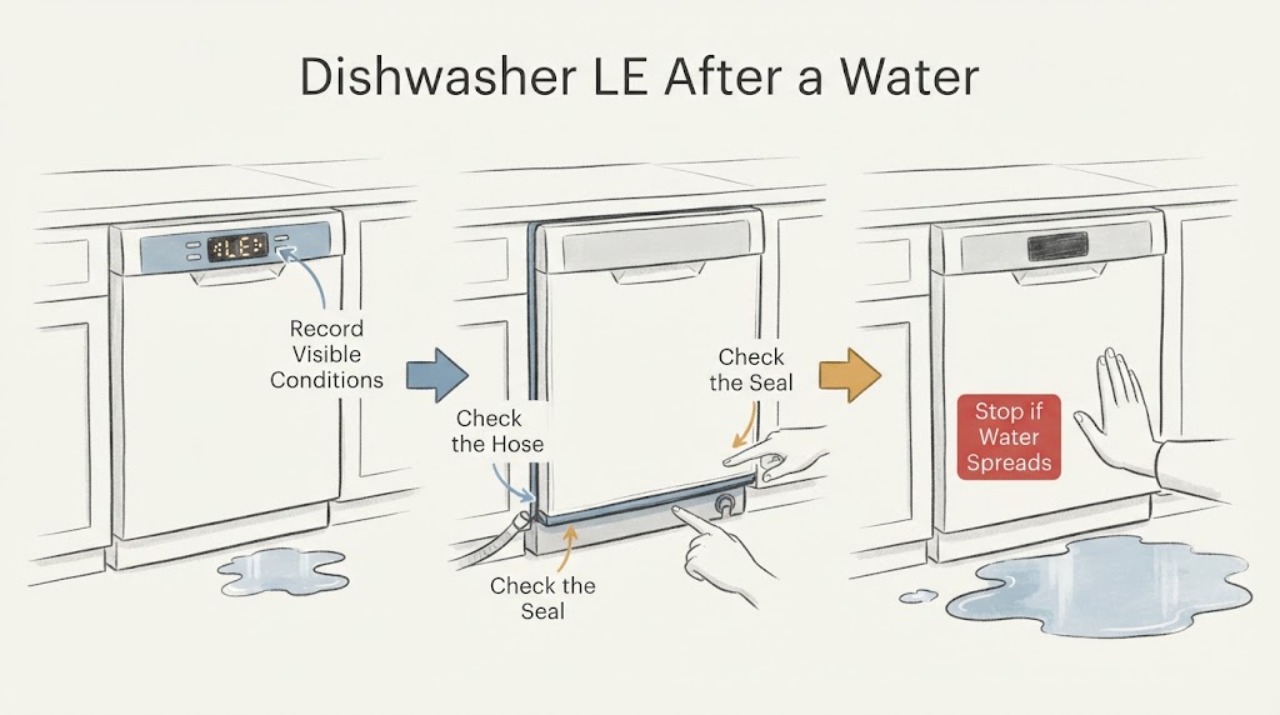
Capture the display exactly as LE or LC, note whether the drain pump is running continuously, and record the full rating-plate model including any suffix. Write down what was cleaned, where water was spilled, whether the dishwasher was moved, and whether the code appeared immediately or after a cycle.
Expected result: The display is clearly LE/LC and the timing follows the spill or cleaning, or the code is uncertain, different, or accompanied by another error.
Next step: Keep the exact label and timing for service. If the code is not clearly LE/LC, stop using generic leak instructions and obtain the full model-specific code guidance.
Stop if: Do not clear the code repeatedly before documenting it or run a cycle just to reproduce the display.
Why this matters
Why: Samsung classifies LE/LC as a leakage indication, but a code captured after a spill does not distinguish residual sensor moisture from an active leak. A different or incomplete code needs the exact manual rather than a guessed LE interpretation.
-
Check 2
If any water is actively reappearing, pooling on the floor, escaping at the door, or wetting a hose connection, close the dishwasher's water-supply valve and turn off its circuit from a safe, dry position. Do not reach beneath the machine or pull it out to search for the leak.
Expected result: Water returns without a new cycle, a hose end is visibly wet, the door area leaks, the floor is wet near the appliance, or no water is visible outside the machine.
Next step: Keep water and power off and arrange Samsung or qualified appliance service. Protect the floor and nearby electrical area without handling contaminated or energized parts.
Stop if: Do not restore power, reopen the water valve, tilt the dishwasher, remove the kick plate or bottom panel, or run a test cycle to locate the leak.
Why this matters
Why: Returning water or a wet connection makes an active leak more likely than a one-time cleaning spill. Samsung directs owners to turn off power for visible leaks and inspect accessible supply and drain connections; the visible absence of water does not rule out moisture below.
-
Check 3
If there is no visible active leak, leave the dishwasher without power and inspect only accessible areas: the floor, door gasket and lower door edge, the visible portions of the water-supply and drain-hose connections, and the reservoir or dispenser area that was cleaned. Blot accessible spill water with a cloth; do not spray more water, use a heat gun or hair dryer, or try to wipe an underside sensor.
Expected result: Only the cleaning spill is documented and the accessible areas are dry, moisture is still present, detergent or rinse aid is pooled, or the source cannot be seen without moving/opening the appliance.
Next step: Remove only accessible spill residue, leave the appliance unpowered to dry naturally, and do not add detergent or rinse aid. If moisture or residue is inaccessible, keep it off and request service rather than moving the unit.
Stop if: Do not tilt, slide, dismantle, blow hot air underneath, probe the sensor, bypass the float/sensor, or open electrical covers.
Why this matters
Why: Samsung says recently disturbed water can splash near the leak sensor and that lingering detergent can also remain wet enough to trigger the sensor. A dry visible exterior supports waiting for natural drying, but it cannot certify hidden areas or an internal leak.
-
Check 4
After the accessible spill is gone, the appliance has dried naturally, and there is no visible leak or unsafe wet electrical area, restore power once from a safe position. Do not start a wash cycle immediately; observe whether LE clears, whether the drain pump stops, and whether the code returns without operating the dishwasher.
Expected result: LE clears and the panel remains normal, LE returns immediately, the pump runs continuously, or the dishwasher powers abnormally.
Next step: If the code returns, leave power off and arrange Samsung service. If it clears, follow the full DMT800RHS manual before a normal cycle; stop immediately if water, odor, abnormal noise, or the code reappears.
Stop if: Do not cycle power repeatedly, run an empty heated cycle as a test, or continue using the dishwasher with LE active.
Why this matters
Why: A cleared code after natural drying is consistent with transient moisture, not proof that every hidden area is dry. A returning code or continuous drain means the leak-sensing condition remains or the appliance needs model-specific diagnosis.
-
Check 5
Prepare a service handoff if LE persists: provide the full model suffix and market, the exact display, the spill location and amount if known, cleaning or repair work performed, when the code appeared, whether the pump runs, photos of accessible moisture, and whether water returns with the supply valve closed.
Expected result: The code persists after natural drying, the pump will not stop, a leak is confirmed, or the unit has no abnormal behavior after the code clears.
Next step: Keep the appliance off and have Samsung or a qualified appliance technician inspect the leak path, sensor area, drain behavior, and installation using the exact model documentation.
Stop if: Do not buy a sensor, pump, seal, or control board from the LE code alone and do not ask for a part replacement before the leak path is established.
Why this matters
Why: Samsung's public guidance sends persistent leakage indications to service. The spill history is useful context, but it cannot distinguish a damp sensor from a leaking hose, seal, tub, dispenser, pump, or installation without professional inspection.
Use your observations
Decision map
Find the observation that best matches what you see, then follow the next safe action.
-
PATH 01Next step
What you see
LE appeared immediately after the reservoir-cleaning spill, no water returns with the appliance unpowered, and only accessible areas were wet.
Do this next
Keep power off and let the dishwasher dry naturally. Restore power once only after it is dry and safe, then request service if LE returns.
Why this path and its safety boundary
Why it matters: Residual moisture is a plausible explanation, but the evidence does not prove that the hidden sensor area or appliance is safe to run.
-
PATH 02Next step
What you see
Water reappears, a hose or door area is wet, the floor is pooling, or the dishwasher continues draining while LE remains active.
Do this next
Close the water-supply valve, switch off power safely, keep the unit off, and arrange qualified Samsung appliance service. Do not tilt or open the underside.
Why this path and its safety boundary
Why it matters: An active leak or unresolved moisture condition is more likely than a harmless one-time spill, and water/electricity now create a safety boundary.
-
PATH 03Next step
What you see
No leak is visible, but LE returns after natural drying or after one safe power restoration, or the full model suffix cannot be confirmed.
Do this next
Leave the dishwasher off, confirm the rating-plate identity, and request Samsung or qualified service with the code, timing, spill history, and photos.
Why this path and its safety boundary
Why it matters: The available external evidence cannot prove transient moisture or identify the failing component; a generic reset or part guess would be unsafe.
-
PATH 04Next step
What you see
The LE/LC display was misread, another code is present, or the unit has an unresponsive panel, burning odor, damaged wiring, or repeated electrical trip.
Do this next
Keep power and water off as appropriate and arrange qualified appliance or electrical service. Do not restore power as a diagnostic test or open electrical covers.
Why this path and its safety boundary
Why it matters: The issue is not safely classifiable as a moisture-only LE event; the exact code and electrical condition take priority.
Helpful context
Understand the symptom
The timing after cleaning matters: a spill can leave moisture in an area that the LE sensor monitors, but the same code can also be caused by a real hose, seal, tub, drain, dispenser, or installation leak. The code alone does not identify a failed pump, sensor, or control board. Treat the water and electrical risk first, then use the visible evidence to decide whether natural drying is reasonable or service is required.
DMT800RHS is a legacy DMT800-series identity. Confirm the full rating-plate model suffix and market before using any model-specific manual or repair instruction. Samsung's current public guidance supports the LE/LC moisture meaning and the safe external checks below, but it does not authorize opening the underside or moving the machine to reach a sensor.
When checks do not resolve it
Need a professional?
Request Samsung or qualified appliance service for a persistent LE/LC code, continuous drain, any confirmed or inaccessible leak, abnormal drain/control behavior, or an identity/manual mismatch. Close the water valve and isolate power safely before service when water is actively leaking.
Safety scope: Do not tilt or slide the dishwasher, remove the kick plate or bottom panel, blow hot air underneath, open electrical covers, bypass the leak sensor or float, probe live parts, or repeatedly reset/run the appliance while LE is active. Do not restore water or power when an active leak or unsafe wet electrical area is present.
Have this ready
- Provide the complete rating-plate model and market, exact code, time relative to reservoir cleaning, where and how much water was spilled if known, whether the unit was moved, pump behavior, photos of accessible moisture, and whether water returns with the supply closed.
Common questions
FAQ
What does LE mean on a Samsung DMT800RHS dishwasher?
Samsung's dishwasher error guide groups LE and LC as leakage errors: the leak sensor has detected moisture where it should not be. On this legacy DMT800RHS identity, confirm the full model suffix and manual before treating the code as a model-specific diagnosis or naming a part.
Can spilling water while cleaning cause LE without a real leak?
It can be a plausible explanation. Samsung says recently disturbed water may splash near the sensor and recommends allowing it to dry when no visible leak is found. That does not prove the appliance is safe to run; keep power off, avoid moving the unit, and request service if LE returns.
Should I tilt the Samsung dishwasher or use a hair dryer to clear LE?
No. Do not tilt or slide the dishwasher, blow hot air underneath, remove the bottom panel, or bypass the sensor. These actions can create water, electrical, installation, or injury risks. Leave it unpowered to dry naturally and use qualified service if the moisture is inaccessible or the code persists.
Can I keep using the dishwasher if LE clears after drying?
A cleared code is consistent with transient moisture but does not prove that there is no hidden leak. Restore power only once after the appliance is naturally dry and no active leak is present; if LE, continuous draining, water, odor, or abnormal operation returns, stop using it and arrange service.
Read the exact guide
Official sources
- Samsung dishwasher is displaying an error codeSamsung · Current Samsung dishwasher code reference; it establishes the LC/LE moisture meaning but does not identify a failed component on the legacy DMT800RHS.
- Samsung dishwasher is leaking or has a leakage error codeSamsung · Samsung's current US dishwasher guidance; use the assigned DMT800RHS full suffix and manual for model-specific differences.
- Dishwashers | Samsung Support USSamsung · Used to direct confirmation of the complete DMT800RHS rating-plate identity and matching manual; the open support hub did not verify a suffix-specific DMT800RHS page.
- 5C/5E, 4C/4E, and LC/LE information codes on my dishwasher.Samsung UK · Supplemental Samsung regional guidance for code categories; it is not used to assert a US-specific DMT800RHS part or installation value.
- Samsung dishwasher will not turn offSamsung · Samsung dishwasher guidance used to interpret continuous draining and to distinguish installation/service escalation; exact DMT800RHS behavior still requires its full manual.
Community feedback
Share a repair observation
Share a plain-text repair observation. Accepted observations are published automatically; this page may take a moment to update.