
On this page
Start here
Quick answer
Treat “inlet valve leaking” as a suspected location, not a confirmed failed part. For a Samsung DW80N3030US/AA dishwasher with visible water, stop the cycle, turn off the dishwasher at the breaker and close the water shutoff before inspecting the accessible supply hose and connections. If the leak is at the hose or a fitting, follow the model installation guide or use a professional installer; if water continues from the dishwasher body or the source is unclear, do not remove panels or test the valve—request service.
Before you begin
Safety first
- Do not run a visibly leaking dishwasher, work on wet electrical parts, remove panels, test an inlet valve, or disconnect internal water tubing. Turn off the breaker and water supply before external inspection.
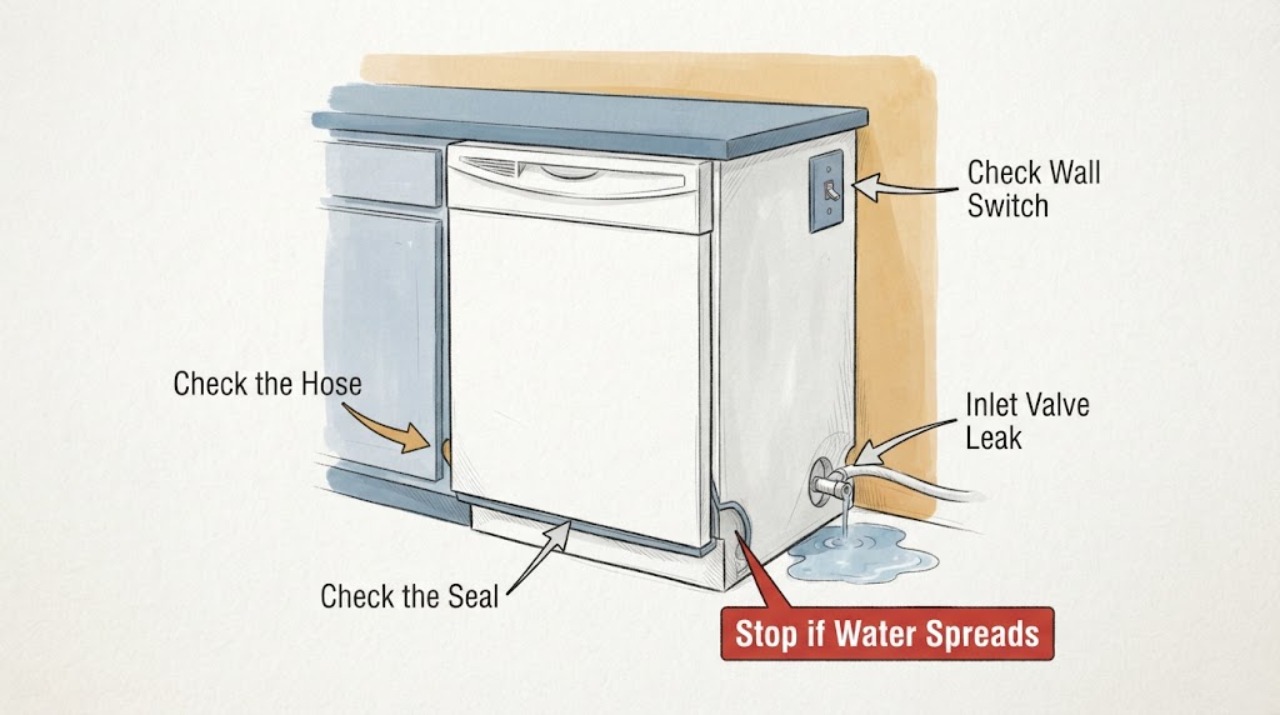
Work through in order
Diagnostic checks
Use only checks that match the exact appliance or system and its official guide.
-
Check 1
If water is visible, stop the dishwasher, switch off its circuit breaker and close the dishwasher water-supply shutoff. Wipe up the water so you can tell whether it returns; do not reach into the base or run another cycle while the leak is active.
Expected result: Water returns after the area is dry, or it does not return and may have been a spill.
Next step: Keep power and water off for a returning leak and continue only with external source identification. If it does not return, do not replace a part based on the original assumption.
Why this matters
Why: A returning wet spot supports a real leak; no recurrence after cleanup does not identify an inlet valve and may mean the original water was a spill.
-
Check 2
With water and power isolated, inspect the accessible supply hose from the home shutoff to the dishwasher connection for moisture, damage, gaps or a loose fitting. Check both ends and the full visible length without loosening a wet connection.
Expected result: Moisture is concentrated at a hose end or accessible fitting, the hose itself is damaged, or the visible supply path is dry.
Next step: Follow the exact DW80N3030US/AA installation guide or use a professional installer for any reconnection or hose replacement. If the visible supply path is dry, do not open the dishwasher to find a valve.
Why this matters
Why: Samsung identifies hose connections and the supply hose as a distinct leak source. A wet external connection does not prove that the dishwasher inlet valve body is leaking.
-
Check 3
Determine whether the wet area is instead at the drain-hose connection, door seal, tub edge, leveling/installation area or a suds condition. Inspect only visible surfaces and do not remove the kick plate or internal water components while the appliance is wet.
Expected result: The leak is at a drain connection, door/seal area, excessive suds, an installation/leveling condition, or remains unexplained.
Next step: Correct only a documented external installation or seal issue with power and water isolated. For a damaged seal, internal leak or uncertain source, request Samsung service.
Why this matters
Why: Samsung lists these as separate leak paths; the visible location matters and a generic “inlet valve” label cannot be transferred to them.
-
Check 4
Verify the full rating-label model and suffix against Samsung’s DW80N3030US/AA support record before looking up any component or manual. Note whether a leakage indicator or error appears and whether the leak is continuous or only during fill.
Expected result: The label matches DW80N3030US/AA, differs from it, or cannot be read; the leakage sensor stops the cycle or no indicator appears.
Next step: Keep the appliance off and provide the model, leak location, timing and any indicator to Samsung service. Do not order or install a valve from a similar model.
Why this matters
Why: The opened product/support pages establish the assigned model and its leakage-sensor feature, but they do not prove which internal valve, hose or control is leaking.
Use your observations
Decision map
Find the observation that best matches what you see, then follow the next safe action.
-
PATH 01Next step
What you see
The leak is at an accessible hose end or shutoff-side connection after power and water are isolated.
Do this next
Use the exact installation guide or a professional installer for the connection/hose correction, then check for recurrence before restoring normal use.
Why this path and its safety boundary
Why it matters: The external supply connection is a more direct suspect than a proven internal inlet-valve failure.
-
PATH 02Next step
What you see
The supply path is dry, but water appears from the dishwasher base, an internal connection or an unidentified location.
Do this next
Keep the water and power off and request Samsung service; do not remove panels or test a wet valve.
Why this path and its safety boundary
Why it matters: The available public guidance does not identify an internal valve or component without opening the appliance.
-
PATH 03Next step
What you see
The water was a one-time spill, or the model label does not match DW80N3030US/AA.
Do this next
Confirm the actual model and only then use its manual or service path. If no leak recurs, monitor without ordering an internal part.
Why this path and its safety boundary
Why it matters: A replacement-valve decision based on the assigned model would be unsupported.
Helpful context
Understand the symptom
A suspected inlet valve is a location, not a diagnosis
Water near the lower front or underneath the dishwasher can come from the supply hose, a connection, the drain path, the door seal, installation/leveling or an internal component. Samsung’s DW80N3030US/AA product page documents a leakage sensor that can detect water below the dishwasher and stop the cycle, but it does not establish that the inlet valve is the failed part.
Make the water and electrical area safe first
Do not keep running a visibly leaking dishwasher. Turn off power at the breaker and close the water shutoff before touching a wet connection. The Samsung leak guide limits homeowner checks to visible hose, drain, seal, leveling and detergent conditions; internal valve diagnosis is a service boundary.
Use the exact model manual for any installation-side correction
The Samsung support record identifies DW80N3030US/AA and provides its installation and user manuals. Use that exact documentation for connection details and the full suffix before considering a hose or installation correction. Do not select an inlet valve or other part from a similar Samsung model.
When checks do not resolve it
Need a professional?
Keep the dishwasher off and request Samsung or qualified appliance service for any leak from the dishwasher body, an unclear source, persistent leakage indication, or suspected internal inlet-valve failure. Turn off power and water before external inspection.
Safety scope: Do not run a visibly leaking dishwasher, work on wet electrical parts, remove panels, test an inlet valve, or disconnect internal water tubing. Turn off the breaker and water supply before external inspection.
Have this ready
- Provide the full rating-label model and suffix, exact leak location, whether the leak occurs during fill or continuously, any leakage indicator, photos of accessible connections and whether the unit was recently installed or moved.
Common questions
FAQ
Does water near the inlet prove the valve is bad?
No. Samsung distinguishes the supply hose and its connections from other leak paths. Confirm the wet location with power and water isolated before deciding whether service is needed; do not diagnose the valve from location alone.
What should I do first if the Samsung dishwasher is leaking?
Stop the cycle, turn off the dishwasher at the breaker and close the water shutoff. Wipe up the water, then inspect only accessible hose connections and visible leak paths.
Does DW80N3030US/AA have leak protection?
Samsung’s product page lists a leakage sensor below the dishwasher that can detect water, stop the cycle, drain and show an error. That feature does not identify a failed inlet valve or replace the need for service when leakage persists.
Read the exact guide
Official sources
- Samsung dishwasher water supply requirementsSamsung Support US · Opened Samsung’s official water-supply guidance. It recommends an accessible shutoff and regular inspection for leaks at the hose connection; exact model instructions govern connection details.
- Stainless Steel Dishwasher with Touch Control & 3rd Rack | Samsung Business CanadaSamsung Canada · Opened Samsung’s official product page for DW80N3030US/AA. It lists the leakage sensor below the dishwasher, which detects water, stops the cycle, drains and shows an error; it does not identify an inlet valve failure.
- Samsung dishwasher is leaking or has a leakage error codeSamsung Support US · Opened Samsung’s official leak guide. It directs users to confirm a real leak, turn off power for visible leakage, inspect the supply/drain hoses and seals, and request service for unresolved or internal leaks.
- Front Touch Control 51 dBA Dishwasher with 3rd Rack | Samsung Support CASamsung Support Canada · Opened the exact Samsung support record for DW80N3030US/AA. It identifies the assigned model and exposes the user and installation manuals; use the exact suffix for connection and service instructions.
Community feedback
Share a repair observation
Share a plain-text repair observation. Accepted observations are published automatically; this page may take a moment to update.