
On this page
Start here
Quick answer
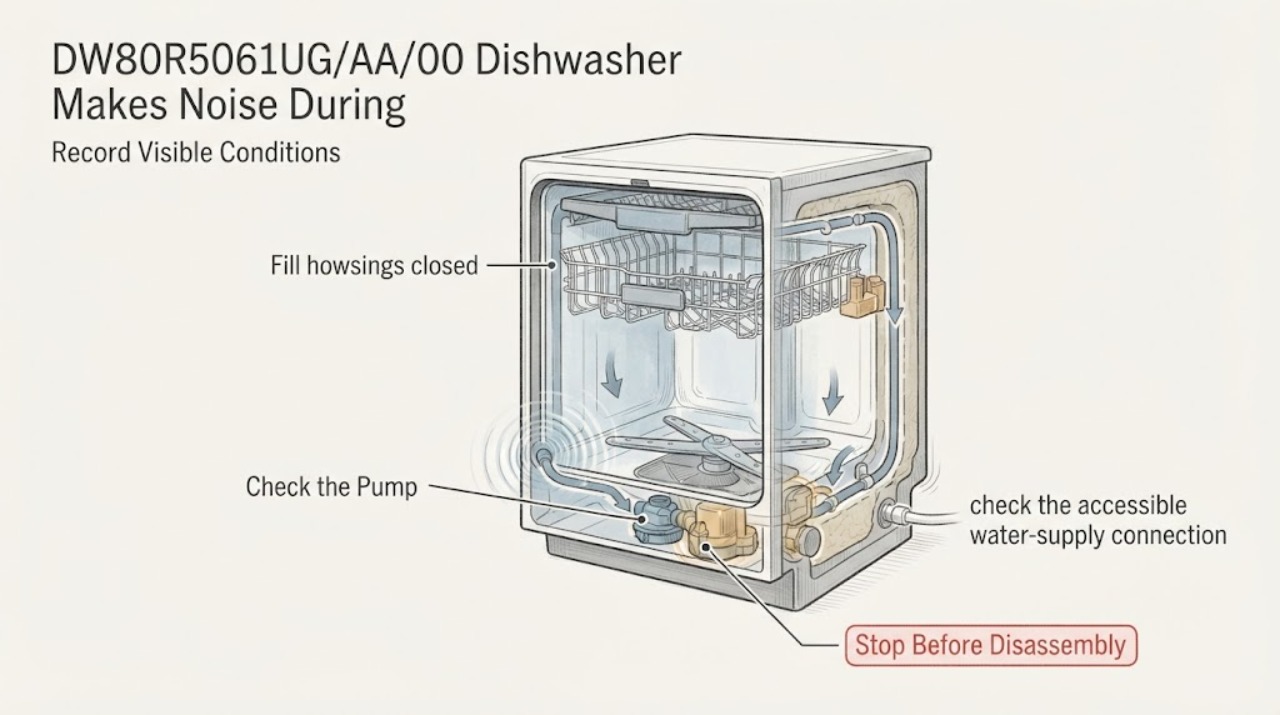
For the Samsung DW80R5061UG/AA/00, first establish whether the sound occurs during the initial drain or after water actually enters the tub. Samsung says a dishwasher may sound as it clears residual water before filling, and watery spray sounds or a low hum can be normal; a high-pitched whine can also come from water moving through pipes. Record the sound and check the external water supply and the cycle timing. If the noise is loud, grinding, persistent, accompanied by poor filling, leakage, or an error, stop treating it as normal operation. With power off and only where the matching manual confirms access, check the filter/pump opening for debris and the racks/filter for loose items; otherwise request Samsung service. The symptom alone does not prove a bad inlet valve, pump, or other replacement part.
Work through in order
Diagnostic checks
Use only checks that match the exact appliance or system and its official guide.
-
Check 1
Run one short observation cycle only if there is no leak, smoke, burning smell, electrical damage, or other unsafe condition. Note whether the sound starts immediately, during the first drain, when water actually enters, or later when spray begins; record the sound for service if it is intermittent.
Expected result: The sound is present before water enters, begins only after filling, occurs during spray, or cannot be tied to one cycle stage.
Next step: If it is the brief initial drain or ordinary watery spray sound and the cycle fills and runs normally, monitor it. If it begins with water entry, is loud, or is repeatable, continue with the external water-supply and noise checks.
Why this matters
Why: Samsung says the dishwasher first clears residual water and may sound before filling, and that watery spray sounds can be normal. Timing is needed before treating the sound as a water-supply fault.
-
Check 2
Classify the sound from outside the closed appliance: low hum/buzz, watery swish, high-pitched whistle/whine, tapping/knocking, or loud grinding. Do not infer an inlet-valve or pump replacement from the sound label alone.
Expected result: The sound matches a low hum or water movement, a pipe-like whistle, a load/rack tapping noise, or loud grinding/buzzing that recurs.
Next step: For a normal-sounding brief event with proper filling, monitor. For tapping, stop the cycle and check load placement when safe. For loud grinding or repeated unusual noise, continue only with the model-appropriate filter/pump access check or request service.
Why this matters
Why: Samsung documents low hum and watery sounds as possible normal operation, pipe whistling as a water-flow sound, loose dishes or filters as tapping causes, and loud grinding/buzzing as potentially related to debris at the drain-pump impeller.
-
Check 3
With the dishwasher stopped, check the accessible water-supply connection and shutoff from outside the appliance. Confirm that the supply is connected and turned on, and use the DW80R5061UG/AA manual's requirements for the installation; do not loosen the water line or remove panels to inspect an inlet valve.
Expected result: The supply is on and connected, the supply condition is uncertain, or the appliance still makes the same loud noise with a confirmed supply.
Next step: Correct only an obvious external supply state permitted by the installation instructions. If the supply is correct but the noise persists, do not substitute an inlet valve or continue cycling repeatedly; use the next filter/load check or service.
Why this matters
Why: Samsung lists a connected, turned-on water supply and compliance with the user manual as the external water check; it does not identify the inlet valve from this observation.
-
Check 4
After turning the dishwasher off and allowing hot parts to cool, check the rack loading and any removable filter only as the exact DW80R5061UG/AA manual permits. Secure dishes so they cannot touch spray nozzles, and if the matching manual shows a removable filter/pump opening, check that the filter is seated and the opening is free of visible debris; do not reach into an inaccessible pump or dismantle the pump.
Expected result: A dish, utensil, loose filter, or visible debris is present, or the filter/pump is inaccessible or correctly assembled with no visible obstruction.
Next step: Remove only the loose load item or re-seat a removable filter exactly as documented, then make one normal test. If the noise is unchanged, the opening is inaccessible, or the model manual does not show that procedure, stop and request service.
Why this matters
Why: Samsung associates tapping/knocking with loose items or a loose filter and says loud grinding can be related to debris in the drain-pump impeller, but access differs by model and the exact manual controls the procedure.
-
Check 5
Keep a record of the exact model suffix, sound recording, cycle stage, whether water enters normally, the supply state, any error or leak, and the result of the safe external checks. Do not pull the dishwasher out, open panels, test energized components, or select a replacement inlet valve, pump, motor, or control board from noise alone.
Expected result: The noise is loud or persistent, filling is poor, a leak/error appears, the filter/pump is inaccessible, or the sound continues after the documented external checks.
Next step: Leave the dishwasher out of repeated test cycles and request Samsung or qualified appliance service with the recorded evidence. Use the exact model label and manual rather than a similar DW80 series model.
Why this matters
Why: Samsung treats persistent loud or unusual noise and inaccessible filter/pump checks as service conditions; the public guidance does not establish an internal component diagnosis for this exact complaint.
Use your observations
Decision map
Find the observation that best matches what you see, then follow the next safe action.
-
PATH 01Next step
What you see
The sound is brief, occurs before water enters during the initial drain, or is a normal watery spray/low hum, and the dishwasher fills and runs without a leak or error.
Do this next
Monitor the cycle and retain a recording if the sound changes. Continue to service if it becomes loud, persistent, or affects filling or cleaning.
Why this path and its safety boundary
Why it matters: Samsung describes these as possible operating sounds, so the timing does not by itself show an inlet or pump failure.
-
PATH 02Next step
What you see
A high-pitched whine starts as water enters, while the supply is connected and on and there is no leak or error.
Do this next
Verify the model's documented supply requirements and record the noise. If the sound remains unusually loud or the fill is incomplete, request service rather than changing an internal part.
Why this path and its safety boundary
Why it matters: Samsung says water running through pipes can produce a whistling or whining sound; this observation does not prove a defective inlet valve.
-
PATH 03Next step
What you see
The sound is tapping or knocking and a utensil, dish, or loose removable filter can contact the spray system.
Do this next
Stop the cycle, correct only the visible load/filter condition using the exact model manual, and test once. If the noise persists on an empty cycle, request service.
Why this path and its safety boundary
Why it matters: Samsung associates these sounds with loading or loose items and says a removable filter must be secured for applicable models.
-
PATH 04Next step
What you see
The sound is loud grinding, loud buzzing, or recurring unusual noise, or it continues after the supply/load/filter checks.
Do this next
Do not dismantle the pump or order a part from the sound alone. Keep the model-specific manual and recording available and request Samsung service.
Why this path and its safety boundary
Why it matters: Samsung identifies possible debris at the drain-pump impeller and routes consistent loud noise to service when the applicable access is unavailable; it does not provide a universal component diagnosis.
-
PATH 05Next step
What you see
Water does not enter normally, there is a leak, an error, repeated failure, or the exact manual does not match the observed filter/pump arrangement.
Do this next
Stop repeated cycling, isolate water/power only according to the installation and safety instructions, and request qualified appliance service for the exact DW80R5061UG/AA/00.
Why this path and its safety boundary
Why it matters: The issue is outside the general noise guidance and cannot be safely narrowed to an inlet valve, pump, or control without model-specific service diagnosis.
Helpful context
Understand the symptom
Confirm the model and the moment the sound starts
The opened Samsung support page identifies DW80R5061UG/AA and lists an installation guide and user manual. The task's /00 suffix is retained, but the exact rating label and the manual for that unit control which removable parts are user-accessible. Start by recording when the sound begins: immediately after Start, after the initial drain, or only once water is entering the tub. This separates a normal cycle sound from a fill-related symptom without naming an internal part prematurely.
Use sound character as a decision aid, not a diagnosis
Samsung describes low humming or buzzing and watery spray noises as possible normal operating sounds, while whistling or whining can occur as water runs through pipes. Loud humming, buzzing, or grinding may indicate debris in a drain-pump impeller, but Samsung does not make that a model-specific conclusion from a fill-time complaint. Keep the filter and pump work conditional on the exact manual and stop at service when the access or result is unclear.
When checks do not resolve it
Need a professional?
When the noise is loud, persistent, grinding, or recurs on an empty cycle., When filling is incomplete, an error appears, water leaks, or the supply check does not resolve the symptom., When the filter or pump is inaccessible, the exact model manual is unavailable for the proposed cleaning step, or the sound continues after the documented external checks., Before opening panels, reaching an inlet valve or pump, testing energized parts, or ordering a replacement component from noise alone.
Common questions
FAQ
Is a noise before the dishwasher fills always a water-inlet problem?
No. Samsung says the dishwasher first drains residual water, so it can sound as if it is operating before water enters. Listen for the point at which water actually enters, then check the supply and the model-appropriate guidance before naming a component.
Can a whistling sound during water entry be normal?
It can be. Samsung says water running through pipes can produce a high-pitched whistling or whining sound. If it is unusually loud, persistent, or paired with poor filling or an error, record it and request service rather than replacing an inlet valve based on sound alone.
Should I remove the pump to stop the noise?
Do not assume the pump is the cause. Samsung says loud grinding or buzzing may relate to debris in the drain-pump impeller, but access and cleaning instructions vary by model. Use only the exact DW80R5061UG/AA manual if it documents access; otherwise request service.
What should I give Samsung service?
Provide the exact model suffix, a recording, when the sound starts, whether water enters normally, the supply state, any error or leak, and what safe external checks changed. This is more useful than naming an inlet valve or pump from the symptom alone.
Read the exact guide
Official sources
- Samsung dishwasher operational soundsSamsung Canada · Samsung dishwasher-family guidance applied to the exact model only for sound timing/classification and conditional external checks; it does not establish a model-specific inlet-valve or pump fault.
- StormWashTM 48 dBA Dishwasher with 3rd Rack | Samsung Support CASamsung Canada · The opened page identifies the Samsung DW80R5061UG/AA support family. The assigned DW80R5061UG/AA/00 suffix is retained, but the exact /00 rating-label suffix should be checked against the unit before applying any model-specific removable-part instruction.
- Routine and deep clean your Samsung dishwasherSamsung Electronics America · Used only for conditional filter/pump and loose-debris checks; Samsung states that access differs by model and the exact user manual controls the procedure.
- Steps to get your Samsung dishwasher starting and filling with waterSamsung Canada · Used for the cycle timing distinction: initial drain noise can occur before filling. It is not used to claim a component diagnosis for the exact complaint.
Community feedback
Share a repair observation
Share a plain-text repair observation. Accepted observations are published automatically; this page may take a moment to update.